Understand any stock in simple English
Enter a ticker to learn what the company does and how it makes money.
Couchbase, Inc.
Couchbase sells database software that helps companies build and run modern applications across cloud, mobile, and AI workloads.
Couchbase is a database software company. It sells the digital filing cabinet that big organizations use to store and retrieve information fast — the kind of data that powers a shopping app, a customer support system, or a mobile game. The company's core product is a "NoSQL" database, which simply means it is built to handle messy, fast-changing, modern data rather than the rigid rows-and-columns style of older databases.
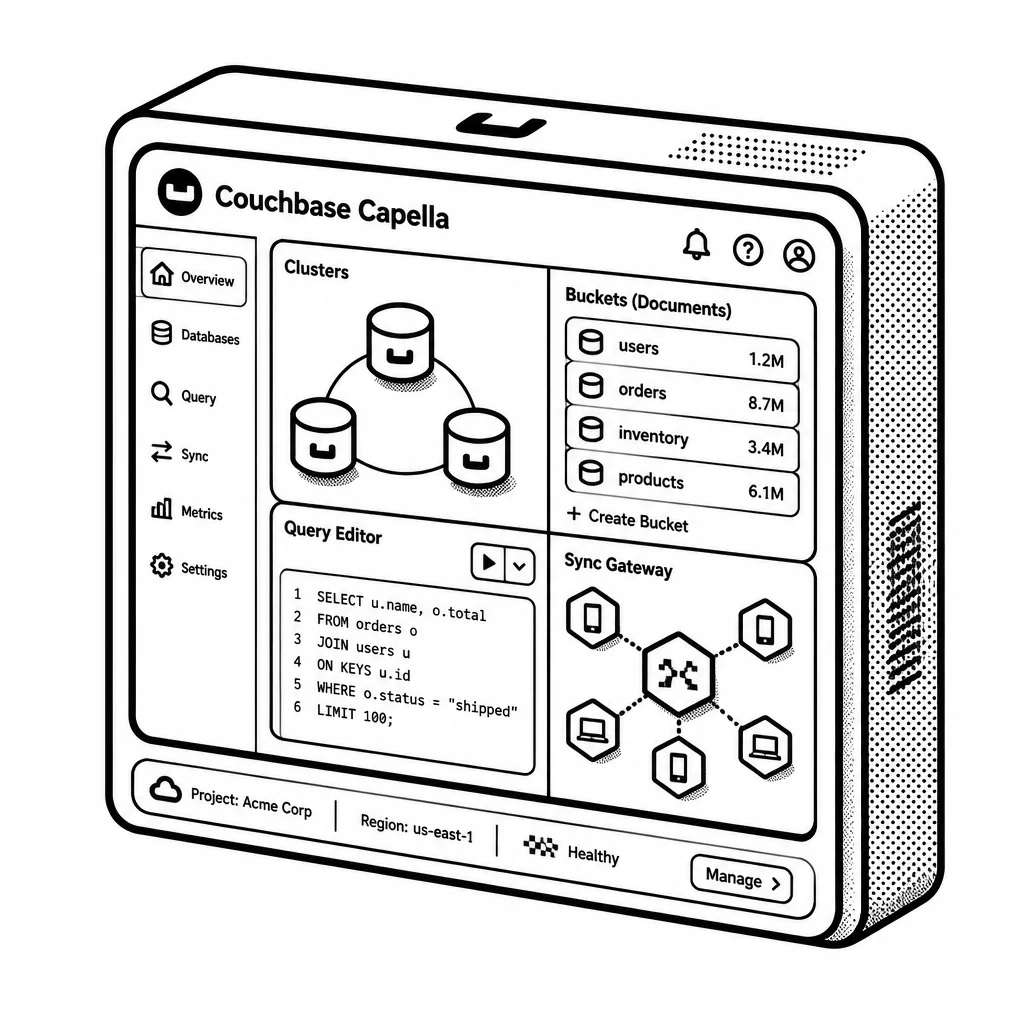
It makes money by selling subscriptions to its database platform, mostly to large enterprises and developers who pay for the software, support, and the ability to run it wherever they like: on their own servers, in the cloud, or on mobile devices. Couchbase's pitch is flexibility and speed — it lets developers build apps that keep working even when the internet drops, then sync back up when the connection returns. That mobile capability is a real differentiator, alongside newer tools for AI workloads. It competes with big database players like MongoDB, Oracle, and cloud providers' own database services. The important recent twist is ownership. Couchbase used to be a public company traded on Nasdaq under the ticker BASE, but its shares no longer trade. In 2025, private equity firm Havelock Fund Investments, owned by investment firm KKR KKR, took Couchbase private in a deal worth roughly $1.5 billion. So Couchbase is now a private company, controlled by its private equity owner rather than public shareholders.
That ownership change matters. As a private company, Couchbase no longer faces the quarterly pressure of public markets, which gives its owners room to restructure the business, invest in product development, and push harder into cloud and AI without worrying about short-term stock moves. It still faces the same fundamental challenge: database software is a crowded, competitive market, and winning means convincing developers and big companies that your platform is the one they want to build on for years.
Saved answer · last researched 14 Nov 2026
BIG PICTURE
97% of companies are trying to shrink their database sprawl, the mess Couchbase sells against
- 97% Organizations consolidating data tools
- 3% Organizations not consolidating
IDC research cited in Couchbase's announcement found that 97% of organizations are working to consolidate their data management tools over the next two years. The average company already runs 16.9 separate database technologies plus 16.8 other data platforms. Couchbase sells itself as one system that replaces several, so every company trying to cut that pile is a potential customer. Source: IDC, as cited in Couchbase's 2026 IDC MarketScape announcement, data from 2026
Timeline
Two Database Projects Are Born
In 2009, two separate groups started companies around the same piece of technology: fast data storage. One team, NorthScale, came from the people who built memcached, a tool that keeps frequently used data in memory so websites don't have to ask the database every time. The other, called Relaxed, offered paid support for Apache CouchDB, a document database. Both were solving the same frustration: traditional databases were slow and hard to grow.
NorthScale Becomes Membase
Later that year, NorthScale took the name Membase and brought in Bob Wiederhold as chief executive, replacing James Phillips. The company was still small and looking for its footing.
Membase and CouchOne Merge
In February 2011, Membase and CouchOne joined forces to become Couchbase, Inc. The idea was to combine the speed and scale of an in-memory system with the flexibility of a document database, building a database that could grow easily and handle lots of traffic.
Couchbase Server 2.0 Turns Document Database
Couchbase Server 2.0, released at the end of 2012, added a JSON document store, distributed indexing and query, and replication across data centers. That combination turned the product into a true document-oriented NoSQL database, and it was the moment the merged vision finally became real.
Couchbase Mobile Launches
In 2014, the company launched Couchbase Mobile, a stack for iOS and Android apps with a local data store and a sync gateway. It let apps work offline and sync later, which became a distinctive niche for high-performance enterprise apps.
Matt Cain Takes Over as CEO
In April 2017, Matt Cain replaced Bob Wiederhold as chief executive. A leadership change mid-way through the company's growth story.
Couchbase Cloud Goes Live
In July 2020, the company's managed database service, Couchbase Cloud (later called Capella), became generally available on AWS. It marked the start of a shift toward cloud services as the core of the business.
Couchbase Goes Public
In July 2021, Couchbase completed its initial public offering on Nasdaq, raising roughly $230 million at $24 a share. It was the big moment that years of database work had been building toward.
First Earnings Report Disappoints
Soon after, the first earnings report as a public company showed a bigger-than-expected loss, and the stock fell more than 15% after hours. The market was learning that growth was costing a lot.
Haveli Buys Couchbase
In June 2025, Couchbase agreed to be acquired by Haveli Investments for $1.5 billion, or $24.50 a share, and the deal closed that September, taking the company private. Couchbase had never turned a profit, carrying operating losses through fiscal 2025, so the public market was no longer the place for it.
New Team and an AI Data Plane
After going private, almost the entire executive team changed, with BJ Schaknowski taking over as chief executive from Matt Cain, along with a new CFO and other leaders. Then, in mid-2026, Couchbase launched its AI Data Plane, a governed data layer for AI agents with persistent memory and an MCP server. The move repositioned the company from a database provider to an AI data platform.