Understand any stock in simple English
Enter a ticker to learn what the company does and how it makes money.
CalDigit Inc.
CalDigit makes Thunderbolt and USB-C docking stations, storage devices, and cables that let creative professionals connect and power all their gear through a single cable.
CalDigit is a hardware company that makes the hubs and docks that turn a laptop into a full desktop workstation. If you're a video editor, photographer, or music producer, you probably juggle a laptop, a big monitor, external hard drives, a card reader, and a tangle of cables. CalDigit's main product, the Thunderbolt Station (widely known as the TS series), lets you plug all of that into one small box, then connect that box to your laptop with a single cable that also charges it. The pitch is simple: one cable in, everything works.
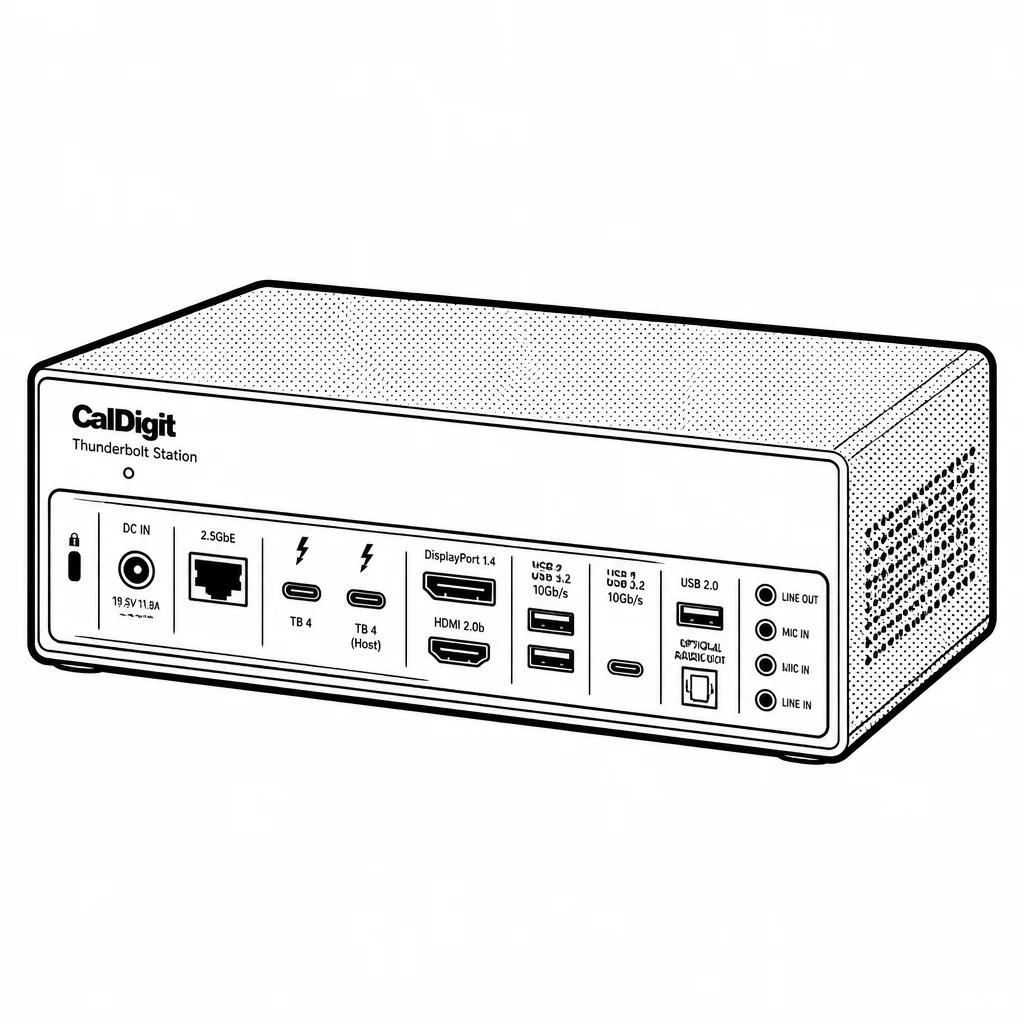
The company earns money by selling these docks, along with related gear — external storage arrays and high-quality cables — mostly direct to customers and through retail partners. Its customers are people who get paid for their creative work and can't afford downtime or flaky connections. That's a demanding crowd, and it's why CalDigit leans hard on reliability and compatibility rather than trying to be the cheapest option. A dock that drops a connection mid-render is worthless, so trust is the real product. CalDigit is small and privately held, which shapes how it competes. Big players like HP, Dell, and Lenovo bundle docks with their computers, and accessory makers crowd the market. CalDigit's edge is focus: it builds for the high end of the Thunderbolt world, where Apple's MacBooks and demanding creative workflows dominate, and it has earned a loyal following there. It can't outspend the giants, so it competes on doing one thing very well.
The catch is that this is a niche business riding on someone else's technology. CalDigit's fortunes rise and fall with Thunderbolt and USB-C adoption, which is largely set by Apple and Intel, and with the health of the creative-professional market. When laptops get fewer ports, docks become more essential — a tailwind. But it's a modest, specialized company, not a growth story, and it stays quiet about its finances. For the people it serves, though, that little metal box is the difference between a clean desk and a cable nightmare.
Saved answer · last researched 15 Nov 2026
BIG PICTURE
In AI shopping answers, CalDigit gets 11% of docking-station mentions, behind Plugable and Anker
- 11% CalDigit
- 18.3% Plugable
- 13.4% Anker
- 9.7% Dell
- 5.5% HP
- 42.1% Others
When people ask ChatGPT or Google's AI to recommend a docking station, CalDigit comes up in about one in nine brand mentions. Plugable and Anker show up more often, and the rest of the field is a long tail. That matters because CalDigit sells docks, hubs and cables to creative professionals, a niche where buyers often research before spending. Finding its name in AI answers is how it reaches new customers. Source: GEOly Docking Stations Category AI Visibility Report 2026, data from 2026
Timeline
Two Founders Bet on Fast Storage
CalDigit started in 2006 with a simple problem in mind: creative professionals needed external storage that was fast enough to keep up with their work. Its answer was a series of eSATA RAID drives. The first, the S2VR Duo, was the world's fastest dual-drive external SATA RAID. Then came the S2VR HD, the first 5-bay eSATA hardware RAID, which reached 230MB/s and could handle uncompressed HD video without the expensive SCSI or Fibre Channel gear that usually came with that kind of speed.
HDPro Tackles Dropped Frames
At the NAB trade show in 2007, CalDigit released the HDPro, its first high-performance PCIe 8-bay RAID tower. It used a technology CalDigit called Active Sustained Transfer Technology, and the point was practical: editors could work with multiple streams of ProRes 422(HQ) without frames dropping. The company later announced the HDPro-24, a 24-bay RAID and PCIe SAN device that could move up to 1600MB/s across the PCIe network.
First USB 3.0 Support for Mac
In 2008, CalDigit became the first company to support a USB 3.0 interface driver and storage device for Mac, a small first that showed the company was willing to adopt new connection standards early.
CalDigit Places an Early Thunderbolt Bet
When the industry shifted to the newly introduced Thunderbolt connector in 2011, CalDigit saw how important it could be for workflows around the world and began work on its first docking station, the Thunderbolt Station. CalDigit was one of the first Thunderbolt development partners from the start, which gave its engineers deep expertise with the protocol.
Thunderbolt Station Opens the Docking Market
The Thunderbolt Station was released in 2013, and it helped pave the way for the docking station market while establishing CalDigit as a premium name in the world of Thunderbolt. A decade after release, it was still pushing the limits of what was possible.
TS5 Brings Thunderbolt 5 Docks
In 2025, CalDigit introduced two new docking solutions, the TS5 and TS5 Plus, built on Thunderbolt 5. The TS5 Plus brought the first two individual 10Gbit/s USB controllers and a 10Gbit/s Ethernet port, and both models support dual 8K displays at 60Hz and up to 140W charging. The TS5 Plus was set to be available at the end of May for 470 euros, and the TS5 from mid-June for 350 euros.