Understand any stock in simple English
Enter a ticker to learn what the company does and how it makes money.
Bloomberg L.P.
Bloomberg sells the data, news, and trading tools that financial professionals rely on to do their jobs, along with the famous terminals that display them.
Bloomberg is the company behind the black terminal screens that light up trading floors everywhere. If you work in finance — at a bank, a hedge fund, an asset manager, or a central bank — there is a good chance you spend your day inside a Bloomberg Terminal. The terminal is a software and hardware package that combines financial data, news, messaging, analytics, and trading tools in one place. It is the single most important product the company sells.
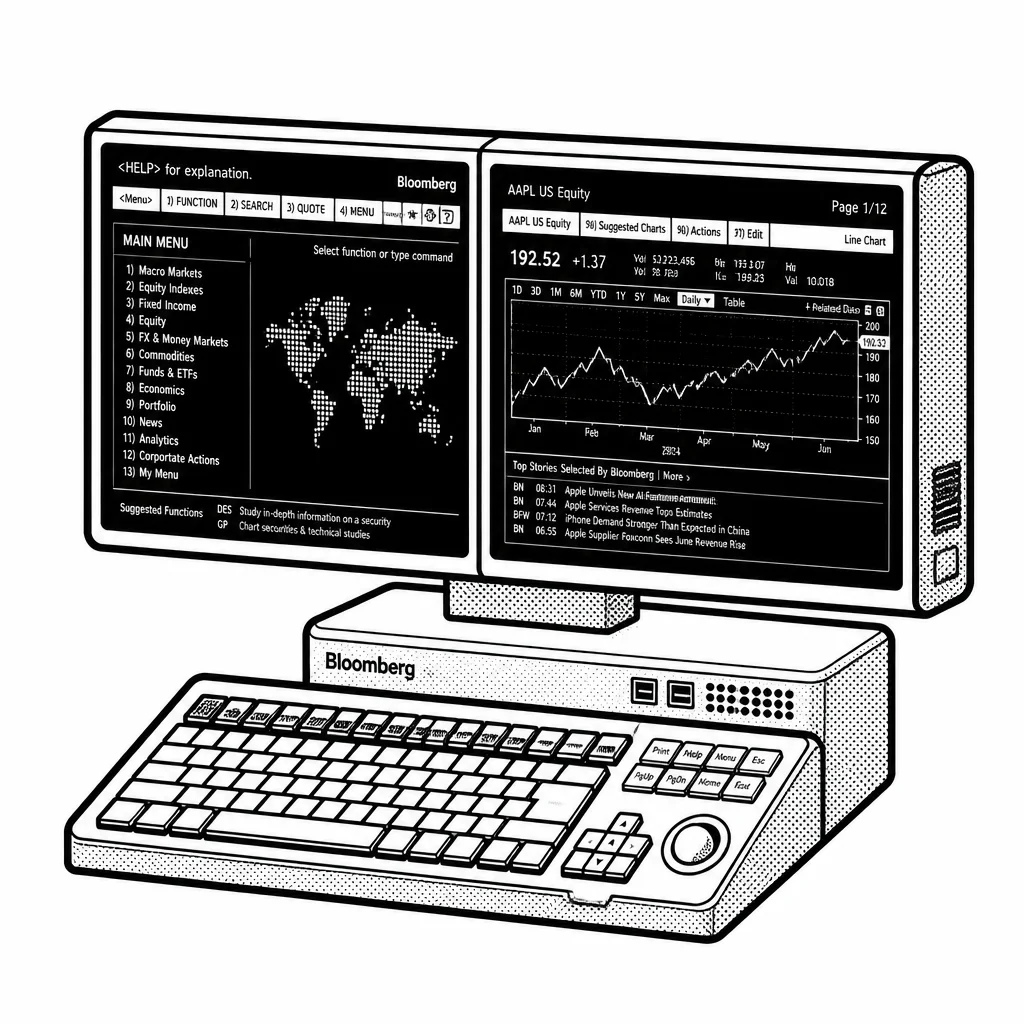
The terminal is how Bloomberg makes most of its money. Customers pay a subscription fee, roughly $30,000 per user per year, and the company has around 350,000 terminal subscribers. That adds up to something like $10 billion a year from terminals alone. Why do people pay so much? Because the terminal is sticky. Once a trader or analyst learns it, and once their colleagues are all messaging each other through it, switching to a rival becomes painful. Bloomberg's main competitor in this space is LSEG, the owner of Refinitiv and the old Reuters data business, though Bloomberg holds the largest share of the market. Beyond the terminal, Bloomberg runs a news operation with thousands of journalists around the world, a radio network, and a business magazine. The news arm does not exist just to sell ads — it feeds the terminal, giving subscribers a reason to keep paying. The company also owns a fast-growing index business: Bloomberg indexes track bonds and other securities, and money managers pay to license them for funds and ETFs. That is a smaller but steadily growing piece of the pie.
The company is privately held, mostly owned by its founder, Michael Bloomberg, who started it in 1981 after being fired from Salomon Brothers. He built the terminal to give bond traders the data they needed, then turned the company into a media and data empire. He later became mayor of New York City and ran for president. Bloomberg gives away a huge share of its profits to philanthropy. The business itself is a cash machine — high margins, recurring subscriptions, and customers who rarely leave — which is why it has stayed private and independent rather than selling shares to the public.
Saved answer · last researched 4 Nov 2026
BIG PICTURE
Bloomberg controls 33% of the financial-data market, more than any rival
- 33% Bloomberg
- 67% Others
About a third of everything spent on financial news and data goes to Bloomberg, according to a profile of the company. That slice makes it the biggest seller in the business. The rest is split among Reuters, Dow Jones, Thomson Financial and smaller players, all fighting for what is left. For a beginner, the point is simple: banks and funds pay Bloomberg for the numbers and tools they need to trade, and Bloomberg gets the largest single cut of that spending. Source: Wall-Street.ro, data from 2026
Timeline
Bloomberg Founds Innovative Market Systems
Michael Bloomberg got fired from Salomon Brothers, and the company handed him a ten-million-dollar goodbye package. He used that money to start a company with a simple idea: sell computer terminals that give Wall Street firms the financial data they need. The firm, Innovative Market Systems, was the seed of what would become Bloomberg L.P.
Merrill Lynch Bets on the Terminals
A year in, Merrill Lynch became the first big customer, ordering 22 terminals. More importantly, it put 30 million dollars into the young company, which gave it both the cash to grow and a powerful stamp of approval that its business model could work.
A New Name: Bloomberg L.P.
The company dropped its original name and officially became Bloomberg L.P., putting the founder's name on the business it had built.
Bloomberg Enters the News Business
The company launched Bloomberg Business News to give terminal users business news and analysis, and to reach a wider audience beyond the screens. The data company was now also a news company.
Buying Back Merrill's Stake
Bloomberg bought back a third of Merrill Lynch's roughly 30 percent stake for 200 million dollars. The deal valued the whole company at about 2 billion dollars, showing just how far the startup had come.
The Last of Merrill's Stake
Merrill Lynch, by then in trouble during the financial crisis, sold its remaining 20 percent back to Bloomberg for a reported 4.43 billion dollars. That valued the firm at roughly 22.5 billion dollars, a giant leap from the early buyback.
Buying BusinessWeek and New Energy Finance
Bloomberg picked up BusinessWeek magazine from McGraw-Hill and renamed it Bloomberg Businessweek, adding a famous print brand to its media arm. It also bought New Energy Finance, a UK data company tracking energy investment and carbon markets.
Bloomberg Buys the Bureau of National Affairs
Bloomberg paid 990 million dollars for the Bureau of National Affairs, a Virginia-based publisher, to strengthen its Bloomberg Government and Bloomberg Law services. The terminal company was now selling legal and government information too.
ASKB Opens to All Terminal Users
Bloomberg made its conversational AI interface, ASKB, available to every terminal user and let them plug in their own content. More than a third of subscribers use it, and the tool sits on top of a complex web of models and AI agents built to help people keep up with floods of unstructured data.