Understand any stock in simple English
Enter a ticker to learn what the company does and how it makes money.
Anysphere, Inc.
Cursor makes an AI-powered code editor that helps software developers write, edit, and understand code faster.
Cursor is a code editor with artificial intelligence baked into it. Developers use it as the place where they write software, and the AI sits alongside them — suggesting the next line, rewriting a messy function, or answering questions about a giant pile of code. You can think of it as a smart text editor for programmers, one that has read a lot of code and can pitch in like a very fast junior colleague.
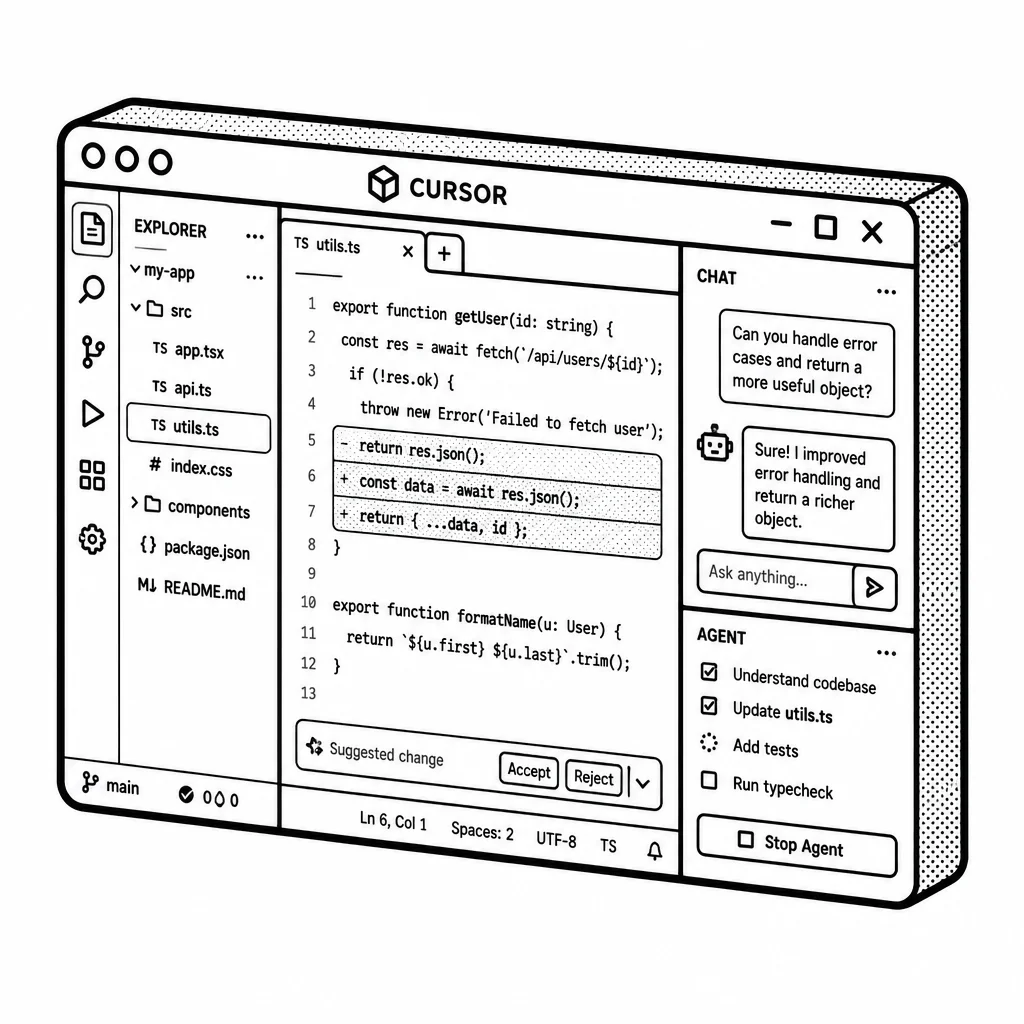
The company behind it is Anysphere, a private startup founded in 2022 by four friends who met at MIT — Michael Truell, Sualeh Asif, Arvid Lunnemark, and Aman Sanger. The product caught on fast. Developers pay a monthly subscription, with individual plans costing roughly $20, and teams and large companies paying more for extra features and controls. Businesses choose it because it plugs into the tools they already use and makes their engineers more productive, rather than forcing them onto some totally new platform. Cursor's rise has been one of the fastest in software history. The company raised money at a valuation of $9.9 billion in mid-2025, then reportedly reached around $29 billion by November 2025 after another funding round. It also bought Supermaven, a smaller AI coding assistant, and pushed into "agents" — AI that can take a task and work through it on its own, not just autocomplete one line at a time.
The competition is fierce. It faces Microsoft's GitHub Copilot, which comes bundled with the tools many developers already pay for, plus rivals like Alphabet's Gemini and various coding tools from Anthropic(private) and others. Its edge is focus: it built an editor from scratch around AI instead of bolting AI onto an old editor. The risk is that the big model makers keep improving their own tools, and the whole category gets cheaper or gets absorbed into the platforms developers already use.
Saved answer · last researched 4 Nov 2026
BIG PICTURE
Cursor was the top AI coding tool a year ago; now Anthropic's Claude Code holds half the market
- 50% Anthropic Claude Code
- 26% Cursor (Anysphere)
- 24% Others
Cursor sells a subscription to an AI code editor, and for a while it led its corner of the market. Its share fell from 41 percent to 26 percent while Anthropic's Claude Code climbed to 50 percent. Cursor still sends most of its agent traffic to Claude, so its rival supplies the brains even as it takes the customers. Source: Börse Express, data from 2026
Timeline
Four MIT Dropouts Start Anysphere
Four friends dropped out of MIT to build a company called Anysphere. Their first idea was an AI helper for mechanical engineers, but nobody really wanted it. So they had a problem: a smart team with a product that flopped, and they needed a better idea fast.
Cursor Bets on Coding
Then they turned to AI tools for software developers, a space they had once thought was too crowded. Their new product, Cursor, helped programmers write, understand and fix code with AI. That single bet changed everything and sent the company on a fast climb.
Cursor's Rocket Ride
The bet paid off far faster than anyone expected. Within a year of launch, Cursor's revenue passed $100 million, and by 2025 the company was valued at about $30 billion with revenue over $1 billion. It was also being used inside more than half of the Fortune 500, which meant the tool had gone from a scrappy startup product to something big companies leaned on every day.
The Model Problem
That success came with a catch. Cursor had been renting its AI models from Anthropic and OpenAI, and both of them launched their own coding competitors, Claude Code and Codex, bundling their models at discounted prices. Cursor had to stop depending on rivals for its core technology, so it built models of its own, going from a fast model nearing the coding frontier to one almost matching market leader Claude. The toolmaker was becoming a modelmaker.
SpaceX Buys Cursor
Then came the twist nobody saw coming. In April 2026, SpaceX announced a partnership with Cursor that included an option to buy the company for $60 billion. SpaceX exercised that option in June, agreeing to an all-stock deal to boost its AI ambitions, and the acquisition closed in August. Cursor walked away with access to what it called the world's largest fleet of GPUs, and the four dropouts' company became part of SpaceX.