Understand any stock in simple English
Enter a ticker to learn what the company does and how it makes money.
Wise Group plc
Wise helps people and businesses send money across borders quickly and cheaply, charging a small fee instead of hiding costs in a bad exchange rate.
Wise is a cross-border money company. If you live in London and need to pay a landlord in Spain, or a small business in Germany needs to pay a supplier in Vietnam, Wise moves the money from one country to another, often within minutes, and tells you upfront exactly what it costs.
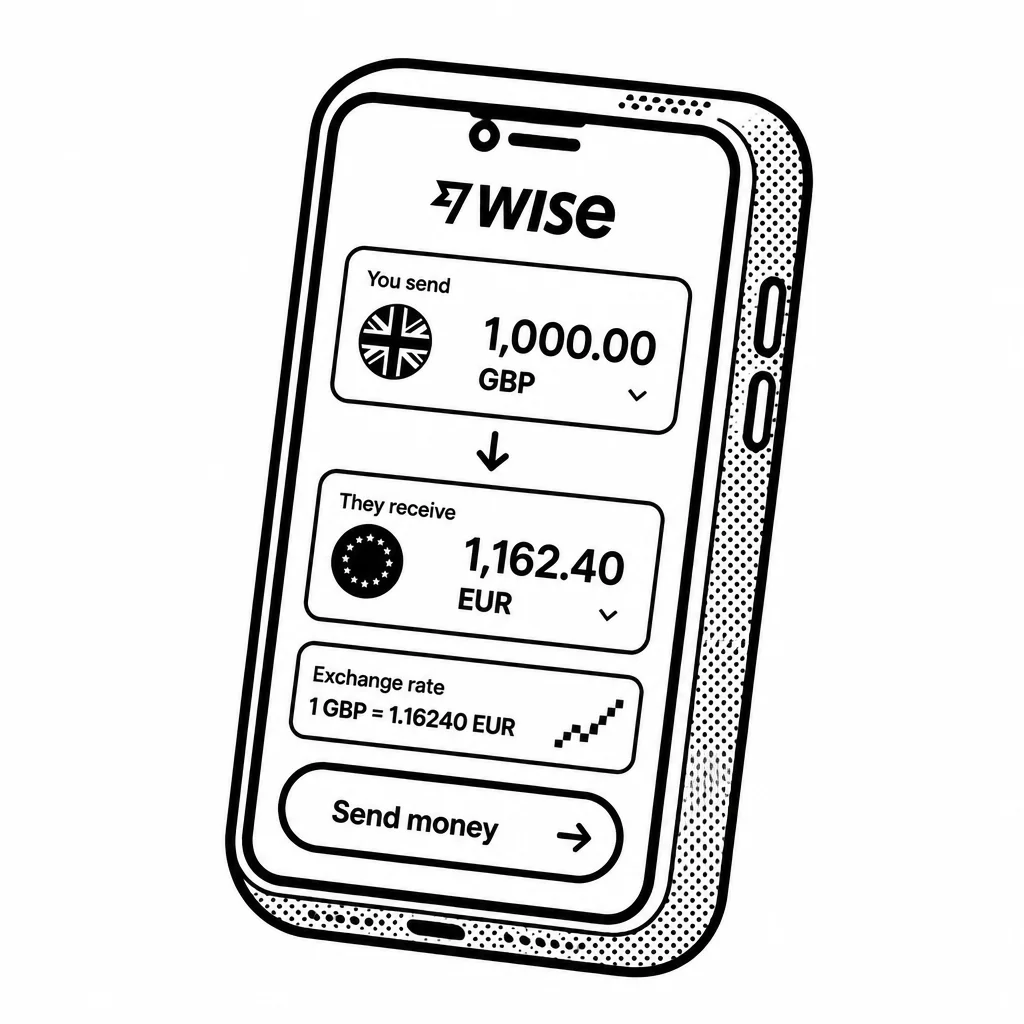
The old way of sending money abroad was a quiet rip-off. Banks and transfer shops would advertise a "zero fee" or a tiny one, then quietly hand you a terrible exchange rate and keep the difference. Wise built its whole brand on the opposite: the real exchange rate, plus one small, visible fee. That transparency is the product as much as the plumbing is. Customers choose it because they can see what they're paying, and because it's usually cheaper than the bank down the street. Under the hood, Wise doesn't actually fly euros to Spain. It holds piles of money in many countries, so when you send euros, it pays out from its local pile and collects your pounds into its UK pile. Most transfers never cross a border at all — they just swap places in Wise's local accounts. The company also offers multi-currency accounts and cards for people and businesses, so customers can hold and spend money in many currencies, not just send it.
Wise makes money on volume: small fees multiplied by millions of transfers. It listed on the London Stock Exchange in 2021 and has since added a US listing, and it serves individuals, small businesses, and increasingly banks and fintechs that plug into its network. The main risk is competition and regulation — rivals like PayPal and traditional banks are chasing the same customers, and moving money across borders means answering to regulators in dozens of countries at once. But the core bet is simple: if you make international money genuinely cheap and honest, people will keep coming back.
Saved answer · last researched 10 Nov 2026
BIG PICTURE
Wise moves fortunes across borders yet holds under 1% of the global market
- 1% Wise's share of the global cross-border market
- 99% The rest of the global cross-border market
The global cross-border market is estimated at $43 trillion, and Wise holds less than 1% of it. That tiny sliver is where its growth story lives. Wise earns most of its money on cross-border transfers for consumers and small businesses, so even a small gain in share means a lot of money moving through its network. Source: trauminc.com, data from 2026
Timeline
Two Friends Beat the Banks
Taavet Hinrikus and Kristo Käärmann both needed to move money between the UK and Estonia, and the banks were quietly taking a big cut through hidden exchange fees. So they did something simple: they matched each other's transfers, using one person's pounds to pay the other's needs and vice versa. That one trick solved a real pain point, and Käärmann filed the company with the UK registry in March 2010.
The Company Gets Its Name
At first, the founders struggled to find serious investors. They renamed the company TransferWise in July 2012, with offices in London and Tallinn, and the name said exactly what it did: cross-border transfers.
Peter Thiel Backs the Startup
The company raised $6 million, including money from PayPal and Facebook investor Peter Thiel. Big-name backers gave a young startup the two things it needed most: credibility and cash to grow.
TransferWise Turns a Profit
Investment rounds brought in around $280 million, and the company reported it was now making a profit. That mattered because it marked the shift from a startup burning cash to a business that could stand on its own.
TransferWise Becomes Wise
The company renamed itself Wise in February 2021 and floated on the London Stock Exchange that July, valued at €9.3 billion. The listing made Käärmann and Hinrikus Estonia's first two billionaires.
Wise Moves to Nasdaq
Through a reorganisation, Wise Group plc became the new ultimate parent, and its primary listing moved to Nasdaq in May 2026, while keeping a secondary listing in London. The goal was to reach more US investors and reshape how the company told its story; by then it was worth roughly $155 billion, with $2.5 billion in yearly revenue and $243 billion in cross-border volume.
Wise's US Bank Charter Denied
Wise had applied to the OCC for a US national trust bank charter through 'Wise National Trust' in Austin, Texas, hoping to operate inside the US banking system. In July 2026 the regulator said no, citing serious supervisory and compliance concerns and a record of anti-money-laundering failures at Wise US. The denial blocked a key part of its US expansion plans.
Belgian Probe and Investor Lawsuit
Belgian prosecutors were reported to be investigating Wise Europe over more than €500 million in suspicious transactions, and the shares slid over several sessions. After news of the charter denial sent them down another 6.2%, investors sued, claiming the company had understated its money-laundering and regulatory risks around the Nasdaq debut.