Understand any stock in simple English
Enter a ticker to learn what the company does and how it makes money.
Silicon Motion Technology Corporation
Silicon Motion designs the controller chips that manage how data gets stored and retrieved inside flash memory devices.
Silicon Motion is a chip designer that most people have never heard of, but you probably own something that uses its work. The company builds controllers — tiny chips that act as the traffic cop inside flash storage — and sells them to the makers of memory devices, who put them into SSDs, phones, and memory cards. The controller is the part that decides where data goes, how to keep it safe, and how to make the whole thing fast enough.
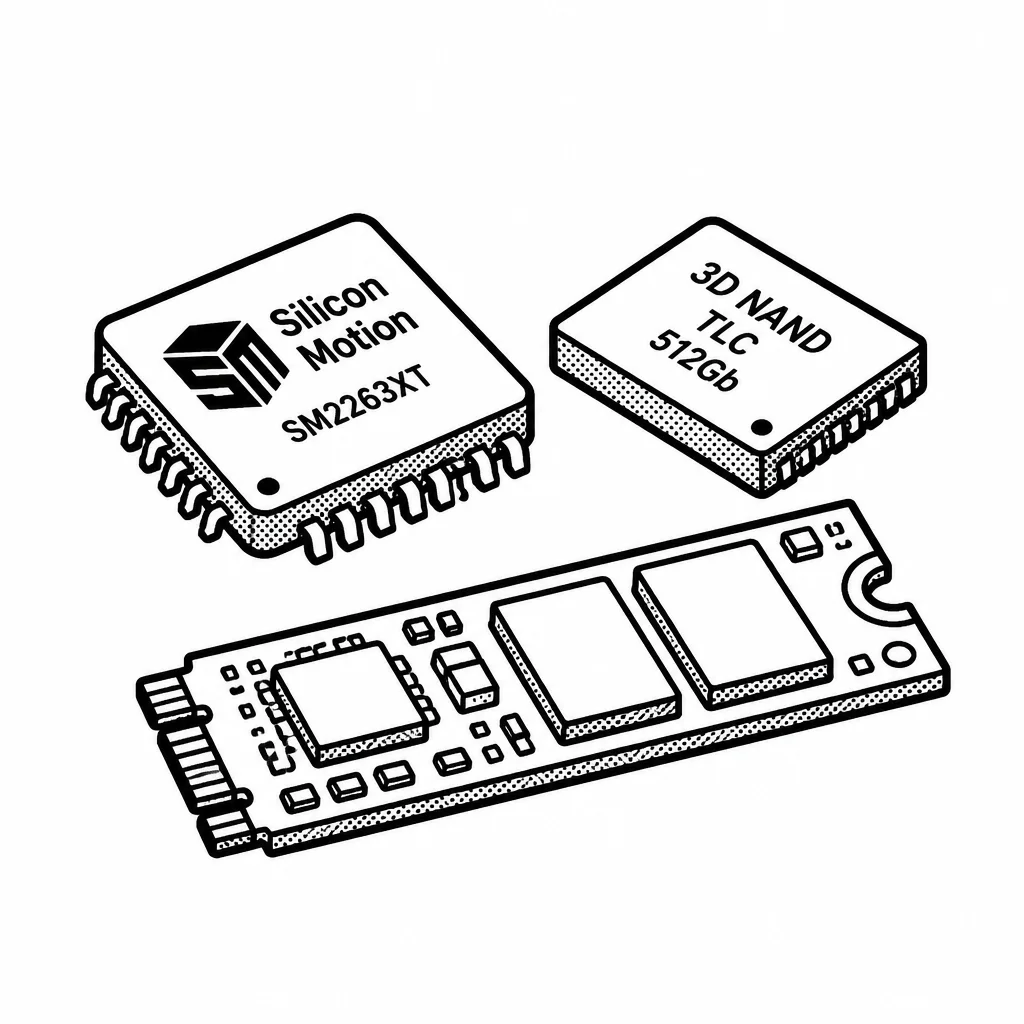
The key idea is that NAND flash memory is messy. The raw memory chips in your phone or laptop wear out, have bad spots, and slow down if you don't manage them carefully. A controller sits between the memory and the rest of the device and handles all of that: tracking where data lives, spreading writes around to extend the memory's life, correcting errors, and making sure the drive responds quickly. Silicon Motion designs these controllers and sells them to storage device makers and original equipment manufacturers, who need a reliable, proven chip they can build around. The company's main business is client SSD controllers — the brains inside the drives found in laptops and PCs. It also supplies controllers for embedded storage and memory cards, plus it sells single-chip SSDs, where the controller and memory are packaged together in one small part. Customers choose Silicon Motion because it has a long track record in controller design, a broad lineup covering many memory types, and a reputation for quality that matters in storage, where a bad chip can mean lost data. Its world is a bit uncomfortable. NAND flash prices swing wildly, which affects demand and pricing for the whole storage market. Silicon Motion competes with bigger chipmakers that also make controllers, so it lives in a tough neighborhood and doesn't control the memory supply it depends on. It also has had a major drama: a planned acquisition by a large Chinese memory player fell apart after failing to clear regulatory hurdles.
Still, the business is lean and tends to throw off cash. Its controllers are designed once and then sold in volume, letting it ride the storage market with relatively little capital. It is a quiet, unglamorous company that sits just beneath the surface of your devices — but when the storage market is hot, buyers on a budget for a fast SSD or a phone can trace much of the performance back to a controller like the ones Silicon Motion designs.
Saved answer · last researched 14 Nov 2026
BIG PICTURE
Silicon Motion controls close to 40% of the PC flash-controller market outside Apple
- 40% PC flash-controller market outside Apple held by Silicon Motion
- 60% Other controller makers and the remaining PC market
Nearly four in every ten PC flash controllers sold outside Apple's world come from Silicon Motion. The company puts its mobile share at 20% to 25% on the same basis. Those two markets, phones and PCs, made up 95% of its business until about a year ago; it now sells more controllers for cars, data centers and AI servers. Source: Investing.com, data from 2026
Timeline
A Chip Designer Starts on His Own
Wallace Kou had spent years leading graphics chip work at Western Digital, and in late 1995 he left to build his own company in Silicon Valley. Silicon Motion's first product was mobile graphics chips, small brains that helped screens draw images. The bet was simple: put good graphics into portable devices.
Intel Kills the Graphics Business
Then Intel started building graphics directly into its chipsets, and Silicon Motion's core market vanished almost overnight. Rather than die, the company found a partner: a Taiwan firm called Feiya that made controllers, the chips that manage how data is read from and written to memory. They merged, moved the headquarters to Taiwan, and renamed the combined company Silicon Motion, betting its future on NAND flash controllers.
Asia's First Chip Designer on NASDAQ
To raise money and gain credibility, the company set up a holding company in the Cayman Islands and listed its shares in the US. That made it Asia's first chip design firm on NASDAQ. The listing gave it a currency for growth, and its controllers would eventually ship in the billions.
Buying a Korean Radio Chip Team
Silicon Motion spent ninety million dollars on a Korean company called FCI to get stronger in radio chips for mobile devices. It was a bet that the company could grow beyond memory controllers. For a while, it was a real part of the business.
A Door Into China's Data Centers
Next came Shannon Systems, a Chinese maker of high-end solid-state drives for data centers. The deal pulled Silicon Motion up the ladder from selling components to selling whole storage products, and opened the fast-growing Chinese data center market.
Selling the Radio Business
Silicon Motion sold FCI, its mobile communications line, to Dialog Semiconductor and walked away from radio chips entirely. The logic was focus: memory controllers and storage were the real engine, and the company wanted all its energy there.
MaxLinear Makes a $3.8 Billion Offer
In the spring of 2022, another chip company, MaxLinear, agreed to buy Silicon Motion for about 3.8 billion dollars. For a company that had spent years grinding out controller sales, it looked like a big payday.
The Deal Falls Apart
A year later, MaxLinear walked away, claiming Silicon Motion had failed to meet closing conditions and had suffered a serious downturn. Silicon Motion disagreed loudly, formally terminated the agreement itself, and demanded damages far beyond the breakup fee. The collapse left it independent again, right in the middle of a brutal memory market slump.
Brakes Off: Record Revenue
Then the business caught fire. Revenue hit a record 451 million dollars in a quarter, more than double the year before, with half of it flowing through as gross profit. The growth came from storage controllers inside phones, cars, and data centers, and management said the company was becoming something bigger than a consumer parts supplier.
Riding the Shift to AI Storage
The big memory makers were moving their factories toward huge enterprise drives for AI data centers, which squeezed the supply of ordinary consumer chips. Silicon Motion leaned into that shift, scaling its newest high-end enterprise controller, MonTitan, and raising over a billion dollars in convertible notes to fund research and expansion.
A Record Quarter, a Falling Stock
Revenue kept climbing to another record, and profit per share was strong. Yet the stock fell nearly in half from its high. Investors worried that the convertible notes would dilute them and that the AI-driven valuation had simply run too far, too fast, even as the underlying business kept improving.
Two Big Customers, More Coming
MonTitan went into commercial production with two top-tier customers, and more were lined up to ramp. A next-generation controller was already being designed into future products, aimed at growth years down the road. Enterprise, AI, and automotive storage were becoming a real share of revenue, which meant Silicon Motion was no longer just a consumer story.