Understand any stock in simple English
Enter a ticker to learn what the company does and how it makes money.
The Sage Group plc
Sage sells accounting, payroll and HR software to small and midsized businesses, mostly on a subscription basis.
Sage makes the boring-but-essential software that runs the back office of a small business: the books, the payroll, the bills, the invoices. If you run a plumbing firm, a design studio, or a 40-person manufacturer, Sage wants to be the system where you record what you earned, pay your staff, and file your taxes. It is one of the older names in business software, founded in 1981 in Newcastle in the north of England, and today it sells mainly by subscription, with cloud products now making up the bulk of recurring revenue.
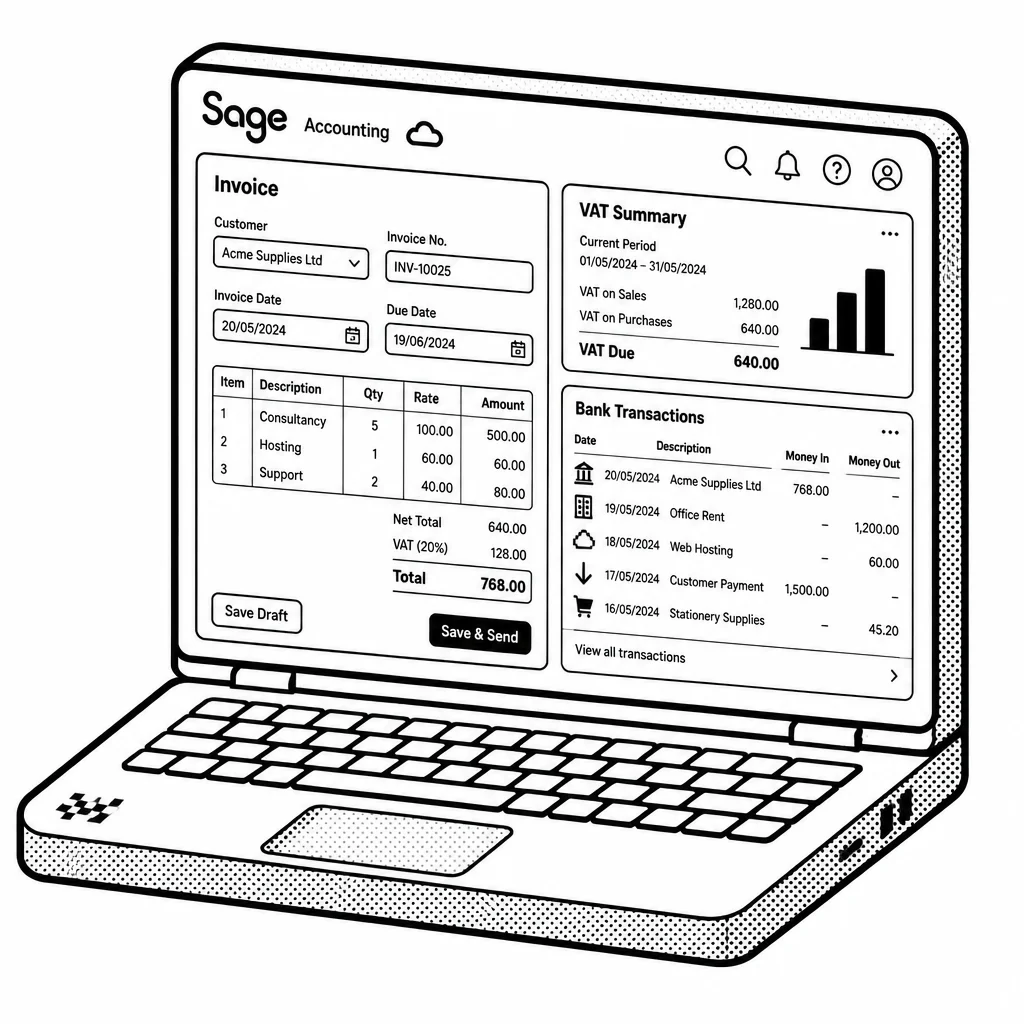
The products split into a few families. Sage Business Cloud Accounting handles bookkeeping and invoicing; Sage 50 is its long-standing desktop accounting line, still widely used by smaller firms; and Sage Payroll and Sage HR cover paying staff and managing people. Geographically, the business is roughly split between North America and the UK and Ireland, with a smaller continental European arm. Its customers are typically firms too small to buy Oracle or SAP, which is exactly the gap Sage fills. Competition is fierce and getting fiercer. Intuit's QuickBooks dominates American small-business accounting, and Xero, a New Zealand-listed rival, has taken large chunks of the cloud accounting market in the UK, Australia and New Zealand. That pressure is why Sage spent years shifting customers from one-off desktop licences to recurring cloud subscriptions. The switch hurts reported revenue in the short run but builds a stickier, more predictable business in the long run, since once a firm's accounts and payroll live in Sage, moving them is a genuine headache.
Sage is a reliable cash machine. It generates plenty of free cash flow, pays a dividend, and has bought back shares in recent years. It has also been buying its way into adjacent areas: the 2022 acquisition of Brightpearl added retail and inventory management software, and earlier deals brought in compliance and HR tools. The honest criticism is that Sage is a mature, slow-growing company defending a stronghold rather than a fast-moving challenger, and its shares have often been valued modestly for exactly that reason. Still, millions of small businesses keep paying every month because switching accounting systems is about as appealing as re-tiling your own roof.
Saved answer · last researched 15 Nov 2026
BIG PICTURE
53% of small firms in France, Germany and the Netherlands want finance built into their accounting software
- 53% Firms that prefer accounting or ERP software for embedded finance
- 47% Firms that prefer other routes
Sage sells bookkeeping and payroll software to small businesses, and it is now pushing into lending and payment cards. When Oliver Wyman surveyed small and mid-sized firms in France, Germany and the Netherlands, 53% said they would rather get those financial products through their accounting or ERP software than anywhere else. Half the market already sees the software Sage sells as the natural front door to banking. Source: Oliver Wyman research cited by Sage, reported by ERP Today, data from 2026
Timeline
A Founder Automates His Own Business
David Goldman ran his own business and was tired of doing print estimates and basic accounting by hand, so he worked with students at Newcastle University to build software that did it for him. Then he realized other companies had the same problem. Sage was formed in Newcastle upon Tyne to sell that software, and in doing so it created a whole category of business software that it still leads around the world.
Sage Goes Public
Eight years in, Sage listed its shares on the London Stock Exchange, turning a small software maker into a public company with outside investors and a new level of scrutiny.
Sage Crosses the Atlantic
Sage's first big move abroad was buying DacEasy, an American accounting software firm, which gave it a foothold in the huge US market and strengthened its standing as a market leader.
Into Britain's Top Tier
A decade later, Sage was big enough to join the FTSE 100, the index of the UK's largest companies, and it has stayed there ever since.
Stephen Kelly Takes Over
Stephen Kelly, a former UK government chief operating officer, became group CEO and found a mess: years of buying other companies had left Sage with 270 products written in 73 different programming languages. He replaced most of the top management as part of a major overhaul.
Sage Buys Intacct
For $850 million, Sage acquired Intacct, a leading North American cloud financial management provider. The deal became the core growth engine for Sage's mid-market business in North America.
Sage Business Cloud and Fairsail
Sage introduced Sage Business Cloud, the platform meant to be the foundation of its shift to selling software as a subscription service, and it also bought Fairsail, a cloud HR platform that became Sage People.
Profit Warnings and a CEO Ousted
Profit warnings and a 25% plunge in the share price led to Stephen Kelly being pushed out. Steve Hare, the former finance chief, took over to steady the company and push cloud investment, in what was described as a brutal management shake-up.
Sage Copilot and More Acquisitions
Sage launched Sage Copilot, its first generative AI-powered assistant, and kept buying, adding Infineo, Anvyl and ForceManager to its lineup.
Strong Momentum and Recurring Revenue
Sage reported strong momentum: double-digit revenue growth, better margins and 97% of revenue recurring. Sage Intacct remained the main growth engine, with North America revenue up 14%, AI-powered agents and Copilot were embedded across products, and management expected organic revenue growth above 9%.