Understand any stock in simple English
Enter a ticker to learn what the company does and how it makes money.
Ørsted A/S
Ørsted builds and runs giant wind farms at sea and on land, then sells the electricity they produce.
Ørsted is one of the world's biggest builders of offshore wind farms — the rows of huge turbines standing in the sea, spinning in the wind and sending electricity back to land through cables. It also runs onshore wind and solar farms, and it still operates some bioenergy plants that burn wood chips and straw to make heat and power. Its customers are mostly utilities and grid operators who buy the electricity, plus governments that award the contracts to build these projects in the first place.
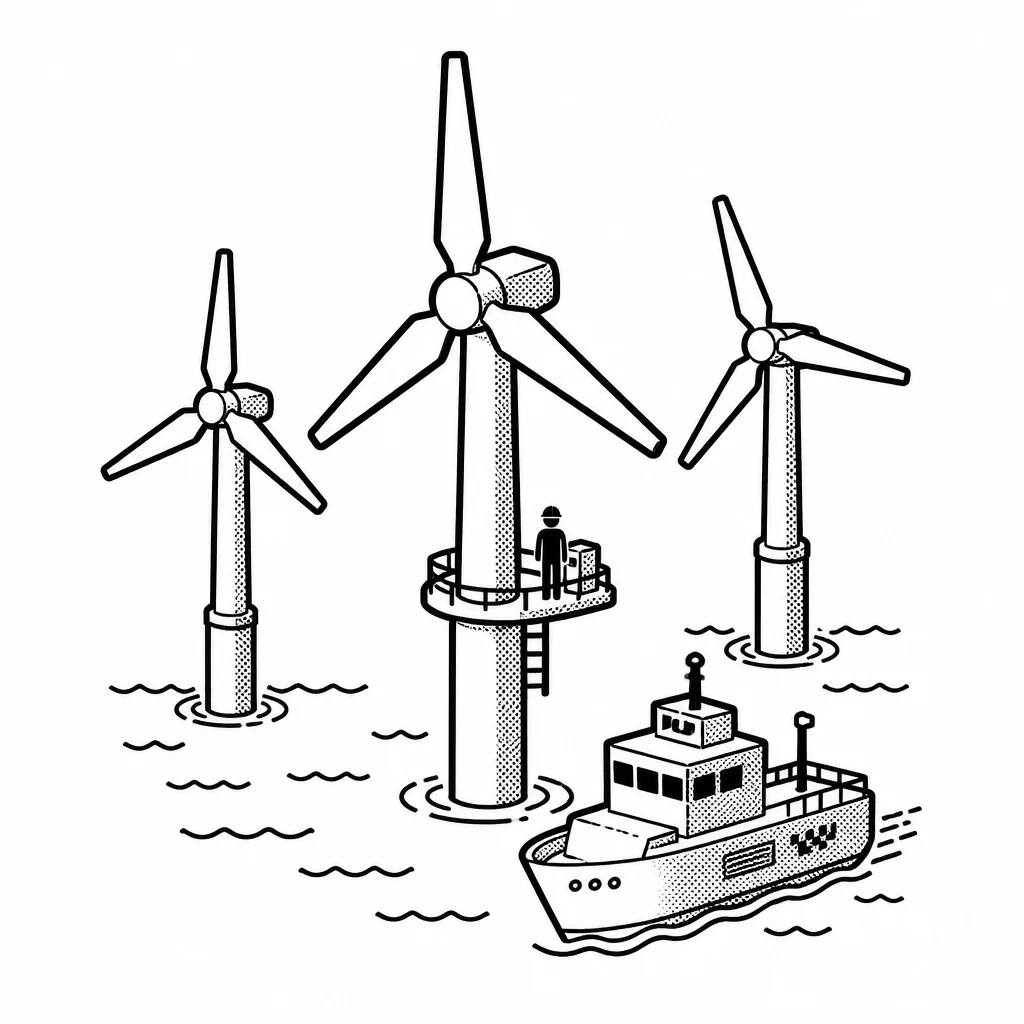
Here's the simple version of how the money works. Ørsted spends years and billions of dollars designing a wind farm, getting permits, ordering turbines, and hiring ships to bolt them to the seabed. Then it sells the electricity under long-term contracts — often fixed prices agreed with a government — so the revenue is predictable for decades. That long, steady cash flow is the whole appeal: a wind farm is expensive upfront but cheap to run once the wind starts blowing. The company has installed more offshore wind capacity than any other developer, which gives it hard-won know-how and scale that rivals have struggled to match. The business has had a rough stretch, and honesty matters here. Higher interest rates made those huge upfront costs much more painful to finance, and supply chains for cables and turbines got squeezed. Ørsted took big writedowns on US projects and cut back its ambitions, and its share price fell sharply from its pandemic-era highs. It has also pulled back from some markets to protect its balance sheet and is focusing on projects where the economics actually work. The lesson is that building things in the ocean is a wonderful business when rates are low and contracts are generous, and a very uncomfortable one when they aren't.
The deeper bet is that the world needs to electrify almost everything — cars, heating, factories — and much of that power will come from wind. Ørsted's main rivals in offshore wind include RWE and Equinor, and it competes with Siemens Energy and Vestas on the equipment side, though those companies supply the hardware rather than own the farms. As a company, it is a play on a simple idea: the wind at sea is free and endless, and whoever figures out how to harvest it cheapest wins. Ørsted bet its whole identity on that idea when it changed its name from DONG Energy in 2017 and sold off its oil and gas business. Now it lives or dies by whether that bet pays off.
Saved answer · last researched 12 Nov 2026
Timeline
Denmark Answers the Oil Shock
When the oil crisis hit in 1973, Denmark found itself dangerously dependent on oil from the Middle East. The Danish state responded by creating Dansk Olie & Naturgas, or DONG, and sending it to pull oil and gas out of the North Sea. It worked — DONG became a solid fossil-fuel company. What nobody knew then was that this state oil company would one day become the base for something completely different.
The First Offshore Wind Farm
Eighteen years later, Denmark built Vindeby, the world's first offshore wind farm — eleven turbines standing in the sea. It grew out of the country's push for energy independence and a homegrown wind industry. It was a small experiment, but it planted the seed of what would eventually become Ørsted's core business.
DONG Energy Is Formed
In 2006, DONG merged with a handful of Danish energy companies — Elsam, Energi E2, Nesa and a couple of local utilities — and became DONG Energy. The new name said something: this was no longer just an oil and gas company, but an energy company. The pieces were coming together.
A Promise to Flip the Mix
At this point, most of what the company produced — around 85% of its heat and power — came from fossil fuels. Only a sliver was renewable. The company committed to flipping that ratio entirely. It walked away from new coal projects and poured money into offshore wind and into converting power stations to burn sustainable biomass instead.
Gas Prices Force a Hard Choice
Then gas prices fell, and revenue fell with them. That squeeze pushed the company to go further and faster into renewables. It also set a new goal: make offshore wind cheaper by building bigger and innovating smarter. The fossil fuel and utility businesses were now on the path to being sold off, piece by piece.
Wind Reaches Cost Parity
The bet started to pay off. For the first time, offshore wind became just as cheap as new coal- and gas-fired power. With that proof in hand, the company went public in the world's second-biggest IPO that year, and its story to investors was simple: offshore wind and the energy transition. Investors bought it.
DONG Becomes Ørsted
After selling off its oil and gas business, the company was now purely a green energy business, and it wanted a name to match. In late 2017, DONG Energy became Ørsted, honoring the physicist Hans Christian Ørsted, who discovered electromagnetism back in 1820. The old state oil company had a new identity.
Ørsted Crosses the Atlantic
Next came a big move abroad. Ørsted bought Lincoln Clean Energy, a leading US onshore wind developer with most of its assets in Texas. That took the company into North America and into onshore renewables for the first time, and the acquired business was rebranded under the Ørsted name the following year.
A Debt Crisis and a Rescue Plan
In 2025, new CEO Rasmus Errboe faced a mess. The company launched a huge rights issue — 60 billion Danish crowns — to cut debt and keep building the troubled US Sunrise Wind project. Investors were shocked, and the stock slumped 29%. US political hostility was also undermining the company's farm-down financing model, which is a fancy way of saying it sells parts of projects to partners to fund the next ones. This was a nasty surprise on top of earlier ones.
The Green Transformation Is Complete
For all the trouble, there was a genuine milestone. Ørsted became the first energy company in the world to finish a full green transformation, cutting its own operational emissions by 98% since 2006. Renewables hit 99% of energy production after it closed its last coal plant in 2024.
Reset and Refocus
After the giant rights issue and finishing its divestment program — including the sale of its European onshore business — Ørsted aimed to bring back dividends in 2026. It refocused on offshore wind in Europe and select Asia Pacific markets, with a big construction program set to lift its installed offshore capacity well above 18 GW by the end of 2027. The company that started as a response to an oil crisis was now a pure-play offshore wind builder, slimmer and pointed in one direction.