Understand any stock in simple English
Enter a ticker to learn what the company does and how it makes money.
Montauk Renewables, Inc.
Montauk Renewables captures methane gas from landfills and turns it into renewable natural gas and electricity to sell.
Montauk Renewables is a renewable energy company that makes its money from other people's garbage. It captures methane, a potent greenhouse gas that forms as trash decomposes in landfills, and processes it into either electricity or pipeline-quality renewable natural gas. Without this capture, that methane would simply escape into the atmosphere. Montauk's roughly two dozen projects across the United States extend across the country, with a large concentration in Texas and the Midwest, plus a newer project in Chile.
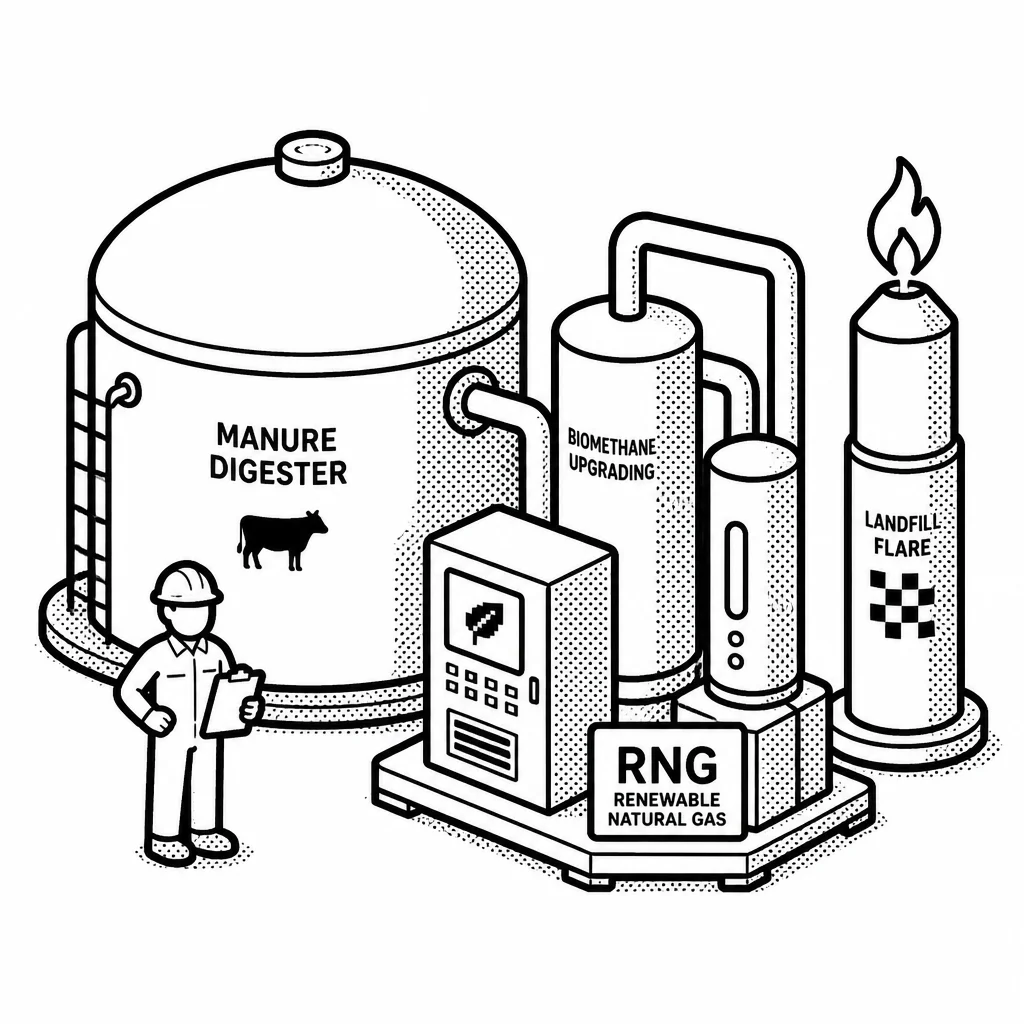
The company has two main businesses. The biggest one, renewable natural gas, cleans landfill gas up to pipeline quality and sells it to utilities and refiners, including major customers in the transportation fuel market. The other business uses landfill gas to generate electricity, which it sells to utilities under long-term contracts. Montauk emphasizes that it is not a landfill owner; it typically partners with the landfill operator, installs its own equipment, and earns revenue from the fuel and power it sells. The economics are unusual. Montauk gets its raw material for free and often gets paid in the form of tipping fees or royalty arrangements with landfill owners. Its output trades at a premium because it counts as renewable fuel: the Environmental Protection Agency's Renewable Fuel Standard and California's low-carbon fuel standard both assign it credits that refiners need to buy. Montauk also books revenue from environmental attributes—the Renewable Identification Numbers and related credits—that are sold alongside each molecule of gas. One hiccup needs watching: a federal tax credit under the Inflation Reduction Act, known as 45Z, could boost the value of clean fuels, but the company's earnings have been uneven as credit prices move around.
Montauk is small, with annual revenue in the low hundreds of millions of dollars, and it went public in 2021, when it was still controlled by its founder, Joseph Cofelice, and his family. That control structure is worth noting for anyone thinking of owning the stock: outside shareholders do not get much of a say. Bigger competitors in the space include Clean Energy Fuels and BP, which owns a large landfill-gas business, but Montauk's specialty is running these projects at landfills where it operates the gas collection itself.
Saved answer · last researched 14 Nov 2026