Understand any stock in simple English
Curaleaf Holdings, Inc.
Curaleaf grows and sells cannabis products to medical patients and adult-use customers through its own stores and wholesale partners.
Curaleaf is one of the biggest cannabis companies in the world by sales, and it does the whole job: it grows the plant, turns it into products like vape pens, edibles, and dried flower, and then sells those products through its own retail stores and to other licensed shops. Its customers fall into two groups. Medical patients buy cannabis to treat conditions like chronic pain or anxiety, and adult-use customers buy it for fun, the way someone might buy a bottle of wine.
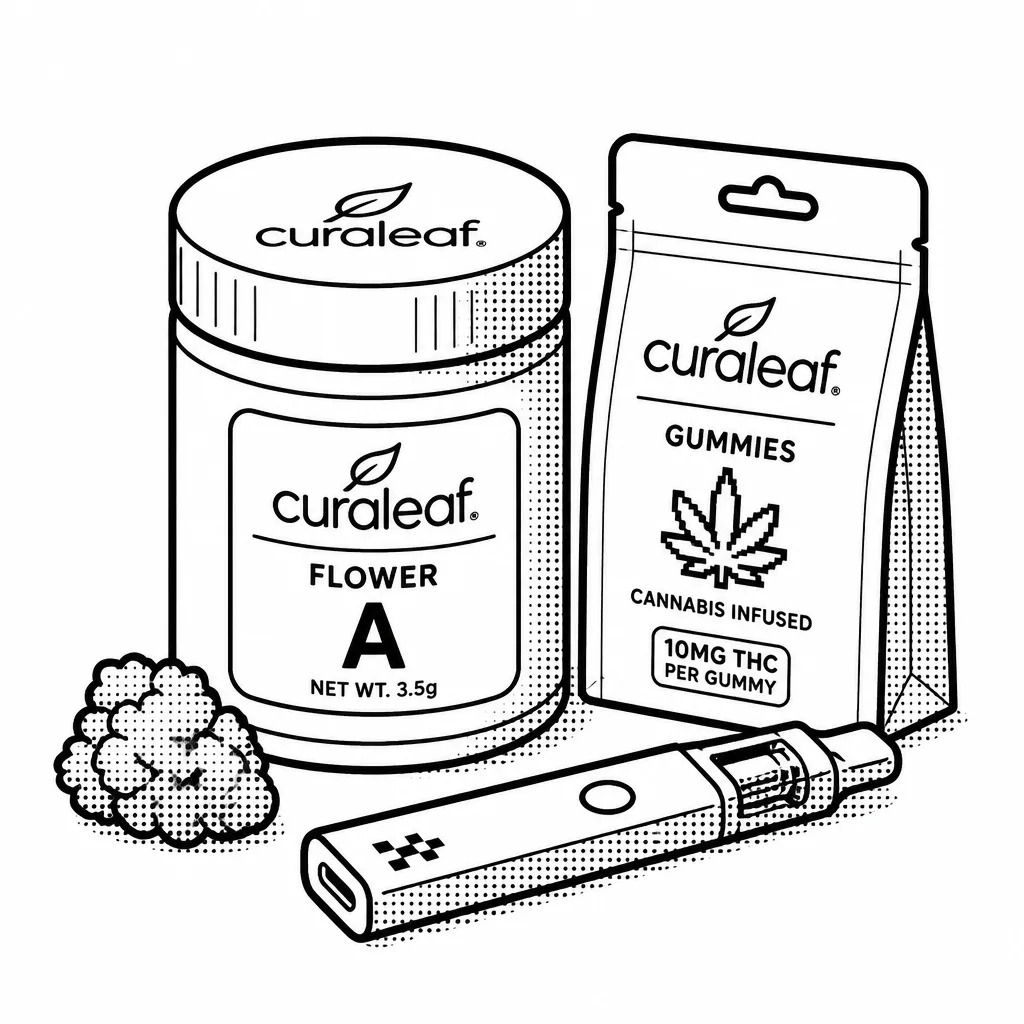
The company runs hundreds of dispensaries, mostly in the United States, under local brand names rather than one national banner. That matters because American cannabis rules are a patchwork: the plant is still illegal at the federal level, so each state writes its own rules, and a company has to win licenses state by state. Curaleaf built its size by buying up local operators and their licenses, which is why it operates under a mix of store names. On the wholesale side it sells its branded products — things like Select vape cartridges and edibles — to other retailers too, which lets it earn money even where it doesn't own a store. Here's the strange part of the business. Curaleaf's shares trade over the counter rather than on a big exchange like the Nasdaq or New York Stock Exchange, because US federal law keeps cannabis illegal and mainstream exchanges won't list plant-touching companies. That also means most big American banks won't touch the money, and the company pays taxes under a rule that blocks normal business deductions, so it hands over far more of its profit to the IRS than a typical retailer would. It's based in New York but its operations are spread across many states. The cannabis industry went through a painful stretch after a 2021 hype cycle, when lots of states legalized and investors assumed boom times forever. Prices collapsed, oversupply piled up, and several rivals went bankrupt or shrank. Curaleaf survived by cutting costs and closing weak stores, and it has kept expanding abroad — notably in Europe, where medical cannabis is a smaller but faster-growing and more regulated market. Its bet is that as more countries and states legalize, the companies with scale, brands, and licenses will win.
The big wild card is Washington. If US federal law ever changes to allow normal banking and listing, Curaleaf's access to capital and its valuation could shift dramatically overnight. Until then, it's a large, cash-hungry retailer and wholesaler navigating a rulebook that changes from state to state — a real business with real customers, wrapped in a regulatory mess.
Saved answer · last researched 17 Nov 2026
Timeline
A Medical Start in New Jersey
Curaleaf began life in 2010 under a different name, PalliaTech, running a research center in Colorado while based in New Jersey. From the start it aimed at medical cannabis, which meant operating in a state where only a handful of licenses were handed out. That choice shaped everything that followed: in a limited-license world, the winners are the ones who get picked, and the rules reward patience and connections over speed.
Boris Jordan Takes Control
A few years in, an investment group led by Boris Jordan bought a big chunk of the company, and before long Jordan was running the board and then the whole thing. He became the architect of its global expansion, turning a small medical player into something far more ambitious. This was the moment the company stopped thinking like a local operator and started thinking like an empire.
PalliaTech Becomes Curaleaf
In 2018, just before going public, the company swapped its old name for Curaleaf. It sounds like a small thing, but a name is the face you show investors, and the new one was built to travel far beyond New Jersey.
Going Public in Canada
Curaleaf listed on the Canadian Securities Exchange that October through a reverse takeover, a shortcut to a public listing, and investors wanted in so badly that the raise grew from a planned $150 million to $400 million. Then the stock fell by more than a third on its first day. It was a strange welcome: huge demand and a rough debut at the same time, a hint that this would be a bumpy, high-stakes ride.
Buying Select for Nearly a Billion
The next year Curaleaf spent close to a billion dollars on Select, a cannabis oil brand. That one deal turned it into the largest cannabis operator in the United States, a leap from scrappy contender to national heavyweight.
Grassroots and Global Scale
Buying Chicago-based rival Grassroots Cannabis pushed Curaleaf further still, making it the world's largest cannabis company by revenue and planting it in 23 states. The company that once needed a license to exist now had a map full of them.
Crossing the Atlantic
Curaleaf then bought EMMAC Life Sciences, the largest independent cannabis company in Europe, giving it growing, processing, distribution and research across the UK, Germany, Italy, Spain and Portugal. The American giant had become a global one. Whether that reach would pay off in a patchwork of foreign rules was the open question.
Moving to the Toronto Stock Exchange
In late 2023, Curaleaf's shares moved up to the Toronto Stock Exchange, a bigger and more respected stage, and left the Canadian Securities Exchange behind. It was a sign of maturity, though the company's fortunes still hinged on laws it did not control.
A Rally That Reversed
Hopes that marijuana would be reclassified at the federal level sent the shares up nearly 90% in 2025. Then, after Trump signed an executive order directing federal rescheduling that December, the stock fell by more than 30%. The market had priced in a happy ending, and the actual news was not the ending it wanted.
A Reverse Split and Heavy Debt
By 2026 Curaleaf needed a 1-for-3 reverse stock split, which shrinks the number of shares to lift the price of each one, just to keep its listing. It traded around $9.50 with a market value of a couple billion dollars, but its enterprise value, which counts debt, was closer to $4.7 billion. That gap told the real story: a company still leaning hard on borrowed money in a business still fenced in by restrictions.