Understand any stock in simple English
AeroEdge Co., Ltd.
AeroEdge makes precision parts for aircraft engines, mainly turbine blades, and sells them to aerospace manufacturers.
AeroEdge is a Japanese manufacturer that makes some of the hardest-to-build pieces inside a jet engine. Its specialty is turbine blades and other rotating parts that spin at extreme speeds and temperatures, and it sells them to the big aerospace companies that assemble engines.
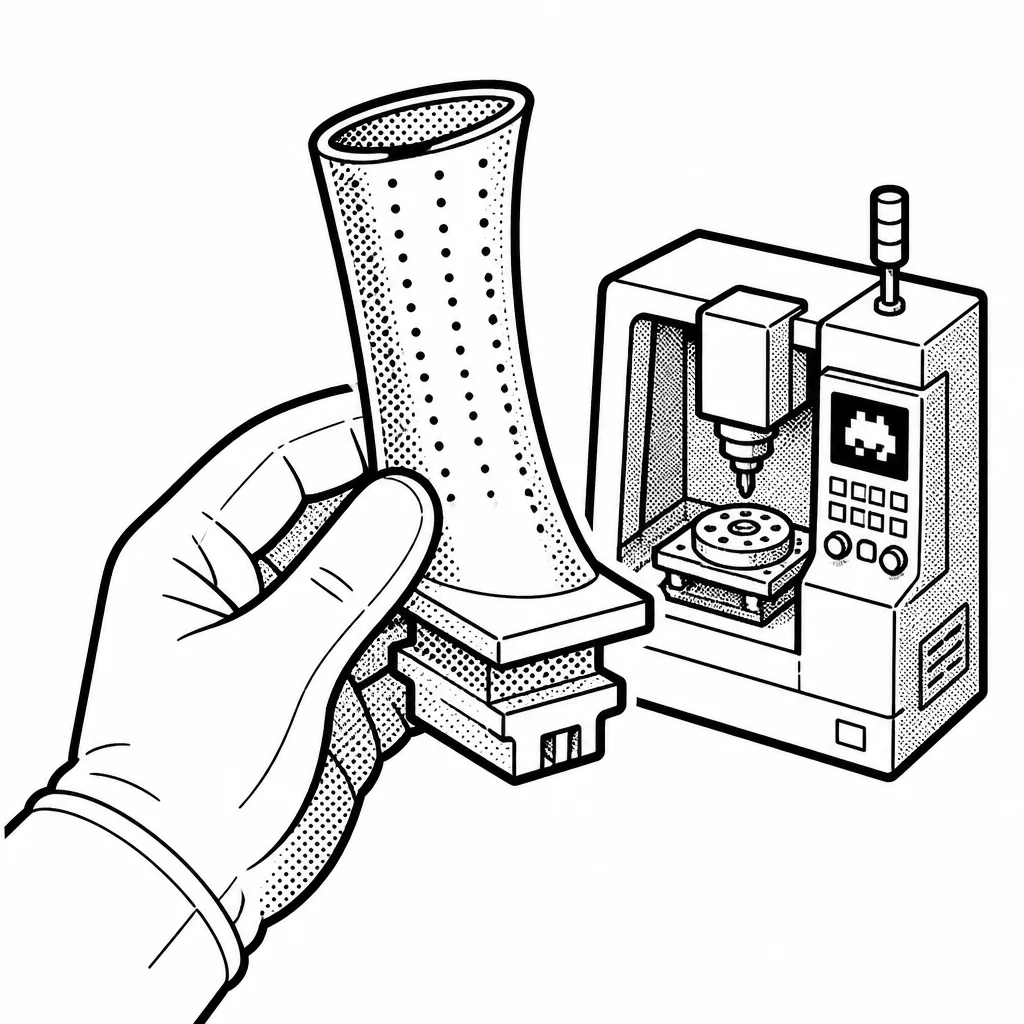
These parts are not simple metal shapes. Turbine blades sit in the hottest part of an engine, where temperatures can exceed the melting point of the metal itself, so they need special alloys, internal cooling channels, and coatings applied with extraordinary precision. AeroEdge's edge comes from its manufacturing skill: it specializes in making these parts efficiently and to exacting standards, which is why engine makers trust it rather than making everything in-house. The business is tied closely to the health of the commercial aviation market. Airlines buy planes, plane makers build them, and engine makers supply the engines and, crucially, the spare parts that keep them flying. That aftermarket demand is a steady revenue stream over the life of an engine, which tends to be more resilient than the initial equipment sales.
Air travel remains a huge long-term growth market, especially in Asia, and that should keep demand for engine parts rising. The catch is that aerospace supply chains are complicated and slow to change, and competition from other precision manufacturers is relentless. AeroEdge's future depends on staying good enough at a hard job that engine makers keep coming back.
Saved answer · last researched 20 Nov 2026
BIG PICTURE
One customer, Safran, pays for 97% of AeroEdge's sales
- 97% Safran
- 3% All other customers
AeroEdge makes turbine blades for the LEAP jet engine, and almost all of its money comes from one buyer: the French engine maker Safran. In the year to June 2026, Safran paid 49.3 billion yen of the company's 50.8 billion yen in sales. That closeness is also the risk, since Safran can cut the supply share if the contract terms are broken. Source: AeroEdge securities report, via Nomura article, data from 2026
Timeline
Kikuchi Gear's Pitch to Safran
Kikuchi Gear made gears for cars and construction machines, a tough business in need of restructuring. Its sales manager, Jun Morinishi, went looking for something better: high-value parts for airplanes. Starting around 2011 he pitched Safran, and by late 2013 the gear maker had a contract to supply titanium aluminide blades for the LEAP next-generation engine.
AeroEdge Spins Out of Kikuchi Gear
The blade business had a problem: it could grow bigger than Kikuchi Gear itself, and it needed lots of money for equipment plus outside investors. So in 2015 the company set up AeroEdge as a wholly owned spin-off, and soon after moved its aerospace division and the Safran blade contract into the new company.
Safran Supplier Performance Award
Years of quietly perfecting those titanium aluminide blades paid off when Safran handed AeroEdge its Supplier Performance Award, given to only a handful of its roughly two thousand global suppliers. It was outside proof that the technology really worked.
Listing on the Tokyo Stock Exchange
With its blade business proven, AeroEdge listed on the Tokyo Stock Exchange Growth Market in 2023, giving it a public currency and access to capital for its next stage of growth.
New Factory and Wider Contracts
The next year brought a new factory building on the head office grounds and a renewed LEAP blade contract that stretched supply out to 2034 while lifting AeroEdge's global share from about 35% to 40%. Just as important, a new ten-year parts supply deal with a major global aircraft manufacturer meant the company was no longer tied to a single product.
Acquiring Onoplant
In 2026 AeroEdge bought all of Onoplant, a processor of aircraft body and defense parts that served major Japanese heavy-industry makers. The move pushed the company beyond engine parts into airframes and defense, and into consolidated reporting.
Safran Lab and New Material Contract
A Safran-certified lab building opened in Ashikaga in 2026, and a new material contract with Safran aimed at mass production from that summer, with a share rise into the high 40% range by 2028. This added a growth engine that runs deeper into the supply chain, from material to finished part.