Understand any stock in simple English
Enter a ticker to learn what the company does and how it makes money.
NEC Corporation
NEC sells IT and network technology — systems integration, cloud services, telecom equipment, and social infrastructure — to governments and large enterprises, mainly in Japan.
NEC is a Japanese technology company that builds and runs the computer and network systems that governments and big companies depend on. If a city wants facial recognition at its airport, a telecom operator needs the gear behind a 5G network, or a government agency needs to modernize its aging computer systems, NEC is the kind of company that gets the call. It does not sell much to ordinary consumers anymore; its customers are institutions with big, complicated problems and long-term budgets.
The business has two broad halves. One is IT services: NEC integrates systems, runs cloud and data-center operations, and provides the software and support that keep large organizations working. The other is network and infrastructure: telecom equipment, submarine cables, wireless gear, and the sensors and systems behind things like biometric identification and public safety. It also runs a small but notable supercomputer business — its SX series machines have long been used for weather forecasting and scientific research. NEC's home market is Japan, where it has deep relationships with government ministries, banks, and telecom carriers, and that closeness is a real advantage — these are loyal customers who value reliability and local support. Abroad, it competes with global giants like Fujitsu, Hitachi, and Cisco in networking, plus the big cloud providers that keep pulling parts of IT spending toward themselves. That is the squeeze NEC lives in: solid, sticky contracts, but slow growth and heavy competition.
The interesting twist is that NEC is not just a stodgy infrastructure firm. It has invested heavily in biometrics and AI, and its facial-recognition technology has been deployed at airports and border checkpoints, though it has also drawn criticism from privacy advocates. It is also a major player in submarine cables, the physical pipes that carry most international internet traffic. Those are growth areas, but they sit on top of a large, mature core business where the real money still comes from long-term government and enterprise contracts.
Saved answer · last researched 12 Nov 2026
BIG PICTURE
Three companies lay almost all the world's undersea internet cables, and Japan's NEC is one of them
- 40% Alcatel (France)
- 30% SubCom (US)
- 21% NEC
- 9% Others
Nearly every international phone call and web page crosses an ocean on a cable lying on the seabed. Three companies split about 90 percent of that business, and NEC holds 21 percent, behind Alcatel at roughly 40 and SubCom at about 30. NEC still sells plenty of everyday IT to Japanese governments and firms, but this quiet cable trade gives it a global role few beginners expect. Source: Yahoo! News Japan (LIMO), data from 2026
Timeline
Japan's First Foreign Joint Venture
In 1899, Kunihiko Iwadare and his partners started NEC as Japan's first joint venture with a foreign company. The country was building its modern infrastructure, and the new firm's founding spirit was simple: better products and services. It began as a telecom technology venture and racked up a string of Japan-first communications innovations.
The Great Kanto Earthquake
The 1923 Great Kanto Earthquake destroyed four NEC factories and killed 105 employees. But the disaster pushed the Ministry of Communications to speed up automatic telephone switching and radio broadcasting. NEC responded by building Japan's first automatic switching system of its own the next year, turning a tragedy into a technical leap.
Into Computers
In 1954 NEC began researching computers, stepping beyond its communications base. Four years later it completed the first fully transistorized computer made in Japan, the NEAC-2201. That launched a long push into computing that would run alongside telecom.
The C&C Idea
At a 1977 industry event in the U.S., NEC pitched a big idea it called C&C: computers and communications merging into one. The concept repositioned the company from a hardware maker into a leader of Japan's information and communications industry. NEC called it its second founding, and it shaped the company's identity as an ICT pioneer.
PC-9801 Takes Japan
In 1982 NEC released the PC-9801, a 16-bit personal computer. The PC-9800 series came to dominate the domestic market, and its software became a de facto standard. People started calling NEC 'Japan's IBM' for its PC dominance.
Exit From PCs
NEC's proprietary PC standard collapsed as the world shifted to global standards. In 2011 the company formed a joint venture with Lenovo and effectively handed its PC business to Lenovo's group. It was a symbolic exit from hardware, part of a 'de-hardware' strategy.
A Social Value Company
In 2013 NEC declared it would transform into a 'social value creation company'. It focused its resources on ICT-based advanced social infrastructure and started treating social problems as growth opportunities. The company called this its third founding.
Buying Northgate
In 2018 NEC acquired Northgate Public Services, a UK software firm serving the public sector. In 2021 it was renamed NEC Software Solutions UK under the global NEC brand. The deal expanded NEC's overseas software and public-sector business.
The CSG Deal
In 2025 NEC announced it would buy U.S. software firm CSG Systems International for over 400 billion yen, aiming to close within 2026. The target was software for telecom operators, central to NEC's shift into an IT company and to rebuilding a growth axis. Stronger finances helped: net income had risen and the stock was up more than fourfold in five years.
The Next Mid-Term Plan
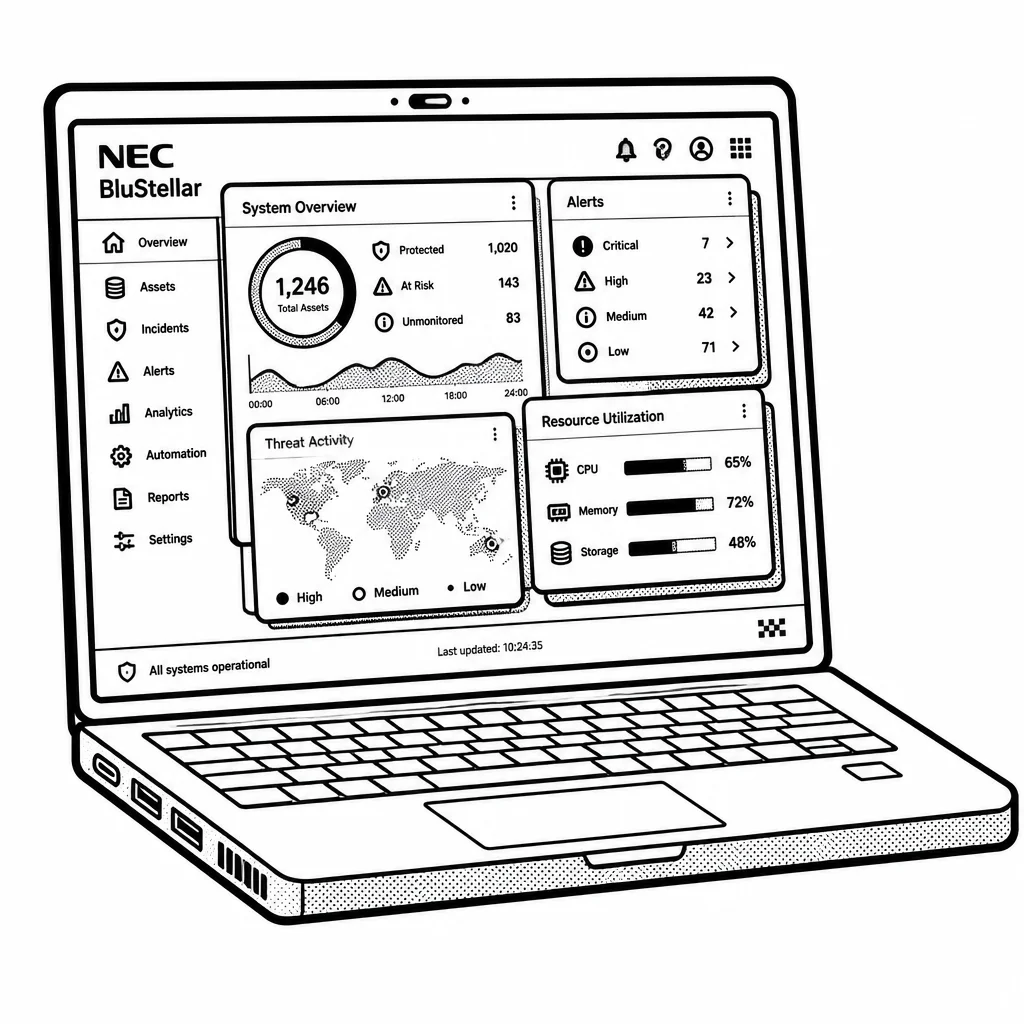
A new mid-term plan targets up to 1.3 trillion yen in growth investment through fiscal 2031, focused on security and digital transformation. NEC positions AI put to work in society and next-generation security as its two core strengths, with BluStellar as the core AI transformation engine. It aims to lift the IT Services operating margin from about 13 percent toward 20 percent by fiscal 2031.