Understand any stock in simple English
Miura Co., Ltd.
Miura makes small industrial boilers that turn fuel into steam and hot water, and it earns most of its money by selling those boilers and then servicing and maintaining them for customers.
Miura is a Japanese company that builds small, compact boilers — the machines that burn fuel to make steam or hot water for factories, hospitals, hotels, and other buildings. A boiler sounds boring, but it is the beating heart of a lot of industry: steam cooks food, sterilizes hospital equipment, heats buildings, and powers chemical processes. Most boilers are big, slow to start, and wasteful to run. Miura's pitch is the opposite. Its "once-through" boilers are small enough to fit in tight spaces, fire up in minutes instead of hours, and are designed to run only when steam is actually needed.
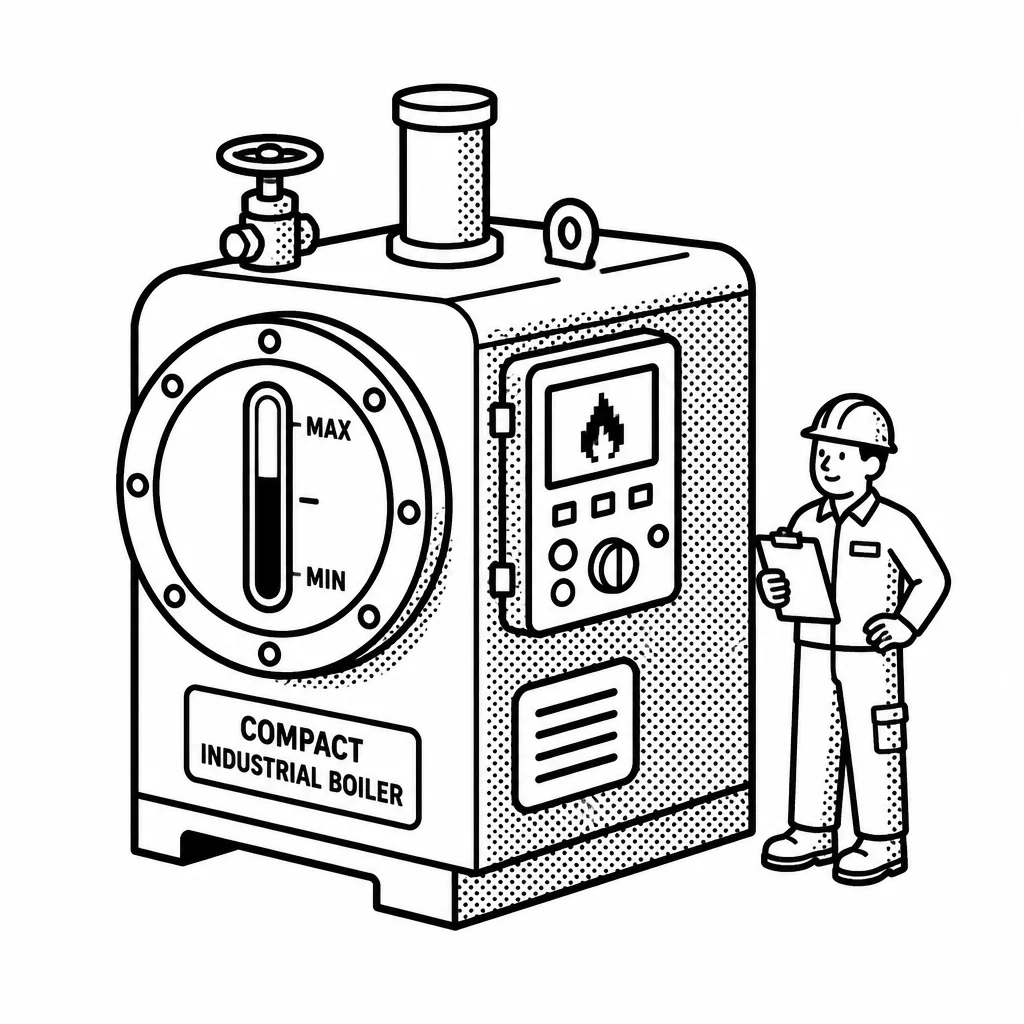
That last part is the real selling point. A traditional boiler sits hot and ready all day, burning fuel even when nobody needs steam. Miura sells its boilers as a system — several small units linked together that switch on and off like cars merging onto a highway, matching supply to demand. Less wasted fuel means lower bills and less carbon, which matters more and more as factories face pressure to cut emissions. The company also runs a large maintenance and service business, which is the steady, recurring part of the story: it stays with a customer for years, checking, repairing, and keeping the equipment running. Miura sells mainly in Japan, where it has a strong position, and increasingly abroad, including in Asia, Europe, and North America. It competes with much larger industrial players, but its focus on small, efficient, closely serviced boiler systems is its niche. The company has also pushed into related water-treatment and environmental equipment, since boilers need clean water to run well.
The business is a nice example of a "razor and blades" model, except the blades are maintenance contracts. Selling a boiler is a one-time event; servicing it becomes a relationship. That recurring service revenue, plus replacement parts and upgrades, helps smooth out the ups and downs of equipment sales. The company has a reputation for strong cash flow and a conservative balance sheet, and it has historically returned money to shareholders through dividends and buybacks while continuing to invest in new products and overseas growth. It is not a glamorous business, but it is a resilient one: as long as factories need steam, someone has to keep the boilers humming.
Saved answer · last researched 20 Nov 2026
Timeline
Boilers in Matsuyama
Miura started in 1947 in Matsuyama, Japan, building advanced boiler systems. Boilers are the big kettles that make steam and hot water for factories, hospitals and buildings, and they stayed the heart of the company ever since.
Miura Goes Public
By 1982 the boiler maker was big enough to list its shares on the Tokyo Stock Exchange. That let it raise money from outside investors, and it stepped into the public markets as a serious industrial company.
The 2001 Listing Record
Company records show its listing date as the first day of 2001, a quiet formality that kept it firmly among Japan's listed machinery makers. The stock was now a public story, with all the pressure and opportunity that brings.
The Peak in 2021
In early 2021 the share price hit an all-time high. It was a proud moment, and also the top of the hill: from there the stock would lag the wider market, setting up the question of what would get growth going again.
A New President Takes Over
In 2024 Tsuyoshi Yoneda became president, chief executive and chief technology officer, taking the top job after joining the company back in 1991. He inherited a solid business with yearly sales around ¥160 billion, and the market was waiting to see what he would do with it.
Buying Cleaver-Brooks
Yoneda's first big move was buying Cleaver-Brooks, a North American industrial boiler business. Sales jumped by more than ¥90 billion in the year that followed, and the deal became the engine driving Miura's push overseas.
Records and a Bigger Goal
The next year brought record revenue and profit, powered by sales at home and by Cleaver-Brooks and CERTUSS abroad. With a plan to reach ¥300 billion in revenue by 2028, the company's growth story now runs through buying its way into new markets.