Understand any stock in simple English
Enter a ticker to learn what the company does and how it makes money.
Formosa Sumco Technology Corporation
Formosa Sumco makes the silicon wafers that computer chip factories use as the raw material for building chips.
Formosa Sumco is a wafer maker. Not the kind you eat. Its customers are chip factories — the fabs that turn sand into processors, memory, and sensors — and the company supplies them with polished silicon wafers, which are the flat, round starting point for every chip. Think of a wafer as the blank canvas a painter works on, except the canvas is a perfect silicon crystal, and the painter is a multibillion-dollar factory running 24 hours a day.
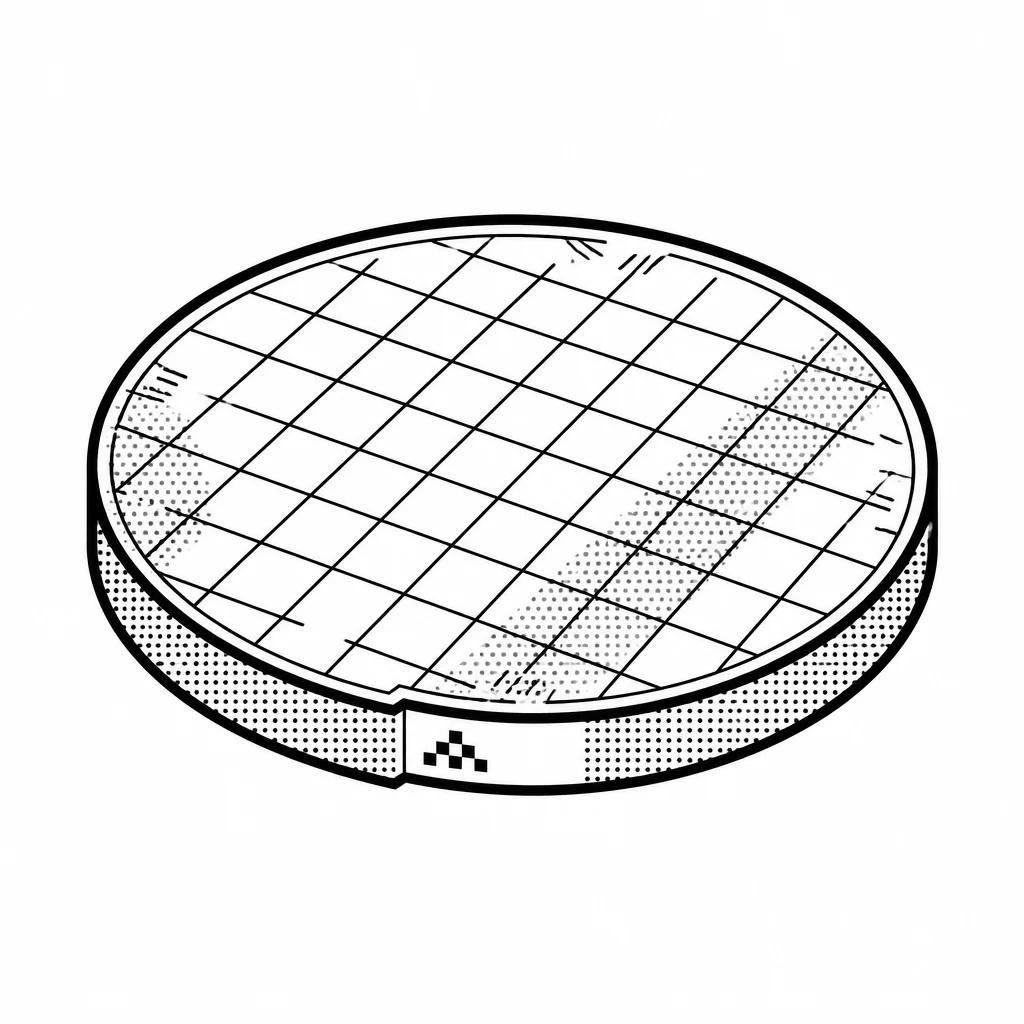
The key thing about wafers is that they are not all the same. Chipmakers need bigger ones for volume production and more precise ones for advanced chips, and they need a supplier who can hit exact specifications every single time. Even a microscopic speck of dust can ruin a batch. That is why there are only a handful of serious wafer suppliers in the world, and why customers stick with suppliers they trust. It is a quiet, capital-heavy business that sits at the very bottom of the chip supply chain. Formosa Sumco is a joint venture between Taiwan's Formosa Plastics group and Japan's Sumco, one of the world's largest wafer makers. That pairing gives it deep pockets on one side and deep wafer know-how on the other. Its competitors include Sumco's global rivals — Shin-Etsu Chemical is one of the biggest, and Siltronic is another major player. The market is dominated by a small group, and that concentration is both a strength and a vulnerability: pricing is steadier than in many industries, but the whole game rises and falls with chip demand.
When chip factories run flat out, wafer demand is strong and prices firm. When the chip cycle turns, wafer orders can soften, and a company like Formosa Sumco feels it fast because its costs are enormous and fixed — building and running a crystal-growing plant is not cheap, and you cannot easily turn it on and off. That cyclicality is the honest core of the business: a high-quality supplier to a critical industry, living and dying with the chip cycle.
Saved answer · last researched 12 Nov 2026
BIG PICTURE
Memory chipmakers make up more than 70% of Formosa Sumco's sales
- 70% Memory chip customers
- 30% All other customers
Formosa Sumco sells silicon wafers, the discs chips are built on, and the customers buying most of them make memory. Management put memory's share of revenue above 70% on the company's first-quarter 2026 earnings call. That makes the wafer maker's fortunes ride on memory prices and inventory swings, which is why four weak quarters hurt so much before the recent rebound. Source: Formosa Sumco Q1 2026 earnings call (BigGo Finance), data from 2026
Timeline
A Wafer Venture in Mailiao
Formosa Plastics and Japan's Sumco teamed up in 1995 to build a silicon wafer plant from scratch on reclaimed land in the Mailiao industrial park. Silicon wafers are the shiny discs that computer chips are printed on, so the plan was to feed Taiwan's fast-growing chip industry. The site started as bare ground and construction crews.
First Wafers Ship
Four years in, the company finally got its first 8-inch wafer factory running. After years of building and early stumbling, it was now a real manufacturer, not just a construction project.
Following Customers to 12-Inch
Chipmakers began moving to larger 12-inch wafers, which fit more chips per disc and cut costs. So the company built a 12-inch plant right next to its 8-inch one, eventually handling both crystal pulling and wafer making for both sizes under one roof.
Renamed to Match Its Parent
Sumco had bought out partner Komatsu Electronic Metals, and with that came a new name in Japan. In early 2007 the Taiwanese joint venture followed along, becoming Formosa Sumco Technology Corporation.
A Stock Exchange Listing
Later that same year, the company went public on the Taiwan Stock Exchange under ticker 3532. The listing gave the business a public price tag and access to outside investors.
Fab 1 Gets Bigger
In 2010 the company finished a second expansion of its main 12-inch factory, adding capacity and know-how. The quiet message: it intended to keep scaling as demand grew.
A Price Letdown Hits the Stock
In 2017, wafer makers hoped to charge more in the second half of the year, but the price hikes came in weaker than the market expected. Investors punished the whole group, and Formosa Sumco's shares plunged on the spot.
Betting Big on the Next Boom
Then in 2021, with chip demand roaring, the company committed roughly NT$28 billion to expand its 12-inch wafer plant in Mailiao. Ground was to break the next year, with mass production aimed at 2024, positioning the business for the next upcycle.
New President at the Top
In mid-2024, Wen-Bee Kuo took over as president from Jason Lin. A leadership handoff, with the hard years of a downturn as the backdrop.
The AI Wave Fills the Lines
Two years of customers burning off excess inventory had squeezed the business into a first-half loss. Then AI demand arrived, and by the third quarter of 2026 every 300mm line was running at full tilt, flipping the company back to profit and more than doubling it from the prior quarter. The new Mailiao factory's entire output was already spoken for by contract chipmakers before it even came online.