Understand any stock in simple English
Enter a ticker to learn what the company does and how it makes money.
Contemporary Amperex Technology Co., Limited
CATL makes the giant batteries that power electric cars and stores electricity for power grids.
CATL is the world's biggest maker of electric car batteries. If you drive an electric vehicle made by Tesla, BMW, Volkswagen, or almost any major carmaker, there is a good chance the battery pack underneath you was built by this Chinese company. It also makes huge battery systems that electric utilities use to store power, plus a smaller business selling rechargeable batteries for things like power tools and e-bikes.
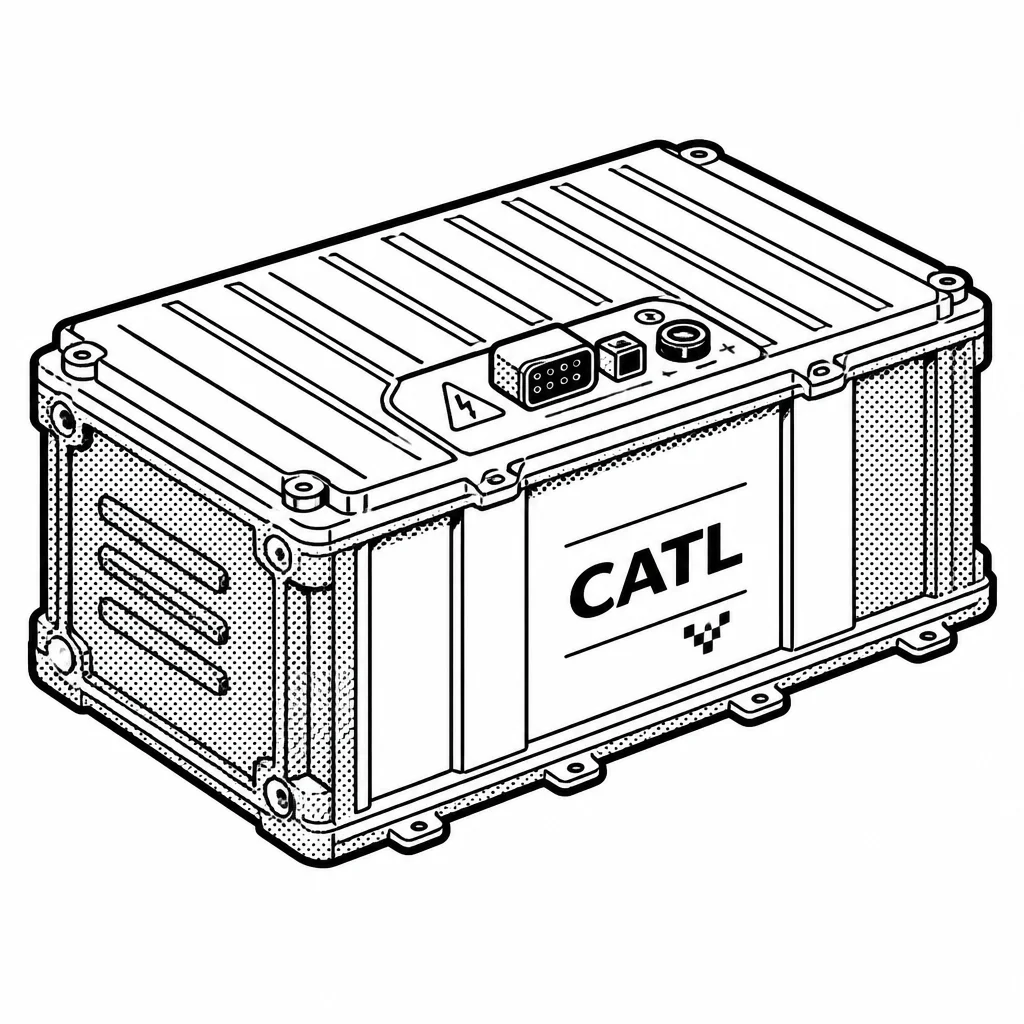
The core of the business is simple to understand once you know what goes into a battery. A battery cell has two sides — one that wants to give up electrons and one that wants to take them — and lithium ions shuttle between them to store and release energy. CATL's edge is making those cells cheaply, safely, and at enormous scale, then packing thousands of them into a sealed case with cooling and software that keeps them from catching fire. Car companies buy these packs because batteries are the single most expensive part of an electric car, and a reliable supplier who can deliver millions of them on time is worth a lot. That scale is the whole story. CATL spends heavily on research and on factories that stretch for what feels like miles, and it has locked up supplies of lithium, nickel, and other ingredients so it isn't caught short when prices spike. Its main rivals are other Asian battery giants like BYD, which builds batteries mostly for its own cars, and LG Energy Solution, which supplies many Western automakers. Governments in the US and Europe worry about depending on a Chinese company for such a critical piece of the car industry, and both have passed rules designed to steer battery money toward local factories — a real risk for CATL's growth outside China.
Timeline
A Battery Team Spins Out in Ningde
Robin Zeng led a team that split off from ATL, a company already good at making batteries, because he saw electric cars coming and wanted to build the batteries that would power them. He set up shop in Ningde, a city in Fujian, and gave the company a name that literally means 'the age of Ningde,' linking its identity to its hometown. The bet was simple: cars were about to need big, safe, cheap batteries, and someone had to make them.
BMW Takes a Chance on the Newcomer
A young company with no reputation landed a partnership with BMW, which gave it a reference customer the whole world could see. Working with BMW forced the team to lift its technical and quality standards, turning it from an unknown into a serious supplier just as China's electric car market began to take off.
Buying Into Battery Recycling
The company bought Guangdong Brunp to get into recycling and regenerating battery materials, pushing itself upstream into the business of recovering the metals inside old batteries. That mattered because batteries are only as cheap and secure as the materials that go into them.
Number One in EV Batteries
For the first time, the company used more battery capacity for electric cars than anyone else on earth, passing Panasonic and BYD. It also started a joint venture with SAIC Motor, a new way of locking in customers by owning a piece of the supply chain together with them.
Going Public and Going Abroad
The company listed on the Shenzhen exchange's ChiNext board, giving it public money to grow, and announced its first overseas battery factory in Thuringia, Germany. That factory marked the start of making batteries outside China, close to the European automakers it wanted to win.
A Second Engine: Grid Storage
The company became the world's top shipper of batteries for energy storage systems, the big packs that hold power for the electric grid, opening a second growth engine beyond cars. It also showed off a sodium-ion battery for cars, a cheaper alternative to the lithium kind.
Lithium Prices Bite
A spike in the price of lithium carbonate crushed profits, with first-quarter net income hit hard and gross margin falling below 15%. Investors responded by cutting the company's market value by as much as half, revaluing it from a fast-growing star into a cyclical business. The episode showed the company could not easily pass rising costs on to automakers.
A Spanish Factory With Stellantis
The company teamed up with Stellantis to invest in a battery factory in Spain, deepening its European manufacturing footprint with a major automaker. It was another step in the plan to make batteries where the cars are made.
The World's Biggest IPO of the Year
The company listed shares in Hong Kong at HK$263, the biggest IPO anywhere that year, raising roughly US$4.6 billion. The money was earmarked for building plants in Hungary, Spain and Indonesia, funding the global expansion.
The Stock Crashes as Customers Pull Back
The Hong Kong shares fell 57% from a record high in June to HK$338.40 by late October, as Xiaomi and Li Auto shifted some orders to their own battery making and to smaller suppliers. The slide reflected a deeper fear: automakers were moving away from the company, and its growth was maturing.
The company is also pushing into grid storage, where utilities buy container-sized battery banks to soak up solar power by day and release it at night. That business is smaller than car batteries but growing fast as power grids fill up with renewable energy. CATL's history is short and dramatic: it was spun out of a Japanese battery maker's Chinese unit in 2011 and grew so quickly that it now supplies roughly a third of the world's electric car batteries. It is a company that quietly became one of the most important industrial firms on the planet — and most drivers have never heard its name.
Saved answer · last researched 7 Nov 2026
BIG PICTURE
One in four dollars CATL earns now comes from storing electricity, not car batteries
- 25% Energy storage share of CATL's global sales
- 75% Everything else CATL sells, mainly EV batteries
Energy storage, the giant packs that hold power for grids, now makes up 25% of CATL's global sales. Five years ago it was 2%. The company already holds 30.4% of that worldwide market and has ranked first for five straight years, while EV batteries still bring in about three-quarters of sales. Source: BatteryIndustry.net, data from 2026