Understand any stock in simple English
Enter a ticker to learn what the company does and how it makes money.
Tibber AS
Tibber sells renewable electricity and smart home energy technology to households in Europe.
Tibber is an electricity company for people who want to use less of it, and pay less for what they do use. It sells renewable power to households in Norway and a handful of other European markets, and it pairs that electricity with a smart device called the Tibber Pulse that clips onto your home's electricity meter and reads your power use in real time. That little gadget is the heart of the pitch: once you can see exactly what power is costing you minute by minute, you can shift your dishwashing, laundry, and car charging to the cheapest hours of the day.
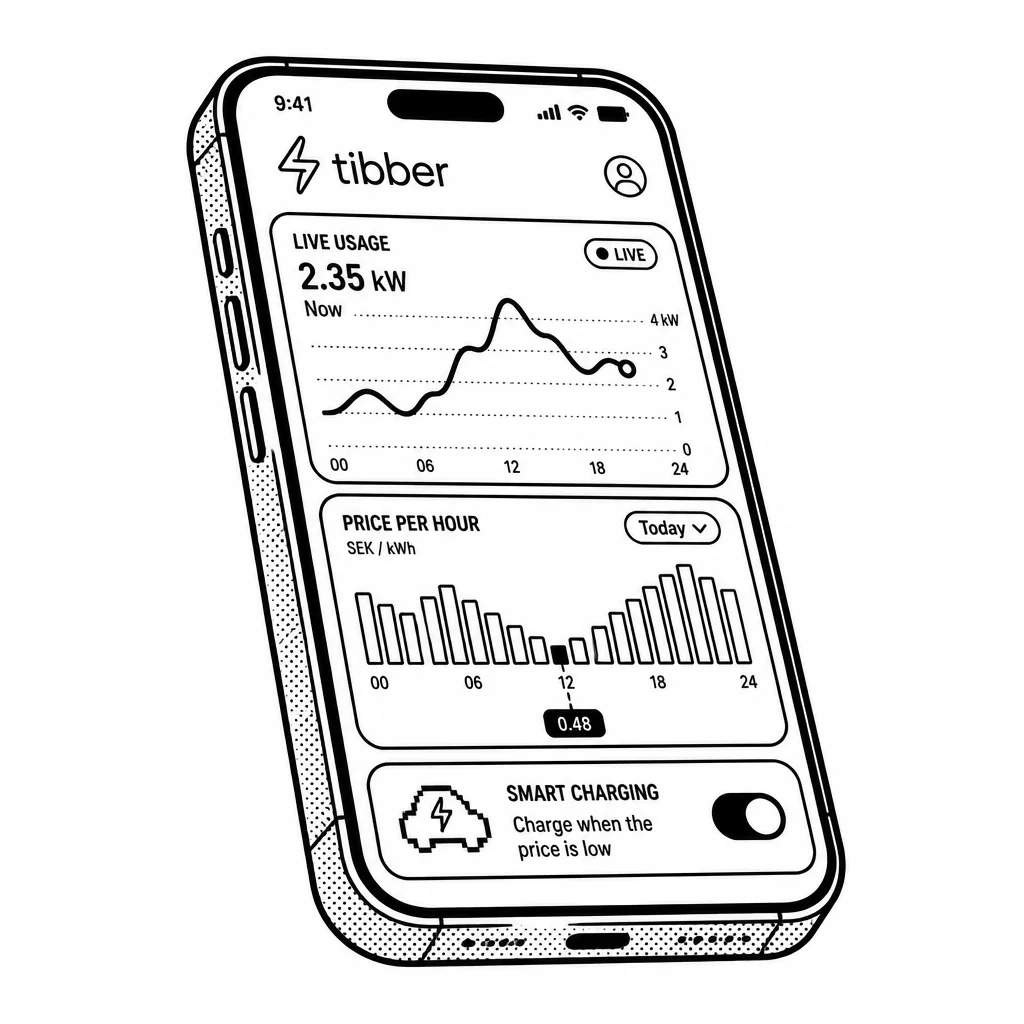
The money comes from a few places. Customers pay a monthly subscription for the app and smart-home features, and Tibber takes a small margin on the electricity itself, often charging customers the raw wholesale price plus a flat fee rather than a traditional marked-up rate. For a household with an electric car or a heat pump, that structure can mean real savings, because it rewards you for using power when the grid is quiet and cheap. Tibber also makes money selling its smart devices and, increasingly, by linking up with things like electric cars and heat pumps so it can automatically steer them to cheap hours — a handy service for people who don't want to think about it. The company's broader bet is on a future where millions of small devices — cars, heaters, batteries — act like a giant flexible battery that helps balance the power grid. Utilities pay for that flexibility, and Tibber sits in the middle as the software layer connecting homes to it. Based in Oslo, Tibber has expanded into Sweden, Denmark, Germany, and the Netherlands, and its users are the kind of people who care about both their energy bills and their carbon footprint. Its competitors are the old-line utilities and other smart-energy startups, but Tibber's edge is its direct relationship with households and its polished app.
The industry it lives in is brutally honest about costs, though: electricity retail is a low-margin business, and a big chunk of Tibber's revenue is money that just passes through to power producers. The subscription and device business is what makes the economics more interesting, and the grid-flexibility angle is where the long-term upside lives. It is also a crowded and regulated space, where wholesale power prices can swing wildly and upset customer expectations. Tibber is still a private company, so it doesn't publish share buybacks or dividends; like most growth-stage startups, it reinvests what it makes into expanding into new markets and building out the smart-home software.
Saved answer · last researched 12 Nov 2026