Understand any stock in simple English
Enter a ticker to learn what the company does and how it makes money.
Tata Sons Private Limited
Tata Sons is the holding company that owns and runs the sprawling Tata group of businesses, from cars and steel to tea and software.
Tata Sons is the parent company at the center of one of India's oldest and largest business empires. It does not make cars or sell tea on its own. Instead, it sits at the top of a giant family tree of companies and controls them through the shares it holds. When you buy a Tata car, use Tata steel, or drink Tata tea, you are handing money to a business that Tata Sons ultimately owns and steers.
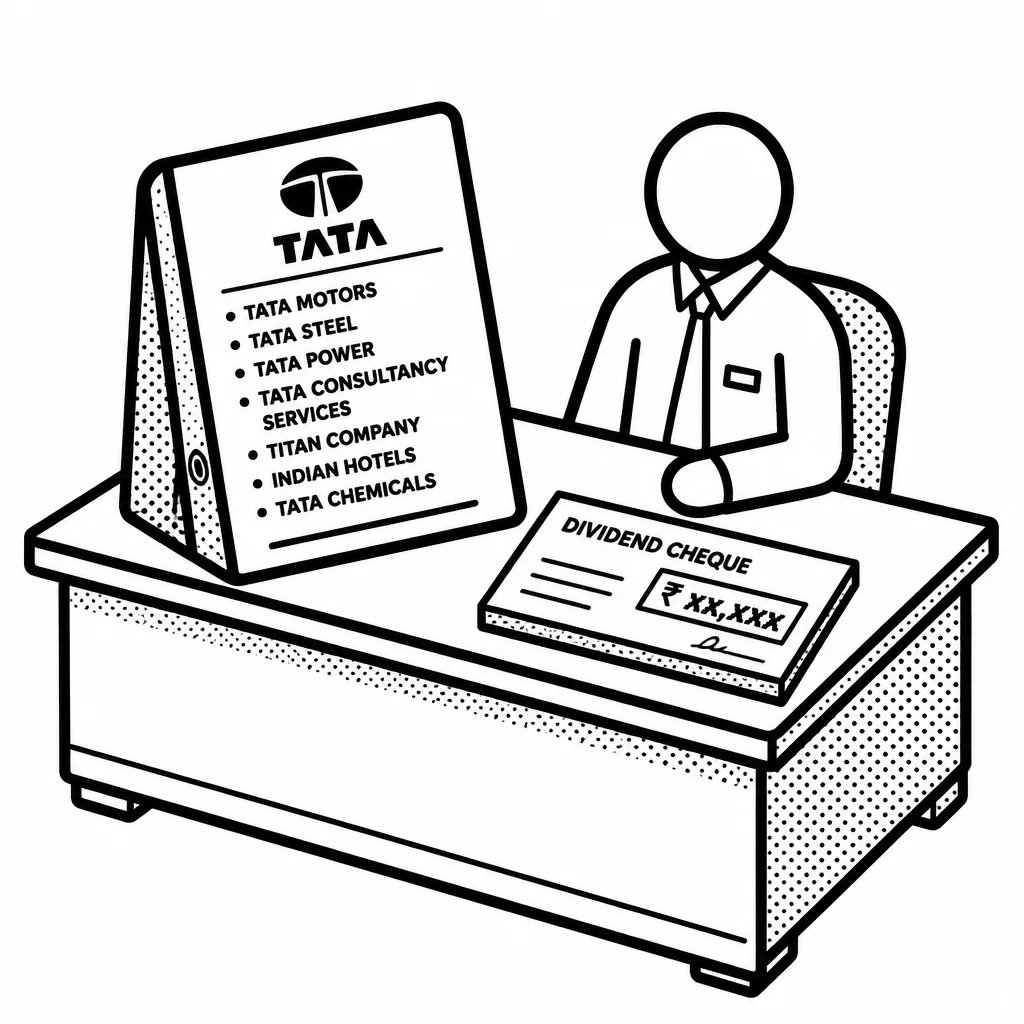
The group's reach is enormous. Its biggest crown jewel is Tata Consultancy Services, one of the world's largest IT outsourcing firms, which handles software and technology work for big organizations around the world. There is also Tata Motors, the country's largest automaker, which owns the British luxury brands Jaguar and Land Rover. Add steel, chemicals, consumer products, hotels, airlines, and even a plan to make semiconductors, and you get a sense of the scale. Tata Sons' main job is to hold stakes in these companies, appoint their leaders, and set the direction for the whole group. The business is unusual in how it funds itself. Tata Sons owns the group's main brand name and collects money by holding shares and sometimes through dividends from the companies it controls. In recent years it has poured billions into new bets like building an Indian semiconductor factory and turning around Air India, the national airline it bought back from the government in 2022. The group also runs a large charitable trust, and much of the wealth it builds flows into hospitals, schools, and research.
Perhaps the oddest thing about Tata Sons is its ownership. A big slice of the company sits with charitable trusts, which means a huge chunk of the profits from all those businesses ultimately funds philanthropy. The group is known less for flashy growth than for stability and a long-term, almost old-fashioned reputation for doing right by employees and the country. That reputation, more than any single product, is what keeps the Tata name trusted across India.
Saved answer · last researched 10 Nov 2026
Timeline
Opium, Tea, and a Name
Tata Sons started in 1917 as a trading house, making good money shipping opium and tea to Mongolia and China. Then it changed course: instead of running businesses itself, it became the holding company that owns the Tata Group. It also holds the Tata name and trademarks, which is why it sits at the center of everything Tata.
From Public to Private
For most of its life, Tata Sons was a public company. In 2017 it converted into a private limited company and took the name Tata Sons Pvt. Ltd. The move did not go quietly: former executive chairman Cyrus Mistry challenged both the conversion and the new chairman in court.
A Professional Takes the Chair
Natarajan Chandrasekaran became Chairman of Tata Sons in February 2017, replacing Cyrus Mistry. He was the first non-Parsi and the first professional manager to hold the Executive Chairman role. Before this, he had run Tata Consultancy Services and turned it into a global powerhouse.
The Supreme Court Backs Tata Sons
The boardroom fight that began with Mistry's removal finally reached the top. In March 2021, the Supreme Court of India upheld Tata Sons' decision to sack him. That closed the battle over the company's leadership and its conversion to a private limited company.
Air India Comes Home
Air India was founded by JRD Tata in 1932 and taken over by the government in 1953. In January 2022, it returned to Tata ownership when Tata Sons' Talace subsidiary agreed to pay an enterprise value of 18,000 crore rupees and take on a chunk of the airline's debt. The group was back in aviation after decades away.
Talk of an IPO
In March 2024, speculation began that Tata Sons was preparing for an initial public offering. Advisory firm Spark estimated the listing could value the company at up to 96 billion dollars. The chatter reflected a wider push by the Tata Group to tap public markets for capital.
Vistara Merges into Air India
In November 2024, Tata Sons struck an agreement with Singapore Airlines. Vistara, the full-service carrier, merged with Tata-owned Air India into a single airline. The combined carrier got a bigger network and fleet, and Singapore Airlines took a stake in the merged business.
The RBI Says No to Going Unregistered
In September 2026, the Reserve Bank of India rejected Tata Sons' application to give up its registration and be treated as an unregistered core investment company. Instead, the RBI told it to follow the rules for upper-layer non-banking finance companies, which was read as a requirement to list on the stock exchange. Tata Trusts, which holds 66 percent, opposes listing, arguing that private status is central to how dividends fund its philanthropy.
Chandrasekaran Steps Aside
In August 2026, Chairman N. Chandrasekaran said he would finish his term ending in February 2027 and not seek reappointment. The Sir Dorabji Tata Trust moved to set up a selection committee. The news added pressure on the firm over succession and a possible stock market listing.