Understand any stock in simple English
Enter a ticker to learn what the company does and how it makes money.
Shield AI, Inc.
Shield AI builds artificially intelligent software and aircraft that let military drones and jets fly and fight without a human pilot or GPS.
Shield AI is a defense technology company that makes military aircraft smart enough to fly themselves. Its customers are armed forces and defense agencies, mainly in the United States and its allies, who pay for the software and the aircraft that carry it. The core idea is simple: on a battlefield, GPS can be jammed and communication can be cut off, and a human pilot can be put in danger. Shield AI wants machines that can still find their way, make decisions, and complete a mission on their own when nobody is able to steer them.
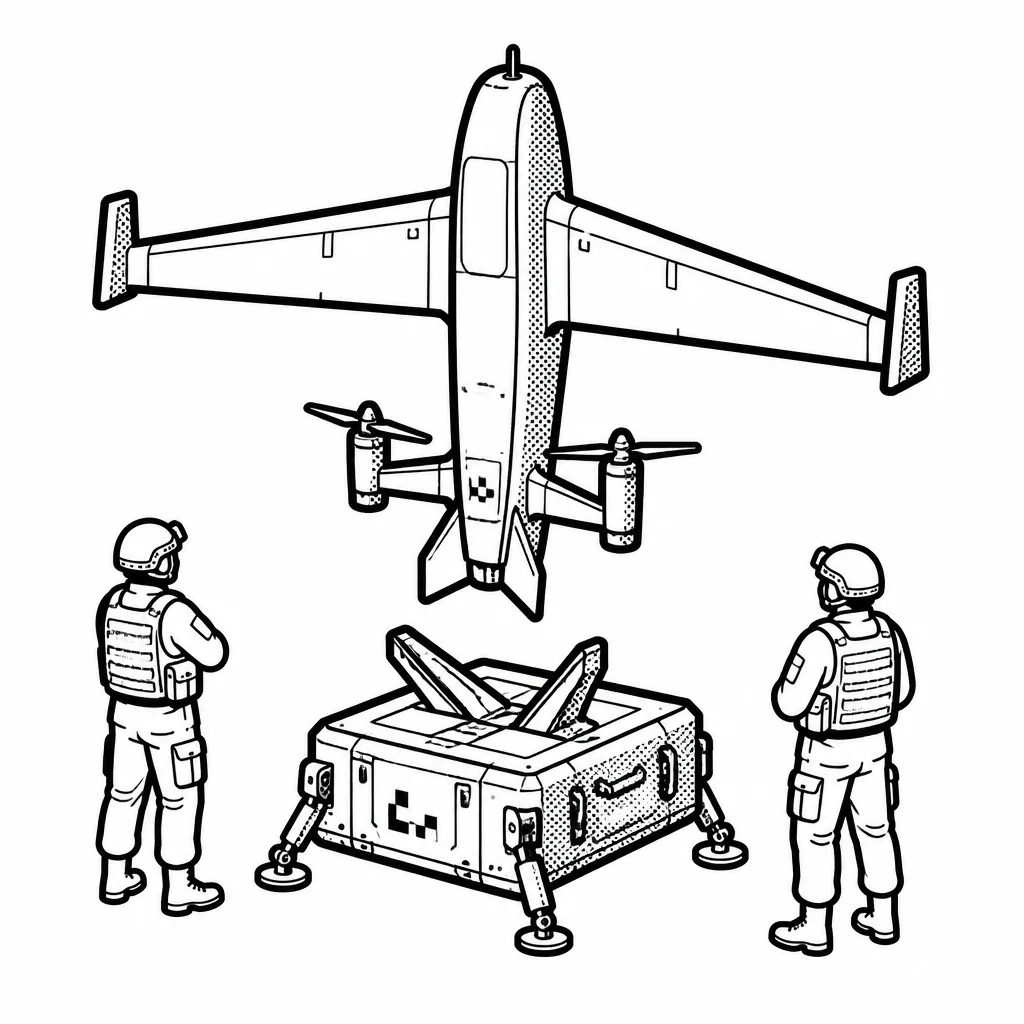
The company's best-known product is Hivemind, an AI "pilot" that flies aircraft without a human at the controls. Think of it as a brain that can be dropped into different bodies: Shield AI has put Hivemind into small quadcopter drones and into fixed-wing jets. Its flagship aircraft is the V-BAT, a drone that takes off and lands upright like a helicopter but cruises forward like a plane, which lets it launch from a small ship deck or a patch of dirt with no runway. Another product is the X-BAT, a jet-shaped combat aircraft designed to fly without a pilot. The thread tying it all together is autonomy: the customer buys the ability to operate in places where remote control and GPS cannot be trusted.
The business is expensive to run and relies on winning government contracts, so it is a bet on the future of warfare rather than a steady cash machine today. It has raised billions of dollars from investors and was valued at roughly $2.7 billion in 2024, and reports in 2025 pointed to a new funding round that would value it far higher. The biggest test is whether large militaries actually buy autonomous aircraft at scale; if they do, Shield AI sits in a strong position because it sells both the software and the aircraft. If budgets shift or competitors win the contracts, the money it has spent building the technology becomes a heavy load. The company is based in San Diego, a hub for defense and drone work, which keeps it close to the US military customers it is courting.
Saved answer · last researched 4 Nov 2026
BIG PICTURE
North America holds 48.3% of the market for AI pilot software Shield AI sells
- 48.3% North America's share of AI autonomous pilot software revenue
- 51.7% Rest of the world
Almost half of the money spent on software that lets aircraft fly themselves is spent in North America, according to one market report. Shield AI sells exactly that kind of software, called Hivemind, and its main customer is the U.S. military. Being based in the country that buys the most means the company is pitching from home turf. Source: marketintelo.com, data from 2025
Timeline
Two Brothers Start Shield AI
Ryan Tseng and his brother Brandon, a former Navy SEAL, started Shield AI in San Diego with Andrew Reiter. In Afghanistan, Brandon had lost fellow soldiers in combat, and that loss shaped the company's mission: protect service members with intelligent machines. The first big goal was an AI that could fly an aircraft and search inside buildings with no GPS and no communications, which is exactly where military teams often lose their signal and their way.
Nova Flies Into Buildings
The company's first real product was Nova, a small quadcopter flown by an AI pilot rather than a human. Working with U.S. Special Operations Command, it became the first such drone used in combat, sent into buildings ahead of troops to spot roadside bombs and hidden shooters. The company says it has saved many lives, which turned a startup idea into a working tool troops trust.
Shield AI Buys Heron Systems and Martin UAV
Shield AI bought Heron Systems, whose AI pilot had beaten an experienced F-16 pilot in simulated dogfights run by DARPA. It also agreed to buy Martin UAV, the maker of the V-BAT, a drone that takes off and lands like a helicopter. The plan was to pour its Hivemind software into every kind of aircraft it could get its hands on, old and new.
An AI Pilot Dogfights an F-16
Shield AI became the first company to fly a combat aircraft with an AI pilot, dogfighting against an F-16 flown by an Air Force weapon school pilot. That mattered because it showed Hivemind could handle fighter jets, not just small drones. The software was becoming a brain you could put in almost anything that flies.
The V-BAT Accident
The story had a hard moment too. During testing, a V-BAT partially cut off three fingers of a U.S. Navy service member, and the drone was grounded under flight restrictions for several months. Shield AI responded by building launch and landing features that need no one standing close by, a reminder that machines around people have to be safe first.
Gary Steele Takes Over as CEO
Shield AI brought in Gary Steele, the former chief of Proofpoint and Splunk, as CEO, with co-founder Ryan Tseng moving to President for strategic growth. The company said it needed someone who had already taken big technology organizations to scale. The founders were handing the wheel to a professional manager for the next stage.
X-BAT, an AI Fighter With No Runway
Shield AI unveiled X-BAT, which it called the world's first AI-piloted fighter jet that takes off and lands straight up. It needs no runway, so it can launch from ships, small islands or rough forward sites where a normal jet could never operate. First vertical flights were planned for the following year and operational validation for two years after that.
A $2 Billion Raise at $12.7 Billion
Shield AI raised $2 billion at a valuation of $12.7 billion, more than double what it was worth a year earlier. The round was co-led by Advent International and JPMorganChase's Security and Resiliency Initiative, with Blackstone providing preferred equity. The money was meant to buy simulation company Aechelon Technology and to scale both Hivemind and the V-BAT.
Shield AI Buys Echodyne
Shield AI agreed to buy radar maker Echodyne for $5.3 billion, pushing it into counter-drone work and mission systems. The company reorganized into three units: autonomy software, autonomous systems and mission systems. Echodyne's radars spot and track small drones, so the same company could now fly the drone and watch for the other side's.
A $1 Billion Series H
Shield AI raised another $1 billion, at a valuation of $29 billion, up from about $13 billion earlier in the year. Blackstone, Disruptive Technology Advisers and InnovationX co-led the round, which was tied to the Echodyne purchase and brought total capital raised to $3.9 billion. In a single year, a builder of drone brains had become one of the most valuable defense startups in the world.