Understand any stock in simple English
Enter a ticker to learn what the company does and how it makes money.
Maxar Technologies Inc.
Maxar builds satellites and sells the pictures and data those satellites capture of Earth to governments and businesses.
Maxar is a space company that does two linked things: it builds satellites, and it sells the view from above. Its satellites photograph the Earth again and again, and Maxar turns those pictures into maps, measurements, and analysis that governments and companies use to understand what is happening on the ground.
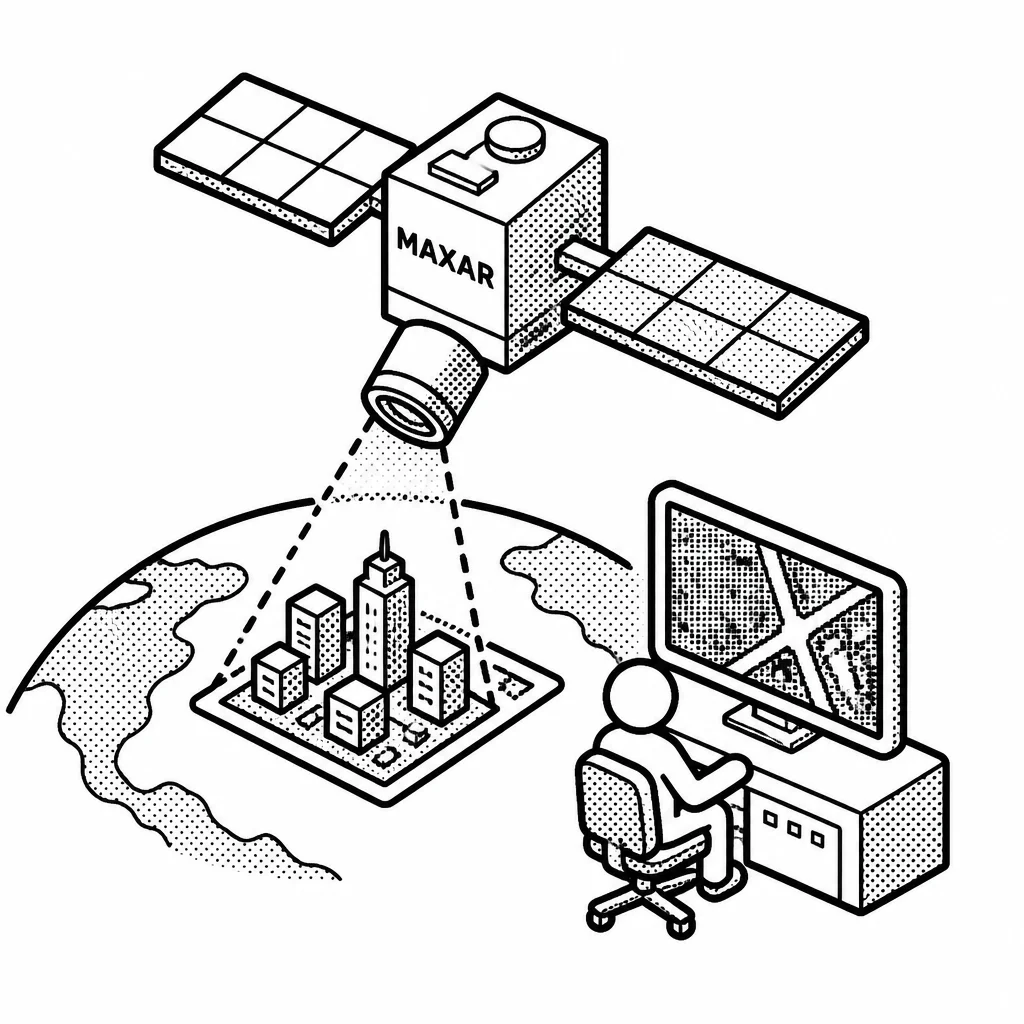
The customer base leans heavily toward government. Defense and intelligence agencies are big buyers of Maxar's imagery because a fresh picture of a port, an airfield, or a border can answer questions no document can. Commercial customers use the same data for things like mapping, farming, insurance, and tracking infrastructure. Maxar also builds spacecraft for others, so it earns money both from making satellites and from selling what satellites see. The company has had a rough ride. It went through bankruptcy in 2023, weighed down by debt and delays, and came out owned by a group of private investors rather than public shareholders. That is why its shares no longer trade. For a business whose product is literally the world's best view of the planet, the irony is that its own finances were harder to see clearly for a while.
Today Maxar's value rests on a simple idea: whoever can reliably deliver fresh, detailed pictures of Earth holds a powerful information advantage. Governments pay well for that edge, which makes Maxar's government contracts its anchor. The risk is that the satellite business is capital-hungry and slow, and competitors with cheaper, smaller satellites are crowding in. Maxar's bet is that its image quality and its decades of archived imagery keep it ahead.
Saved answer · last researched 11 Nov 2026
BIG PICTURE
Maxar holds nearly a quarter of the commercial Earth observation satellite market
- 24.4% Maxar Technologies
- 10.7% Airbus Defence and Space
- 64.9% Others
Of every dollar spent on commercial Earth observation satellites, Maxar's share comes to about 24 cents, while Airbus Defence and Space takes roughly 11. Four other big players share the rest. Maxar sells the sharp pictures its satellites take to governments and businesses, and that lead rests on very high resolution imagery and its WorldView Legion craft. Source: Global Market Insights, data from 2025
Timeline
Two Engineers Start MDA
In 1969, John MacDonald and Vern Dettwiler started a small Canadian company building space systems. They named it MacDonald, Dettwiler and Associates, or MDA. It was the seed of everything that followed, though the name on the door would change more than once.
MDA Buys Space Systems/Loral
For decades MDA grew as a Canadian space-systems shop. Then in 2012 it bought Space Systems/Loral, a satellite maker in Palo Alto, for a sum just under a billion dollars. That deal turned MDA into one of the world's leading makers of communication satellites, and the California factory became a core piece of the company's future.
MDA Buys DigitalGlobe and Becomes Maxar
Then came the move that defined the company: MDA bought DigitalGlobe, the leading Earth-imaging company, and renamed the whole thing Maxar Technologies. Now one company made satellites and also owned the cameras in the sky. It listed its shares in New York and Toronto and set up headquarters in Colorado.
A Collapse in Half a Year
The good years did not last. In 2018, sales and profit in the satellite-making arm fell short, and the stock plunged. In half a year, the company's value on the market fell from about three billion dollars to roughly three hundred million. Then a satellite was lost, and insurance covered only a fifth of what it cost to launch. By spring 2019, Maxar had to rework its debts to survive.
Dan Jablonsky Takes Over
Dan Jablonsky stepped in as chief executive at the start of 2019, right in the middle of the mess. He launched a broad restructuring and rebranding. Instead of running a pile of brands, he organized the company by what it actually did, and he decided to keep the communication-satellite business rather than sell it, but to fix it instead.
Maxar Sells MDA
To pay down debt, Maxar sold its Canadian MDA businesses to a group led by Northern Private Capital for about three quarters of a billion dollars. MDA walked out the door as its own company again. What stayed behind was a leaner Maxar focused on two things: Earth imagery and the hardware that goes into space.
Maxar Shows the World a Convoy
Maxar's satellites had a moment on the world stage in 2022. When Russia invaded Ukraine, Maxar published images of a long Russian military convoy on the move. That made the company's role plain: it was a key supplier of satellite pictures to Ukraine, and its cameras were now part of how the world watched a war.
Advent Buys Maxar
In 2023, the private equity firm Advent International bought Maxar outright for six and a half billion dollars in cash and took it private. The shares stopped trading in New York and Toronto, closing the book on Maxar's run as a public company.
Maxar Splits in Two
Soon after, Advent broke Maxar into two business units: Maxar Space Systems, which builds satellites, and Maxar Intelligence, which handles imagery. The point was to let each half run as its own business under Advent's ownership, without one dragging on the other.
The Maxar Name Retires
In 2025 the two halves got new names. Maxar Intelligence became Vantor, leaning toward software and full-picture spatial intelligence, while Maxar Space Systems became Lanteris and kept building satellites. Both still belonged to Advent. The Maxar name, born from a deal a few years earlier, was retired.