Understand any stock in simple English
Enter a ticker to learn what the company does and how it makes money.
Kaspersky Lab
Kaspersky makes antivirus and cybersecurity software that protects computers, phones, and corporate networks from hackers and malware.
Kaspersky is one of the best-known names in antivirus software. You have probably seen its green-and-white shield logo on a laptop, or heard its name when a computer pops up a warning about a virus. The company sells security software for ordinary people and for big organizations, and it makes money by charging for subscriptions and licenses rather than giving the product away.
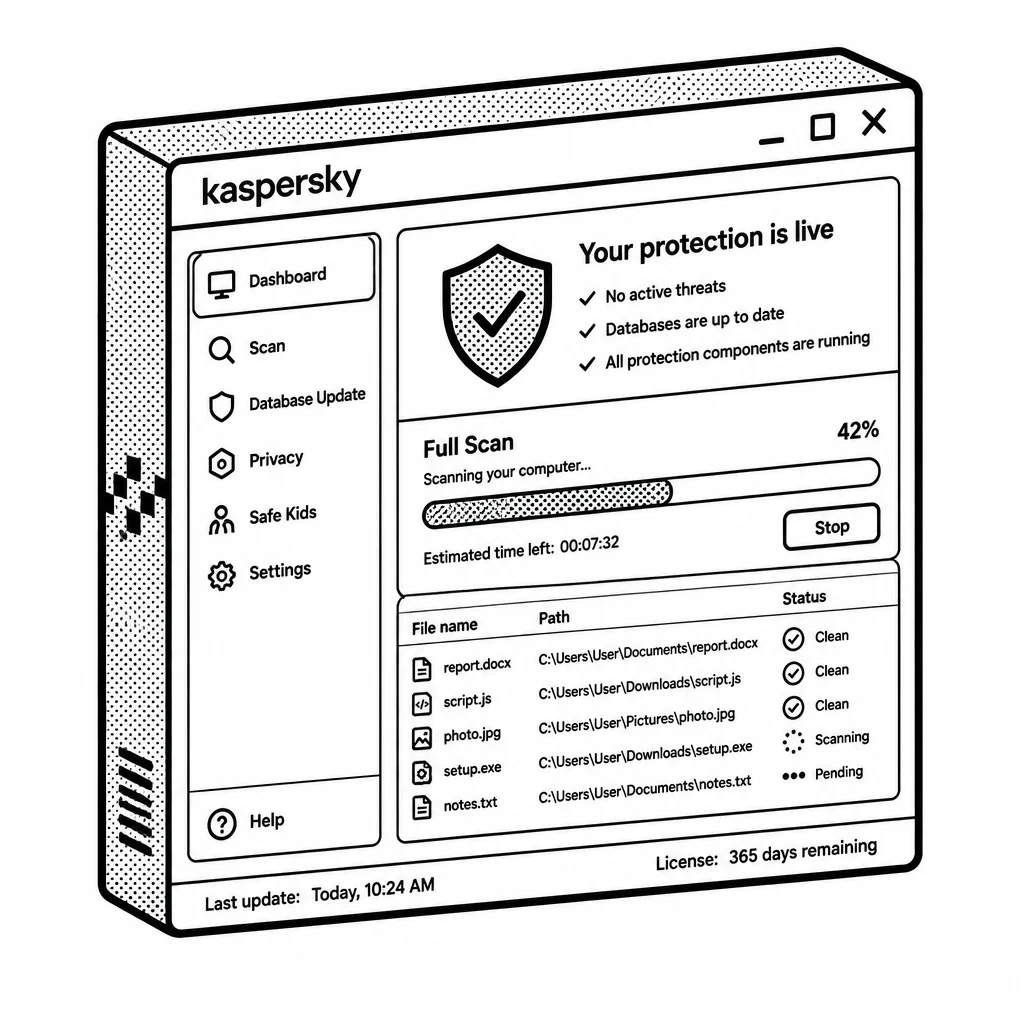
Its core product is antivirus protection: software that watches files and downloads for malicious code and blocks it before it does damage. Around that core, Kaspersky has built a wider security suite that includes a password manager, a VPN, parental controls, and protection for phones. For businesses, it sells endpoint security, which protects every individual laptop and server on a corporate network, plus tools that help security teams spot and respond to attacks. Customers choose Kaspersky largely on the strength of its malware detection, which independent testing labs have repeatedly rated highly, and on price: its consumer plans usually cost less than rivals like NortonLifeLock or Microsoft's built-in Defender. The company's history is unusual and shapes its business today. It was founded in 1997 by Eugene Kaspersky, a Russian mathematician who had worked in military cryptography and turned a hobby of studying computer viruses into a company. It grew into a global brand headquartered in Moscow, with customers in nearly every country. That Russian base became a serious problem: in 2017 the U.S. government banned federal agencies from using its software, and later restrictions widened. In 2022, after Russia's invasion of Ukraine, the U.S. added Kaspersky to its list of companies posing a national security threat, and in 2024 it banned sales of Kaspersky products in the United States outright. Kaspersky has strongly denied that it has ties to any government. Those bans hurt. The United States was one of its biggest markets, and losing it forced Kaspersky to shrink and refocus. The company wound down its U.S. business and shifted attention to Europe, Asia, the Middle East, and Latin America. In 2024 it announced a major restructuring, cutting jobs and pulling back from some Western markets. It has also pushed a "cyber immune system" strategy, selling security services and threat intelligence to large organizations rather than just boxed antivirus software.
The deeper story is a lesson in how geopolitics can wreck a good product. Kaspersky's software is genuinely respected by security researchers, and the company invests heavily in research, uncovering major hacking campaigns that other firms miss. But antivirus software sits deep inside your computer, with broad access to your files, which is exactly why governments grew nervous about a Russian-owned firm holding that position. For years Kaspersky has tried to address this by opening "transparency centers" in Europe where outsiders can inspect its source code. That has won some trust back in places like Germany, but it has not undone the U.S. ban, and the company remains a cautionary tale about how a business built on trust can lose it for reasons that have nothing to do with the quality of its code.
Saved answer · last researched 10 Nov 2026