Understand any stock in simple English
Enter a ticker to learn what the company does and how it makes money.
Grammarly, Inc.
Grammarly sells AI-powered writing software that checks spelling and grammar, polishes tone, and helps people and businesses write more clearly.
Grammarly is a software company that acts like a copy editor looking over your shoulder. You type in a browser, an email, a Word document, or a phone keyboard, and its AI quietly flags mistakes, fixes grammar, and suggests clearer wording as you go. Roughly 40 million people use it every day, spread across about a million registered users and 50,000 organizations, from students writing essays to sales teams firing off emails.
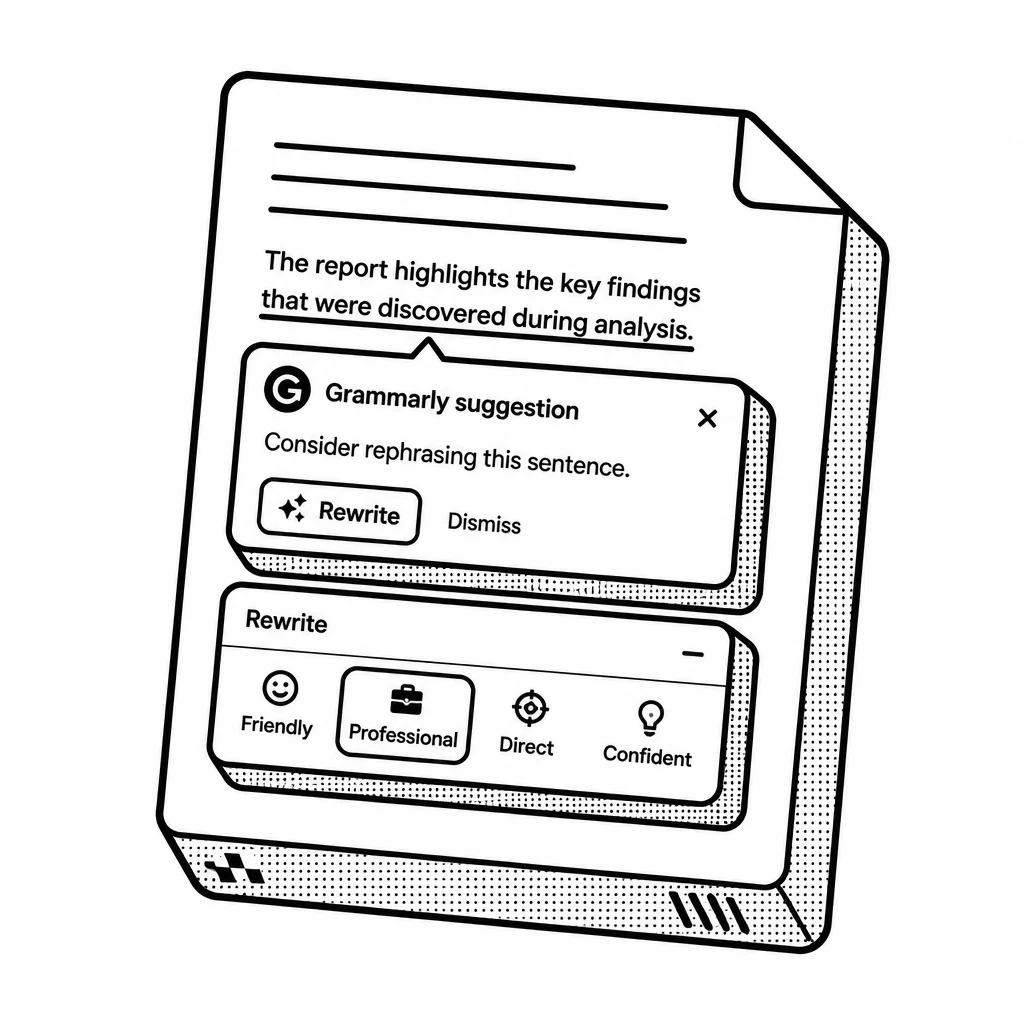
The core product is free, and that free version is the engine of the whole business: it gets the software onto millions of screens, then the company charges for the more useful stuff. Grammarly Premium, aimed at individual professionals and students, adds tone suggestions, full-sentence rewrites, plagiarism checks, and a generative AI tool that can draft and reply to messages. Grammarly Business sells seats to companies that want consistent, on-brand writing across their teams, plus admin controls and analytics. That subscription model is the money maker — people pay a monthly or annual fee, and the company keeps earning as long as users keep typing. What makes Grammarly hard to dislodge is where it lives. It works inside the tools people already use — Gmail, Microsoft Word, Slack, Google Docs, and hundreds of other apps — so a rival has to match both the accuracy of the suggestions and the reach across all those surfaces. Its main threats are the AI features now baked directly into those same tools, like Microsoft's Copilot and Google's Gemini, plus writing assistants from companies like Microsoft-backed OpenAI and a swarm of AI startups. Grammarly's bet is that a specialist focused only on writing can beat a general assistant that does writing as one feature among many.
The company is private and was founded in Kyiv, Ukraine, before moving its headquarters to San Francisco as the war with Russia upended its home base — a story that matters because a large share of its engineers are still in Ukraine. It has stayed independent for years, funding growth from subscriptions rather than going public. In 2024 it laid off about 230 people, roughly a quarter of its staff, as it restructured around AI, a blunt acknowledgment that the writing-assistant market it helped create is now crowded and moving fast. The whole business rests on one simple question: when AI can write for everyone, will people still pay for something that helps them write better themselves?
Saved answer · last researched 4 Nov 2026
BIG PICTURE
Among AI apps used at work, Grammarly trails only ChatGPT
- 45.2% ChatGPT
- 24.8% Grammarly
- 12.5% Microsoft Copilot
- 6.4% DeepL
- 2% QuillBot
- 9.1% Others
When a security firm sorted workplace AI traffic by app this year, ChatGPT took 45.2% of transactions and Grammarly took 24.8%, ahead of Microsoft Copilot at 12.5%. Writing and content tools were the biggest category at 28.3%. Grammarly makes money by selling premium subscriptions to people who write at work, so a quarter of office AI use is a strong base and a reminder that general chatbots are its real rival. Source: Zscaler, data from 2026
Timeline
Three Founders Start Grammarly
Alex Shevchenko, Dima Lider, and Max Lytvyn had just sold their startup that caught students copying work. That business taught them something surprising: students often plagiarized because they couldn't put their own ideas into words. So the three built an online editor that helped people fix their writing, sold it as a paid subscription, and called it Grammarly.
Brad Hoover Becomes CEO
A few years in, the early product caught the attention of Brad Hoover, who took over as CEO. Under his leadership the young company wrote down what it stood for and kept growing.
Grammarly Turns to Everyday Consumers
Grammarly had mostly served students. That changed when it decided to chase a much bigger crowd: ordinary people who write every day. It rolled out subscription plans and started advertising on Facebook, Twitter, and YouTube.
Grammarly for Chrome Goes Freemium
The next big move was a browser extension, Grammarly for Chrome, paired with a new way to charge: free to use, pay for more. That freemium model opened the door to far more people, and versions for Safari, Firefox, and Edge soon followed.
One Million Daily Users
The free-to-start model paid off fast. Grammarly reached a million people using it every day, a huge jump from its early base of paying subscribers.
Thirty Million Daily Users
Five years later, that number had multiplied into the tens of millions of daily users. And it wasn't just individuals: thousands of professional teams across many industries were using Grammarly Business.
A Thirteen Billion Dollar Startup
Investors poured in a couple hundred million dollars, valuing Grammarly at thirteen billion. That made it the most valuable startup with Ukrainian roots.
ChatGPT Changes the Game
Then came a shock. OpenAI's ChatGPT arrived at the end of 2022, and suddenly a machine could write whole paragraphs. Grammarly raced out its own generative AI tool, GrammarlyGO, in April 2023, alongside a major shakeup that replaced its CEO, CTO, and product chief.
Grammarly Buys Coda
The company had been a one-product business. Buying Coda at the end of 2024 changed that, turning Grammarly into a multi-product brand. Coda's co-founder and CEO, Shishir Mehrotra, took over as chief executive.
Grammarly Buys Superhuman
Next came the email tool Superhuman, part of a push to build a full AI-powered productivity suite. The move followed a recent billion-dollar funding round from General Catalyst, giving the company cash for AI workplace tools. Superhuman's CEO, Rahul Vohra, came along with over a hundred employees.
The Parent Company Becomes Superhuman
On October 29, 2025, Grammarly rebranded its parent company as Superhuman, bringing Grammarly, Coda, Superhuman Mail, and a new assistant called Superhuman Go under one roof. Superhuman Go is an agentic AI helper that works across apps and devices. The writing helper had become an all-in-one AI productivity platform.