Understand any stock in simple English
Enter a ticker to learn what the company does and how it makes money.
Dataminr, Inc.
Dataminr sells real-time alerts and analysis of breaking news and social media to companies and governments so they can react to events as they happen.
Dataminr is an artificial intelligence company that scans the public internet — news wires, social media posts, blogs, and now even satellite and sensor data — and turns the flood into short, urgent alerts. Its customers are organizations that need to know about a crisis before it hits: banks, energy companies, airlines, retailers, newsrooms, and government agencies. When a fire breaks out near a factory, a protest forms in a city, or a cyberattack starts, Dataminr's systems flag it and push a warning to the people who need it, often minutes before traditional news coverage catches up.
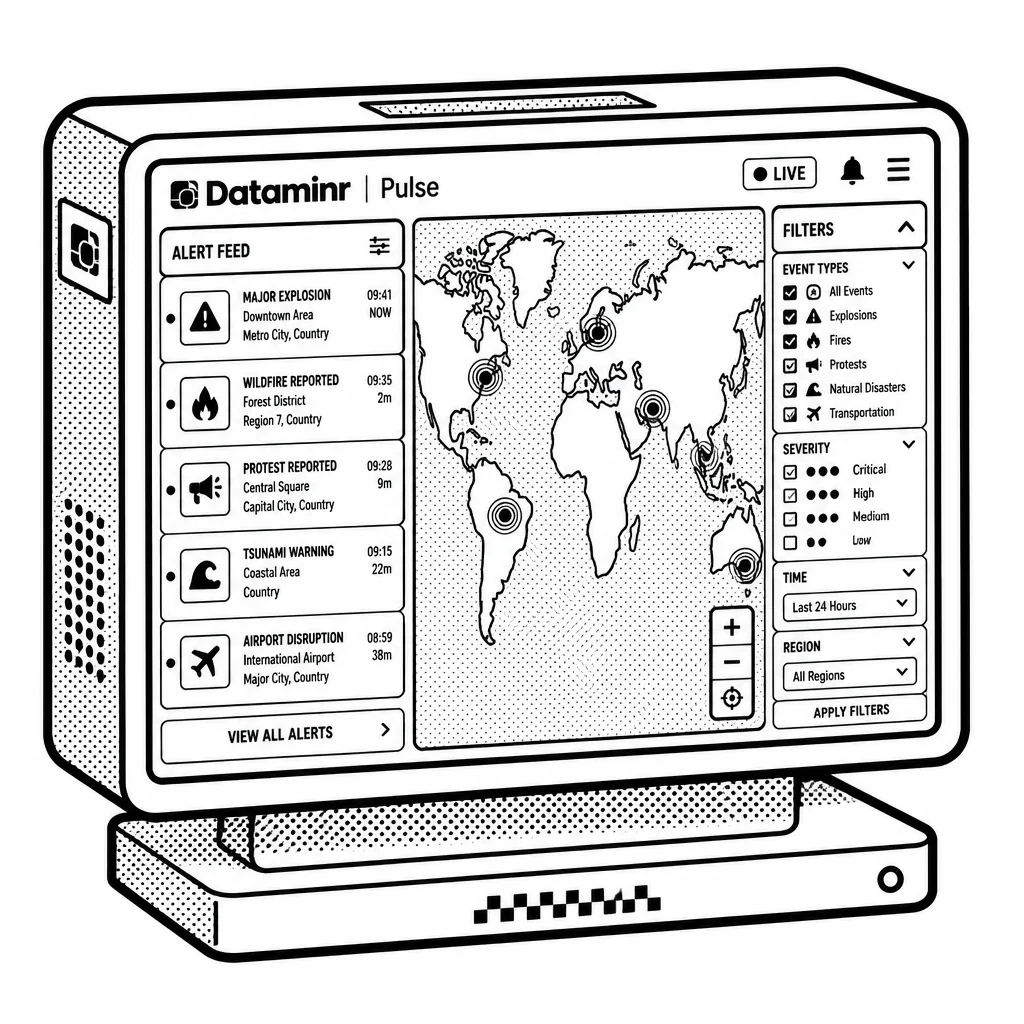
The company's core product is its real-time event detection platform, which it licenses to customers as a subscription. It also sells specialized versions for the public sector, such as for emergency responders and defense and intelligence agencies, who use it to monitor threats and disasters. Customers pay recurring fees for access to the alerts and the dashboards that organize them. The reason they choose Dataminr over a competitor is speed and signal — the software is trained to spot the first faint signs of an event in noisy social chatter, before it becomes obvious. Dataminr has grown into one of the more prominent private AI companies in New York, where it is headquartered. It raised money from investors including Fidelity and Valor Equity Partners, and it has been valued at over $4 billion in private funding rounds. Its rivals include other risk-intelligence firms and the in-house monitoring teams of large organizations, but its biggest edge is the breadth of public data it ingests and the speed of its detection. The company generates most of its revenue from corporate and government subscriptions, and it has also built a business around the 2020s boom in monitoring for physical security, supply chain disruption, and geopolitical risk.
The business is not without its challenges. Dataminr depends heavily on access to public social media data, and changes to platforms' data access rules can affect what it can see. It also operates in a sensitive market, selling surveillance-like awareness tools to governments, which has drawn scrutiny from privacy advocates and civil liberties groups. Still, the company has positioned itself as an early-warning system for a messy world, and its private backing has let it invest heavily in AI and data partnerships rather than chase short-term profits.
Saved answer · last researched 9 Nov 2026
BIG PICTURE
Half of America's 100 biggest companies pay Dataminr to hear about trouble first
- 50% Fortune 100 companies that use Dataminr
- 50% Fortune 100 companies that do not
Dataminr says half of the Fortune 100, the 100 largest US companies by revenue, are customers. These are firms with their own security teams and analysts, yet many still pay an outside company for early warnings. Dataminr watches public posts and news in over 150 languages and sells alerts when something breaks, so the customers are buying minutes of warning before a situation reaches their own people. Source: Dataminr, data from 2026
Timeline
Ted Bailey Starts Dataminr
The idea came from a hard lesson: on 9/11, people inside the towers lacked the real-time information they needed to get out. Ted Bailey set out to close that gap, building a platform that could spot important events as they happened. He started with two Yale roommates, and the first customers were hedge funds hungry for market-moving news before anyone else had it.
A Deal With Twitter
The big unlock came when Dataminr struck a partnership with Twitter for direct access to every public tweet in the world, as it was posted. That firehose of data became the foundation the whole detection engine was built on.
Into the Newsroom
Partnering with CNN and Twitter, the company built a tool that flagged emerging stories to journalists in real time. The customer base was no longer just finance; it now included newsrooms.
Entering Government
Dataminr pushed into the public sector, putting its early-warning system in the hands of intelligence agencies and first responders. That widened the customer base again, this time into government.
The First COVID Signals
In late 2019, Dataminr's system picked up the first signals of the COVID-19 outbreak in public social media posts, before the world at large was aware. The same year it partnered with the UN to equip thousands of personnel with its First Alert product, a sign its detection worked far beyond markets.
A Painful Restructuring
In 2023 the company cut about a fifth of its workforce, roughly 150 jobs. CEO Ted Bailey pointed to the economic downturn and a push to speed up AI development, aiming to put Dataminr on strong financial footing and focus on generative AI.
Two Hundred Million and an IPO Path
The business crossed roughly $200 million in annual recurring revenue and brought in an ex-CrowdStrike CFO to prepare for a future IPO. It also raised several funding rounds that year, including $85 million in March and $300 million in convertible debt in September.
Buying ThreatConnect
Dataminr announced plans to acquire cyber threat intelligence firm ThreatConnect for $290 million in cash and equity. The idea was to fuse Dataminr's real-time public signals with ThreatConnect's internal intelligence platform, pushing the company into cyber defense.
A Big Government Contract
Dataminr won a five-year, $318 million contract with the U.S. Department of War to provide real-time alerting across the entire department. It also launched First Alert Advanced, moving from plain real-time alerts toward what it called Autonomous Real-Time Intelligence powered by agentic AI.