Understand any stock in simple English
Enter a ticker to learn what the company does and how it makes money.
Cognition AI, Inc.
Cognition makes an AI software engineer called Devin that can write, debug, and ship code on its own, and sells it to companies that want to automate programming work.
Cognition is an artificial intelligence company that builds something unusual: an AI "software engineer" named Devin. You give Devin a task in plain English — fix this bug, build this feature, clean up this codebase — and it goes off on its own, reading files, writing code, running tests, and coming back with a finished piece of work. It's less like a chatbot that suggests a line of code and more like hiring a junior developer who never sleeps.
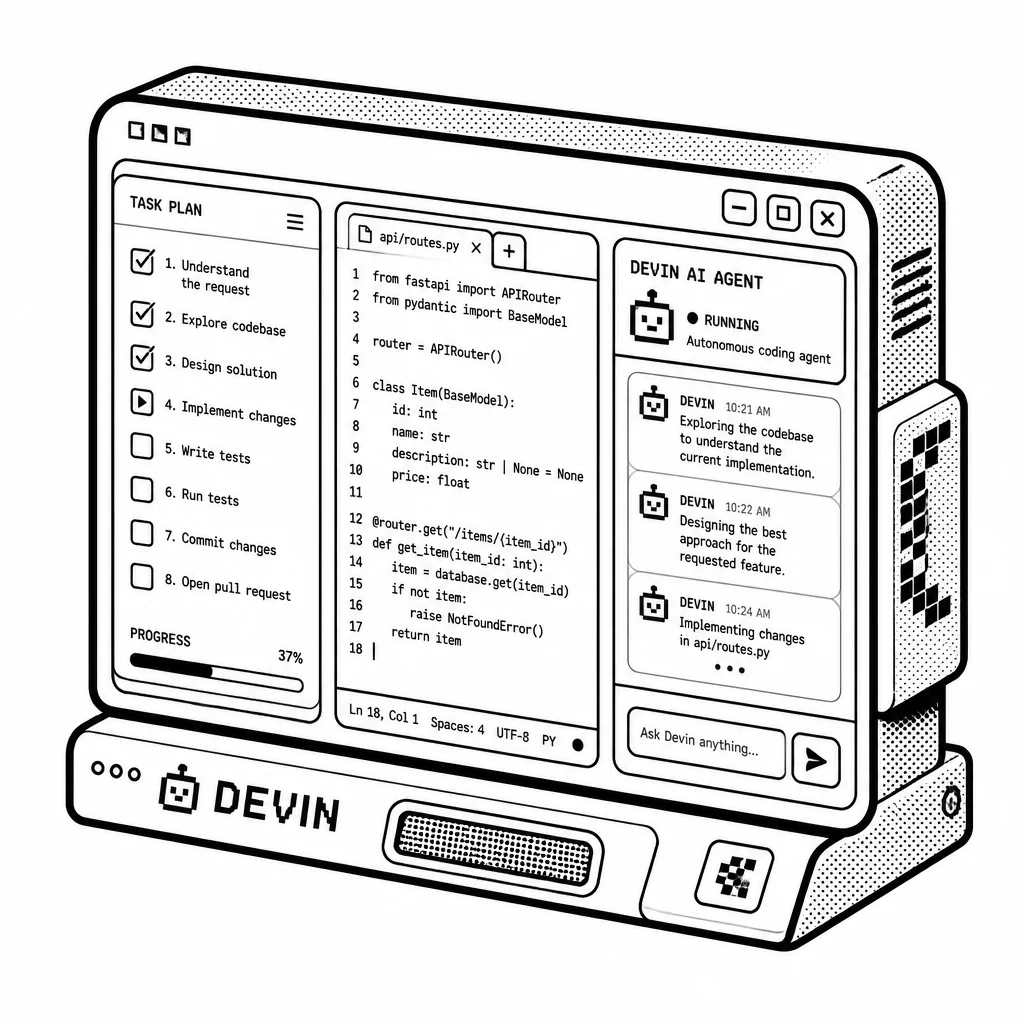
The company sells Devin to businesses, mostly software companies and big enterprises that want to speed up engineering work or handle the boring, repetitive parts of programming. Customers pay a subscription, and the pitch is simple: Devin lets a small team of human engineers get more done, or lets a company clear a backlog of small tasks without hiring more people. It competes in a crowded field — Microsoft with GitHub Copilot, Alphabet with its Gemini coding tools, and a swarm of startups all racing to automate pieces of software development. Cognition's bet is that Devin's ability to work independently, not just autocomplete, sets it apart. Cognition became famous fast, partly through a wild bit of startup theater. In early 2024 it showed off Devin in a demo video that went viral, and the company was barely a few months old. Then in 2025 it did something stranger: it bought Windsurf, a rival AI coding startup, after that company's founders were partly poached by Alphabet. The deal made Cognition a bigger, more serious player almost overnight. The company is private and venture-backed, with investors including Founders Fund, and it has raised hundreds of millions of dollars at a multibillion-dollar valuation. It has also drawn skepticism — critics note that AI agents like Devin still stumble on complex, messy real-world code, and that flashy demos can oversell what the tool actually does day to day.
The big question hanging over Cognition is whether "AI software engineer" becomes a real category or just a feature that bigger platforms swallow up. Every major AI lab and code-hosting company is pouring money into automated programming, and the tools are improving quickly. Cognition's edge rests on how good Devin actually is in the trenches, how well it plugs into a company's existing workflow, and whether businesses trust an autonomous agent with their code. If they do, the payoff could be enormous, because software is expensive to build and every company needs more of it. If they don't, Devin risks becoming an impressive demo rather than the way code gets written.
Saved answer · last researched 4 Nov 2026
BIG PICTURE
Cognition says its own AI now writes more than 90% of its production code
- 90% Code written by Devin
- 10% Code still written by human engineers
A year ago, Devin wrote 13% of the code inside Cognition, the company that sells it. Now the company says its own software engineer writes more than nine in ten lines it ships. The figure is self-reported, so treat it with care, but it hints at the pitch Cognition takes to banks and carmakers: software work can largely run without a human at the keyboard. Source: Forbes, data from 2026
Timeline
Three Medalists Start a Crypto Company
Cognition began with three friends who were among the best young programmers in the world, gold medalists at the International Olympiad in Informatics. They started in a New York apartment as a cryptocurrency company, a plan that went nowhere once ChatGPT showed up. The smarter bet was obvious: use AI to write and fix software itself. So they pivoted to AI coding, aiming at a very hard problem.
Devin, the First AI Software Engineer
The idea became a product called Devin, launched as the world's first AI software engineer. You describe a project in plain language, and Devin plans it, writes the code, finds the bugs, and tests the whole thing on its own. This was a big leap, and the launch, plus a small early funding round, turned three unknown medalists into a global name in AI coding.
A Unicorn in a Month
Devin's hype was so loud that investors rushed in. Just a month after that first round, Founders Fund led a huge round at a two-billion-dollar valuation. The company's price jumped from a few hundred million to two billion in about a year, all on the promise of Devin.
Cognition Buys Windsurf
When Google hired away Windsurf's CEO and core team, Cognition stepped in and bought what was left: the product, the brand, the intellectual property, and the remaining staff. The deal doubled Cognition's revenue and brought in hundreds of big business customers. It also gave the company a second product, an AI coding editor to sit alongside Devin. Within two months, its valuation had jumped from four billion to about ten billion. That set the stage for what came next, which would shock even the optimists.
A $26 Billion Valuation
A massive funding round valued Cognition at twenty-six billion dollars, with revenue racing along at an annual pace near half a billion. The most striking part: Devin was now writing the vast majority of Cognition's own code. Big names like Citi, Goldman Sachs, Mercedes-Benz, and the U.S. military were customers. The tiny apartment project had become a serious business.
A $48 Billion Round
Cognition closed another round, more than two billion dollars, led by a16z and Accel. It valued the company at forty-eight billion dollars, with revenue nearing nine hundred million a year. Three years from a crypto pivot, it stood as the leading independent AI coding agent company. The founders had found the problem worth solving, and then some.