Understand any stock in simple English
Enter a ticker to learn what the company does and how it makes money.
Cloudera, Inc.
Cloudera sells data and AI platform software that helps large organizations store, manage, and analyze their data across cloud and on-premises systems.
Cloudera sells software that helps big organizations make sense of their data. Its platform lets companies store huge amounts of information, run it through analytics and now AI tools, and do it all on their own servers, in the cloud, or a mix of both. Think of it as plumbing for corporate data: the customer's data flows in from many sources, and Cloudera's software cleans, organizes, and protects it so that analysts and AI models can actually use it.
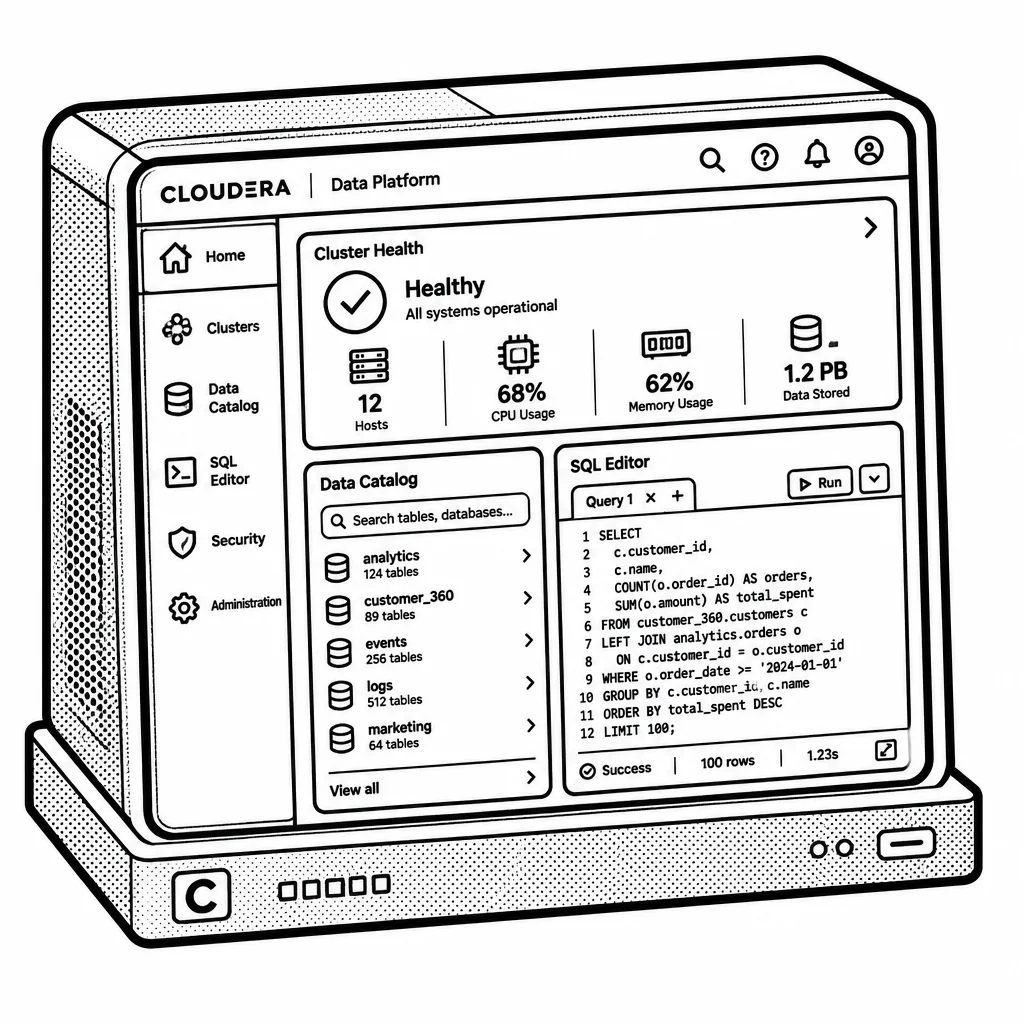
The company's roots are in Hadoop, the big-data technology that exploded in the late 2000s. Cloudera built a business around making that open-source software usable for enterprises, and at one point it was one of the hottest names in Silicon Valley. That journey ended in one of the quieter outcomes in tech history: Cloudera went public in 2017, then in 2021 it was taken private in a $5.3 billion deal by the private equity firms Clayton, Dubilier & Rice and KKR, so its shares no longer trade. Today a private-equity-owned company, it sells to large enterprises and public sector organizations, especially those in regulated industries like finance and healthcare that need tight control over their data. It fights for those customers against cloud giants like Microsoft, Amazon, and Alphabet, plus rivals such as Snowflake and Databricks that were born cloud-first. Cloudera's pitch is choice: customers keep their data wherever it lives, including aging on-premises systems, rather than being forced onto one cloud vendor.
The main tension in the business is that the market has moved fast toward cloud-native tools, squeezing older on-premises giants. Cloudera has responded by pushing its platform hard on AI, betting that strict data governance requirements will keep large organizations with it. That bet is the whole story now: the founders, the IPO, and the stock ticker are gone, and what remains is a private software company trying to stay useful in an AI-saturated world.
Saved answer · last researched 14 Nov 2026
BIG PICTURE
98% of IT leaders have scrapped at least one AI project over bad model behavior
- 98% IT leaders who pulled back an AI deployment
- 2% IT leaders who have not pulled back an AI deployment
Nearly every company that tried to put AI to work in production has had to pull one deployment back after a failure, a hallucination or some other unexpected behavior. Cloudera sells the software that stores and governs data underneath those AI projects, so its pitch is that careful groundwork prevents these stumbles. The company commissioned the survey itself, which is worth keeping in mind. Source: Cloudera State of Enterprise AI 2026 (Wakefield Research), data from 2026
Timeline
Four Engineers Start Cloudera
In 2008, four engineers from Google, Yahoo, Facebook, and Oracle started Cloudera in California. They saw something the tech world was missing: the tools for handling huge amounts of data would soon spread past internet companies into banks, insurers, and hospitals. The software itself, Hadoop, was free and open source, so Cloudera gave the product away and made money selling support and consulting around it.
Hadoop's Creator Joins
A few months later, Doug Cutting, one of the people who created Hadoop, joined the company. He had insisted on keeping Hadoop open, which is why the whole industry pitched in to improve it. That convinced the founders to bet the company on it.
A New CEO Takes Over
In 2013, founder Mike Olson stepped back from running the company, moving to chairman and chief strategy officer. Tom Reilly, who had run another software company, took the CEO job.
Intel Bets Big
The next year, Intel put in about $740 million for roughly a fifth of Cloudera. The deal valued the company at $4.1 billion, more than double what it was worth just ten days earlier, and made Intel its largest shareholder. It was a giant bet that Hadoop and big data were the future.
The IPO Comes In Low
Cloudera went public in 2017 at $15 a share, valuing it at about $1.9 billion. That was a down round: its private investors had valued it at $4.1 billion a few years earlier, so the market was pricing it at roughly half. The public markets were already less starry-eyed than Intel had been.
The Cloud Eats Hadoop
After the IPO, the share price kept sliding as sales fell. The problem was the cloud: customers were moving their data work to services from Amazon, Snowflake, Google, and Microsoft instead of running Hadoop on their own machines. The very shift the founders had predicted, data going everywhere, was now working against the company's core product.
Cloudera Merges With Hortonworks
In early 2019, Cloudera closed a $5.2 billion merger with its big Hadoop rival, Hortonworks. The two leading big data companies became one under the Cloudera name, with Cloudera's shareholders owning 60% and Tom Reilly staying as CEO. The idea was that two leaders could do together what neither could alone.
The Stock Craters
It did not go that way. Disappointing results arrived alongside news the CEO was leaving with no permanent replacement, and the share price fell more than 40% to an all-time low. Customers had paused purchases while waiting for the new Cloudera Data Platform, and investors began asking a hard question: why merge two money-losing companies when the cloud giants were coming for both?
Taken Private
In 2021, two private equity firms, KKR and Clayton, Dubilier & Rice, bought Cloudera and took it off the public market for about $5.3 billion. The retreat reflected the same pressure that had haunted the stock: the cloud giants and customers' changing habits.
A New Leader Under New Owners
Two years later, in 2023, Charles Sansbury became CEO, now running the company for its private equity owners rather than public shareholders.
The Private AI Pivot
Under private ownership, Cloudera rebuilt its story around three ideas: cloud anywhere, AI anywhere, and data anywhere on Apache Iceberg. The target is private AI and keeping data inside regulated industries. By 2026 the numbers were strong, with new business up 50% and revenue around $1 billion, but a layoff of 10–15% of the workforce showed who was now in charge: owners who wanted profit soon, not just growth.