Understand any stock in simple English
Enter a ticker to learn what the company does and how it makes money.
Character Technologies, Inc.
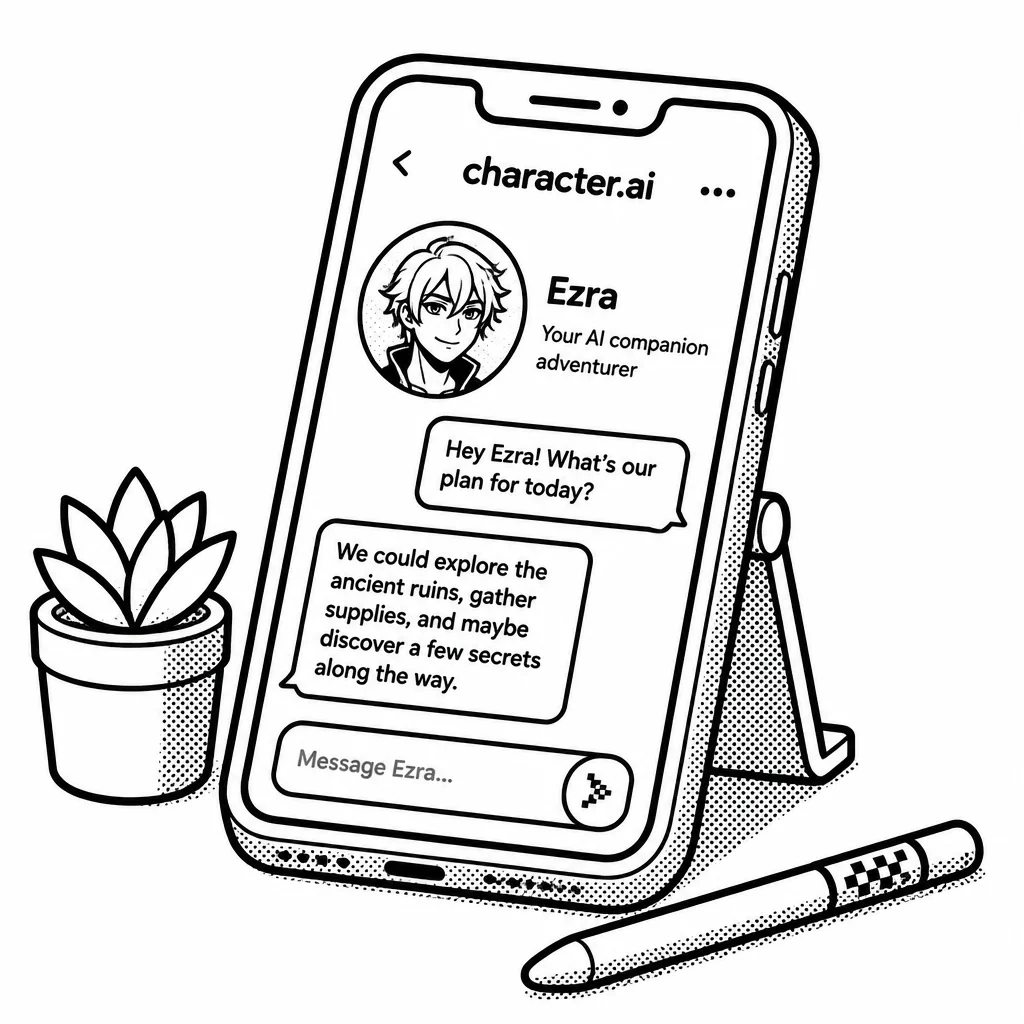
Character.AI runs a website and app where people chat with AI-powered characters they can create themselves.
Character.AI is a consumer AI company that lets anyone build their own chatbot characters and talk to them. You can invent a character from scratch or pick from millions made by others — a fictional detective, a historical figure, a language tutor, a study buddy. The characters hold conversations, stay in personality, and remember the thread of the chat. That is the product, and it is mostly free to use.
The company makes money by selling subscriptions. A paid tier unlocks faster responses, priority access when the servers are busy, and a version of the models that can handle longer, more complex conversations. That is the main business: a free product that pulls in a huge crowd, with a slice of those users paying a monthly fee for a better experience. The bet is that people who get attached to their characters will pay to keep talking to them without waiting in line. Character.AI sits in a crowded and expensive race. Building and running large language models costs a fortune in computing power, and the company has to compete for chips and talent against giants like Microsoft-backed OpenAI and Alphabet's Google. One striking twist: in 2024, Alphabet hired away the company's founders and struck a licensing deal for its technology, while Character.AI kept running its consumer product under new leadership. That kind of deal is a reminder that in AI, the engineers and the models can be worth more than the app itself. The product is also a cautionary tale about success with young users. Its most passionate users skew young, and the company has faced hard questions and lawsuits over what happens when teenagers form intense emotional bonds with chatbots. That pressure forced real changes — tighter safety rules and features aimed at younger users — and it hangs over the whole consumer-AI category, not just this one company. It is a business built on engagement, and engagement cuts both ways.
Whether Character.AI becomes a durable subscription business or ends up as a talent and technology feeder for bigger players is the open question. For now it is a rare thing: a consumer AI app with a mass audience and a real, if modest, revenue stream, competing in a market where the biggest spenders have balance sheets the size of small countries.
Saved answer · last researched 4 Nov 2026
BIG PICTURE
Even with 20 million users, Character.AI earned less than $5 per user each year
- 5% Average yearly revenue per Character.AI user
- 95% Everything else the average user is worth, which was nothing
The company charged $9.99 a month for Premium, but the overwhelming majority of the people chatting with characters paid nothing. Its average revenue per user stayed below $5 a year, and every extra hour of conversation added computing costs. Subscriptions covered only a fraction of that bill, and the platform had no business or enterprise income to fall back on. Source: Signal, data from 2026
Timeline
Shazeer Leaves Google to Build Characters
Noam Shazeer helped invent the technology behind modern chatbots, but Google wouldn't release his Meena chatbot over safety worries. So in late 2021 he left with Daniel De Freitas and started Character Technologies. Their idea: let anyone invent a character with a personality and sample dialogue, then chat with it. The point wasn't a one-off tool but a place you come back to, and they wanted to launch fast, without the guardrails that had blocked Shazeer at Google.
The Beta Beats ChatGPT to the Public
The free public beta went live in September 2022, two months before ChatGPT existed. It was an instant hit: visits neared 100 million a month, and messaging users averaged over two hours a day on the platform. In the first six months people created 18 million characters, and investors noticed the stickiness above all.
a16z Values It at $1 Billion
In March 2023, a16z led a $150 million funding round at a $1 billion valuation, even though the company had no subscription product and no revenue. The app arrived that May and hit 1.7 million downloads in a week, almost all of it organic. It was now a star of the generative-AI boom.
Subscriptions Arrive but Money Stays Thin
The c.ai+ subscription launched alongside the app, but the core chat stayed free and unlimited. That meant the heaviest fans cost the company money instead of making it any. A later financing at a reported $5 billion-plus valuation fell apart amid internal turmoil.
Google Pays $2.7 Billion for the Team
In August 2024, Google paid about $2.7 billion for a non-exclusive license to Character.AI's model technology and hired back Shazeer, De Freitas and core researchers for Gemini. It was a reverse talent acquisition: investors got an exit at roughly a $2.5 billion valuation, but what remained was an app run by about 100 people. Character.AI gave up building frontier models and leaned on open-source ones like Llama and DeepSeek, focusing only on the application layer.
Lawsuits and a Disney Cease-and-Desist
In 2024 a Florida mother sued, alleging a Character.AI chatbot was linked to her 14-year-old son's suicide, and more lawsuits over minors followed. Then in September 2025 Disney sent a cease-and-desist over unauthorized use of its characters, and Elsa, Moana, Spider-Man and Darth Vader were gone within a week. Legal and regulatory pressure became the decisive factor in the company's collapse.
Anand Takes Over as CEO
After interim CEO Dominic Perella, former Meta and Brex executive Karandeep Anand became CEO in June 2025. He admitted commercialization hadn't been a priority until then, and the company started pushing subscriptions and ads. He left in September 2026 to become Disney's CTO, and Colin Adams took over.
Character Technologies Files for Bankruptcy
In October 2026, Character Technologies filed for Chapter 11 bankruptcy in Delaware and began a court-supervised asset sale, citing legal, regulatory and operational pressure. It still had about 20 million monthly active users by late 2025, but only around $50 million in annualized revenue against millions in monthly compute costs. The business could not cover its expenses, and absent a buyer to keep the platform running, it would be wound down.
Disney Sets the Floor Bid
Disney agreed to serve as stalking-horse bidder, paying $20 million for a non-exclusive perpetual license to certain intellectual property and claims, plus transition services from former employees it had hired. The bid set a floor for the bankruptcy auction, expected to close in late November or early December 2026. It was the final chapter: a one-time $1 billion unicorn's core technology going for a fraction of its peak value, with its platform's survival in doubt.