Understand any stock in simple English
Enter a ticker to learn what the company does and how it makes money.
Binance Holdings Ltd.
Binance runs the world's largest cryptocurrency exchange, where people buy, sell, and trade digital coins and tokens.
Binance is the world's biggest cryptocurrency exchange — a marketplace where people swap digital coins like Bitcoin and Ether, park their crypto, and trade all sorts of tokens against each other. If you want to buy crypto, it's one of the first places you'd look. It's not a bank and it doesn't issue coins; it's the venue, the matching engine, and increasingly the whole arcade around the coins.
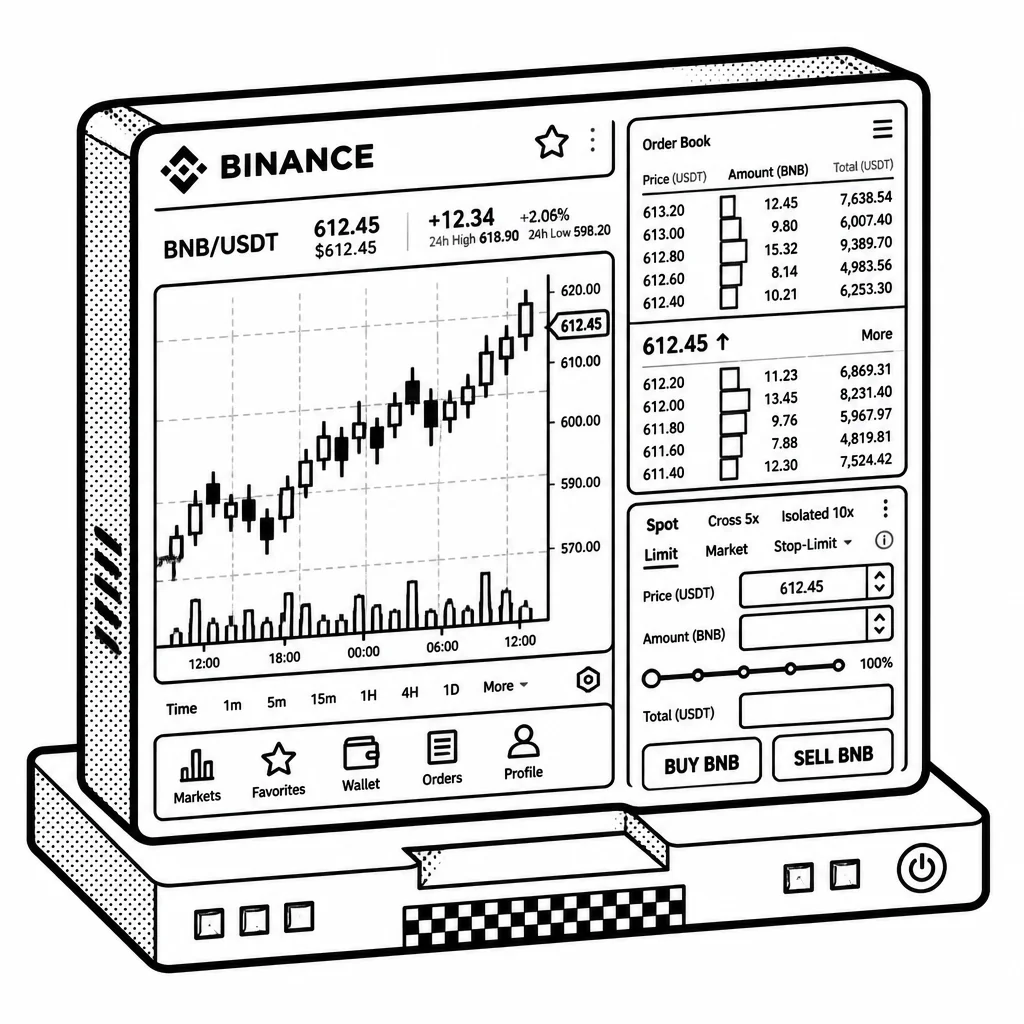
How it makes money is straightforward. Every trade on its spot market carries a small fee — a tiny slice of a huge volume adds up fast. Then there's the stuff wrapped around the trading: a suite of trading products, a stablecoin it issues, a venture arm, and a payment card. Its founder Changpeng Zhao — everyone calls him CZ — built it around 2017, and it grew to become the largest exchange in the world by trading volume. Users choose it for deep liquidity (you can trade large amounts without moving the price much), a huge menu of tokens, and low fees. The messiness matters. Binance has spent years tangled in regulatory fights across the globe. In 2023 it pleaded guilty in the United States to money-laundering and sanctions violations and agreed to pay about $4.3 billion, one of the largest corporate penalties ever. Zhao stepped down and later served time in prison, and the company has since been rebuilding its compliance apparatus under new leadership. Its legal home base has also wandered — it has pointed to the UAE as its headquarters, a reflection of how crypto firms shop for friendlier jurisdictions.
What sets Binance apart is scale and reach: volume, token listings, and products the rest of the industry copies. What makes it vulnerable is the same thing that makes any exchange fragile — it lives on trust and regulatory goodwill, and the crypto market's wild swings can dry up trading activity overnight. Competitors like Coinbase have leaned into regulation as a selling point, while Binance has had to prove it can play by the rules it once skirted.
Saved answer · last researched 4 Nov 2026
BIG PICTURE
Most of Binance's users now come from emerging markets, not rich countries
- 77% Users in emerging markets
- 23% Users elsewhere
Binance says 77% of its users live in emerging markets, and those customers make up 83% of people using more than one of its products. The exchange earns most of its trading fees from places where a single funded account can stand in for a patchy banking system, which is why it keeps adding payments, savings and tokenized stocks rather than only coin trading. Source: Binance Research, data from 2026
Timeline
Two Founders Launch Binance
Changpeng Zhao, known to everyone as CZ, and Yi He started Binance in Shanghai. They launched it with a clever little hook: a coin of their own, Binance Coin, that gave users a discount on trading fees. It worked. Within six months, Binance was the biggest crypto exchange in the world by trading volume.
China Cracks Down and Binance Moves
China then slammed the door on the crypto market, so Binance packed up. It moved its headquarters from country to country, landing in places friendly to crypto like Japan, Malta, and the Cayman Islands.
Binance Hits a Billion-Dollar Valuation
That same year, Binance's value passed a billion dollars, and it opened offices in Malta, Bermuda, and Jersey. A company without a real home was becoming very big, very fast.
Binance Buys Trust Wallet
Binance bought Trust Wallet, one of the most popular crypto wallets. That mattered because a wallet is where people actually hold their crypto, so Binance was no longer just a place to trade. It was starting to build a whole ecosystem around itself.
Hackers Steal $40 Million in Bitcoin
A big security breach hit Binance: hackers grabbed thousands of Bitcoins worth about forty million dollars. Binance stopped withdrawals and deposits but kept trading going, and it promised to pay customers back from its safety fund. The lesson was clear: if you hold other people's money, you had better have a cushion.
Lockdowns Send Crypto Soaring
Then came COVID. Stuck at home with lockdowns and travel bans, people around the world went looking for something to do with their money, and a lot of them picked crypto. Binance rode that wave perhaps better than anyone, and by the end of 2023 it handled at least half of all crypto trading worldwide.
FTX Collapse Lifts Binance
When rival exchange FTX collapsed, Binance's position got even stronger. Other exchanges simply could not keep up with its share of the market.
CZ Steps Down and Binance Pays a Fine
The good years came with a bill. CZ resigned as CEO after pleading guilty to anti-money laundering and sanctions violations, and Binance agreed to pay the US Department of Justice a fine of several billion dollars so it could keep operating. Richard Teng, the company's head of markets, took over as CEO.
Teng Says No to an IPO
New CEO Richard Teng made one thing clear: Binance would not go public. It had plenty of money and did not need to raise more. Instead, he focused on making the company look more like a normal business, with a board, better relations with regulators, and finally a real headquarters.
Yi He Becomes Co-CEO
Binance brought back co-founder Yi He, a crypto veteran who had worked at OKCoin and helped build Binance from the start, as co-CEO alongside Richard Teng. The idea was to keep the company innovative while making its regulatory base sturdier. It was the biggest leadership change since CZ left.
The Biggest Crypto Theft on Record
Then came the worst test yet. Hackers drained an estimated six billion dollars from Binance's hot wallets, the largest crypto theft ever. Binance said North Korean hackers did it with social engineering and malicious software, and it refilled almost all of what was stolen from its safety fund and its own treasury, so users would not lose money.
Binance Hires a New CFO
After that hack, Binance named Justin Yek as its new chief financial officer, replacing Kaiser Ng, who had held the job for several years. Yek came from the payments firm Airwallex and investment banking at Citi and Morgan Stanley. The message was clear: tighter financial controls and more professional governance.