Understand any stock in simple English
Enter a ticker to learn what the company does and how it makes money.
Atom Computing Inc.
Atom Computing builds quantum computers that use atoms as their core building blocks.
Atom Computing is a quantum computing company. It builds machines that store and process information using individual atoms, and it sells time on those machines to researchers, governments, and businesses that want to run experiments too complex for ordinary computers.
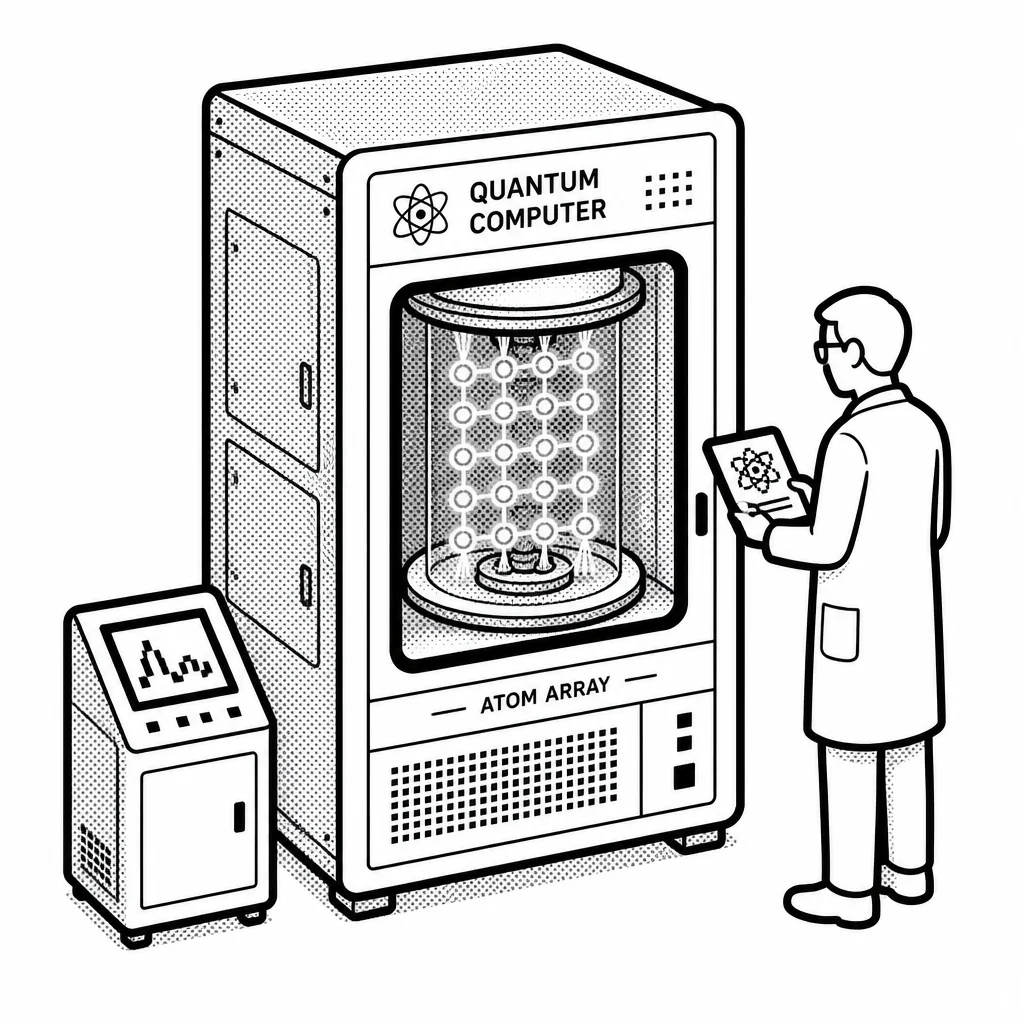
The core idea is a little like a tiny, controllable grid of atoms. The company traps atoms in place using lasers and then uses those atoms as "qubits," the quantum version of a computer bit. Atom Computing has focused on a specific type of atom, ytterbium, because it can hold quantum information for a usefully long time and can be controlled with light. The pitch is that this design is easier to scale up — to pack more qubits into one machine — than some rival approaches. Its systems are aimed at making quantum computing practical rather than just a lab curiosity.
Founded in 2018 and based in Berkeley, California, the company is privately held and funded by venture investors rather than selling stock to the public. That means it lives or dies on research milestones and fundraising, not quarterly earnings. It has raised money from investors and has been building toward larger, more capable systems as the quantum field heats up. The big risk is the same one facing every quantum startup: the technology is still early, customers are few, and the field is crowded with better-funded players like IBM and Microsoft, plus a wave of rival startups. Atom Computing's bet is that its atom-based design gives it an edge in scaling — but whether that bet pays off is still an open question.
Saved answer · last researched 10 Nov 2026
BIG PICTURE
Atom Computing holds about 5% of the neutral-atom quantum market, as five firms take 85.9%
- 5% Atom Computing
- 80.9% Other top four players
- 14.1% Others
The market for quantum computers built from neutral atoms is young and tightly held. In 2025, five companies including Atom Computing collected about 85.9% of global revenue in that niche, and Atom Computing's slice was roughly 5.0%. Most of its money today comes from selling early machines and government contracts, so a small share of a small market is the starting line rather than the finish. Source: Global Market Insights, data from 2025
Timeline
Two Founders Bet on Neutral Atoms
Ben Bloom and Jonathan King started Atom Computing in 2018 with $5M in seed money. Bloom had looked at the different ways to build a quantum computer and decided neutral atoms were the best path to one that could scale up. That is the bet the whole company was built on.
Phoenix Prototype and Series A
A few years in, the company raised $15M and showed off a 100-qubit prototype called Phoenix. It worked by trapping neutral atoms with light, which proved the founding idea was more than a theory.
Series B and a Home in Boulder
Next came $60M in Series B money and a commercial operations facility in Boulder, Colorado. The team moved into a 40,000-square-foot building, with most of its people based there, so the company now had room to grow beyond a lab.
Past 1,000 Qubits
Then Atom announced a second-generation machine with over 1,000 qubits. That made it the first quantum company to cross the 1,000-qubit mark for a universal gate-based system, a signal that its approach could keep getting bigger.
First Commercial Sale to QuNorth
In 2025 the company sold its first on-premises quantum computer to QuNorth, a Nordic quantum initiative, working with Microsoft. It was the industry's first commercial sale of a logical-qubit quantum computer, meaning a machine built around error-protected qubits rather than raw ones.
Error Correction and Fresh Capital
The company then showed full quantum error correction using a toric code, becoming the first neutral-atom company to do it and only one of two in the industry. Around the same time it passed $300M raised in total, including a $100M Series C led by Third Point Ventures and a $100M letter of intent with the U.S. Department of Commerce.
DARPA Picks Atom for Final Stage
DARPA chose Atom to move to the final stage of its Quantum Benchmarking Initiative, with potential funding of up to $300 million. That stage will independently test whether the company's utility-scale neutral-atom computer can actually be built and run as designed.