Understand any stock in simple English
Enter a ticker to learn what the company does and how it makes money.
ALDI Nord Deutschland Stiftung & Co. KG
Aldi Nord is a discount supermarket chain that sells everyday groceries and household goods at very low prices.
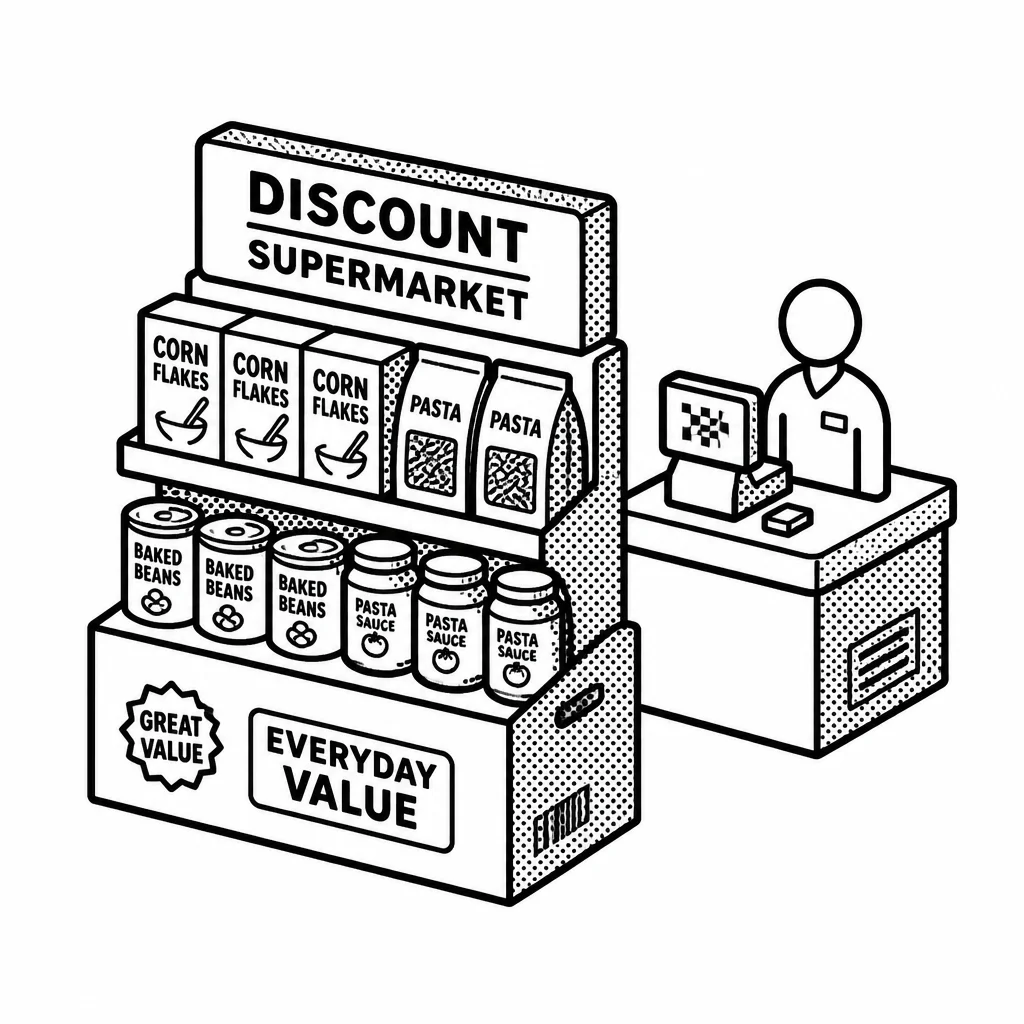
Aldi Nord is a discount supermarket chain. It runs thousands of no-frills stores across northern Germany and much of Europe, selling groceries, drinks, and household basics at prices that undercut traditional supermarkets. The whole idea is radical simplicity: a small selection of products, mostly the store's own brands, displayed on pallets still in their cardboard boxes. Shoppers bring their own bags, bag their own groceries, and often pay a small deposit to borrow a cart. All of that cuts costs, and the savings get passed to customers.
Here is the unusual part. Aldi is actually two separate companies. Aldi Nord covers the north of Germany and countries like the Netherlands, Belgium, France, Spain, Portugal, Poland, and Denmark. Aldi Süd covers southern Germany and markets like the US, UK, Ireland, and Australia. The two split in the 1960s when the founding Albrecht brothers had a disagreement over whether to sell cigarettes. Their territories have stayed separate ever since, and they are not the same business, even though shoppers see the same style of store. The company makes money the way any grocer does: it buys goods cheaply and sells them for a little more. The difference is how thin the margins are and how much it relies on volume. Aldi Nord keeps costs down by limiting choice, negotiating hard with suppliers, and running lean stores. Its own brands mean it does not pay for big-name marketing. Customers come for the low prices and stay because the quality of the own-brand goods is usually good enough. Competitors include other discounters and full-price supermarkets, and the German grocery market in particular is brutally price-competitive.
Aldi Nord is privately held, owned through a foundation structure tied to the Albrecht family, so it does not report detailed public financials or pay dividends to outside shareholders. That privacy is part of its character: the company is famously secretive. The business is steady and cash-generative, but it is not a growth story in the way a tech firm is. Its main risks are the thin margins of grocery retail, price wars with rivals like Lidl (part of the Schwarz Group, a private company), and the slow, expensive work of modernizing stores and expanding online. In short, Aldi Nord is a machine built to sell a lot of groceries for very little profit per item — and to keep doing it, quietly, for a very long time.
Saved answer · last researched 2 Nov 2026
BIG PICTURE
One in five German shoppers names Aldi Nord their favourite supermarket
- 19.8% German shoppers who name Aldi Nord as favourite
- 80.2% Shoppers naming any other retailer
In a survey of nearly 150,000 German app users, 19.8% picked Aldi Nord as their favourite supermarket, putting it second behind Aldi Süd's 24.4%. For a chain that sells plain groceries at low prices, that is a strong signal: shoppers are not loyal to fancy branding, they are loyal to the deal. Source: MarkenDetektive, data from 2026
Timeline
A Baker's Fresh Start
In 1913, Karl Albrecht senior opened a small baked-goods business in Essen, Germany, giving up his lodgings so he could marry and stand on his own feet. When World War I came, his wife Anna, who came from a merchant family, turned the shop into a food store. That little shop planted the seed of a simple idea the couple's sons would later scale across the country: put the customer first.
A Bigger Food Store
A few years later, the family widened what they sold and moved to a larger building in Essen, buying the property along with the shop. This bigger food store became the blueprint for the business concept their sons would eventually take nationwide.
The Sons Take Over
After World War II, the brothers Karl and Theo took over the family business and quickly pushed beyond Essen's city limits. Their plan was simple: a select assortment, good quality, and low costs, so they could offer the lowest prices.
Customers Serve Themselves
In 1954, the flagship store in Essen introduced self-service, at a time when the network already had dozens of shops. Customers liked picking their own goods, and the idea rolled out across the stores in the years that followed, proving a lasting success.
The Brothers Split the Map
As supermarkets and discount houses started crowding in, the brothers made a bold call: they divided the store network, with Karl taking the south of Germany and Theo the north. The two companies still worked closely together, and this line on the map still defines ALDI Nord and ALDI Süd today.
The Name ALDI Appears
The brothers brought their discount stores under one name, ALDI, short for Albrecht Diskont. Theo opened the first ALDI Nord market in Dortmund, built on a single principle: concentrate on the essentials and on the customers.
Across the Dutch Border
ALDI Nord stepped outside Germany for the first time, opening a store in Rotterdam in the Netherlands. The move grew the network sharply and quickly made ALDI Nord an important player in Dutch retail.
East Germany Opens Up
From 1990, East Germans could suddenly shop at ALDI Nord, starting with a market in Brandenburg that was briefly housed in an empty barn. ALDI Nord became one of the first discounters to set up in the former East Germany.
A Family Feud Stalls the Business
When founder's son Berthold Albrecht died, a years-long inheritance dispute over the foundations controlling ALDI Nord began, even reaching the courts. Investment decisions stalled, stores started to look outdated, and rival Lidl pulled ahead with modern branches, putting ALDI Nord on the defensive.
The Dispute Ends and the Stores Get a Facelift
Once the family dispute was settled, ALDI Nord pushed ahead with modernizing its store network, which had fallen behind. The discounter poured hundreds of millions into stores, logistics and IT, refreshing more than a hundred locations a year.
A Single Holding and a First CEO
With the family fight behind it, ALDI Nord reorganized its leadership and got its first CEO, Torsten Hufnagel, who had led the business since 2018 and was the architect of its Aniko modernization program. Operations came under a unified holding, the ALDI Nord Stiftung & Co. KG.
Revenue Jumps and Market Share Grows
ALDI Nord closed 2025 with group revenue up over 7% to more than 31 billion euros, gaining market share in every country, especially the Netherlands and Germany. It opened around a hundred new stores, modernized over two hundred locations, and invested roughly 1.5 billion euros in expansion and modernization.
A New CEO Takes the Reins
After 28 years, CEO Torsten Hufnagel stepped down at the end of 2025, handing the top job to Nicolás de Lope, who had been on the executive board since 2023. Under Hufnagel, ALDI Nord had sharpened its market presence and supply chain and sold off unprofitable segments like the Danish business.