Understand any stock in simple English
Enter a ticker to learn what the company does and how it makes money.
ProShares Short FTSE China 50
It is an exchange-traded fund that aims to deliver the opposite of the daily return of an index of large Chinese stocks listed in Hong Kong.
ProShares Short FTSE China 50 is a special kind of exchange-traded fund, or ETF, that lets an investor place a bet that big Chinese companies listed in Hong Kong will fall in value. Most funds simply buy stocks and rise when those stocks rise. This one is built to do the reverse: on any given day, if the FTSE China 50 Index drops one percent, the fund aims to gain roughly one percent, and if the index rises one percent, the fund aims to lose roughly one percent.
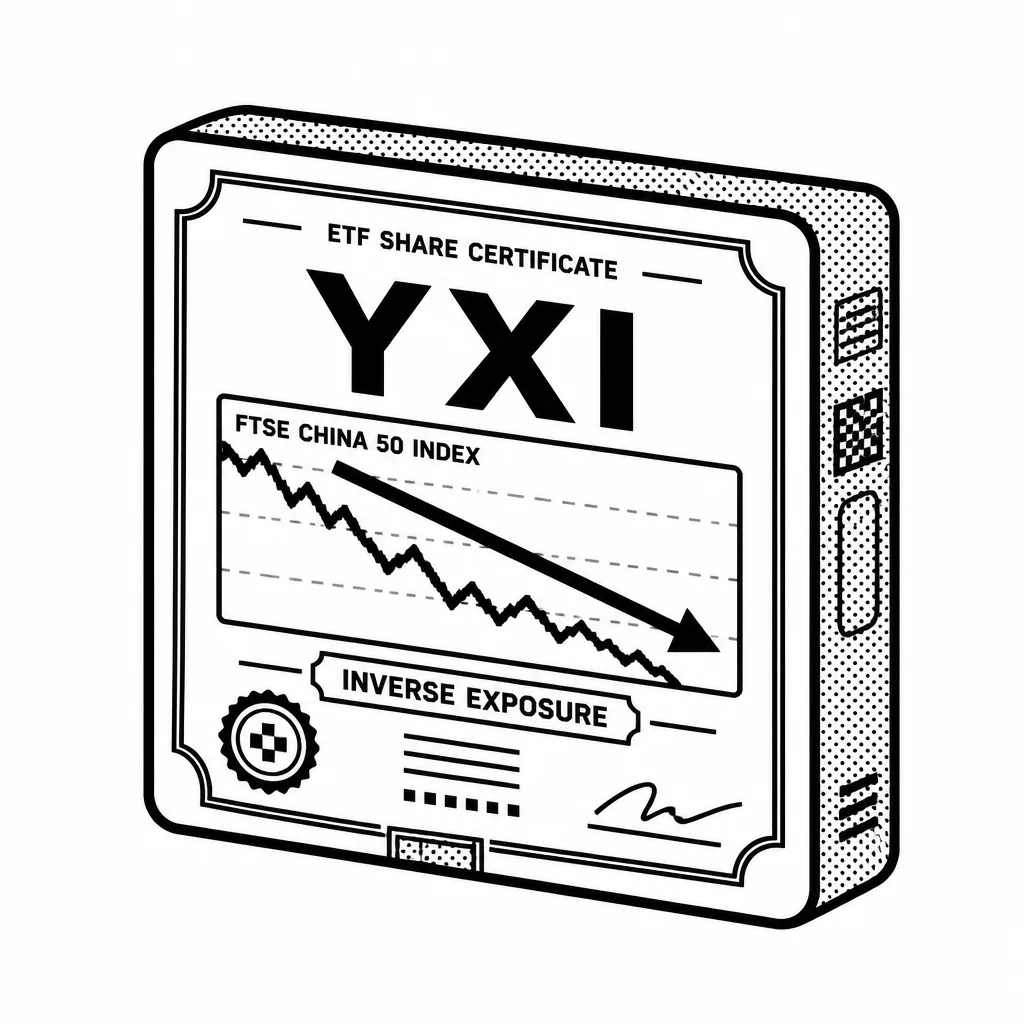
The FTSE China 50 Index tracks fifty of the largest and most liquid Chinese companies whose shares trade in Hong Kong — names familiar to many investors in businesses like internet platforms, banks, insurers, and energy. The fund does not own those shares directly. Instead, it uses financial contracts and other tools, largely swaps and futures, arranged with big banks and brokers, to create the inverse result. That is why it can offer a short position to ordinary investors who might not want to borrow shares and sell them short themselves. The word "daily" matters enormously. The fund resets its exposure every trading day, so its promise holds for one day only. Over weeks or months, compounding and the natural ups and downs of the market can make the fund's return drift far from a simple minus-one-times the index's cumulative move. In a choppy market that goes nowhere overall, a short fund can quietly bleed value even if the index ends flat. This makes it a tactical tool for short-term traders and hedgers, not a buy-and-hold investment.
ProShares, the fund's issuer, is a Maryland-based firm known for a wide menu of these specialized "inverse" and "leveraged" funds, and it collects a management fee for running the operation. The fund is listed on NYSE Arca. Because it is a niche trading vehicle rather than a business that sells products to customers, its fortunes rise and fall with Chinese market sentiment and with the daily mechanics of its contracts, and investors should treat it as a sharp instrument rather than a savings account.
Saved answer · last researched 16 Nov 2026