Understand any stock in simple English
Enter a ticker to learn what the company does and how it makes money.
Yimutian Inc.
Yimutian runs an online marketplace that connects farmers and food suppliers in China with buyers who need to purchase agricultural products in bulk.
Yimutian is a Chinese e-commerce company that operates a business-to-business marketplace for agricultural products. It connects farmers, cooperatives, and food suppliers with wholesale buyers like restaurants, supermarkets, and food processing companies. Think of it as a digital matchmaker for the food supply chain, linking the people who grow or gather produce with the businesses that need it in large quantities.
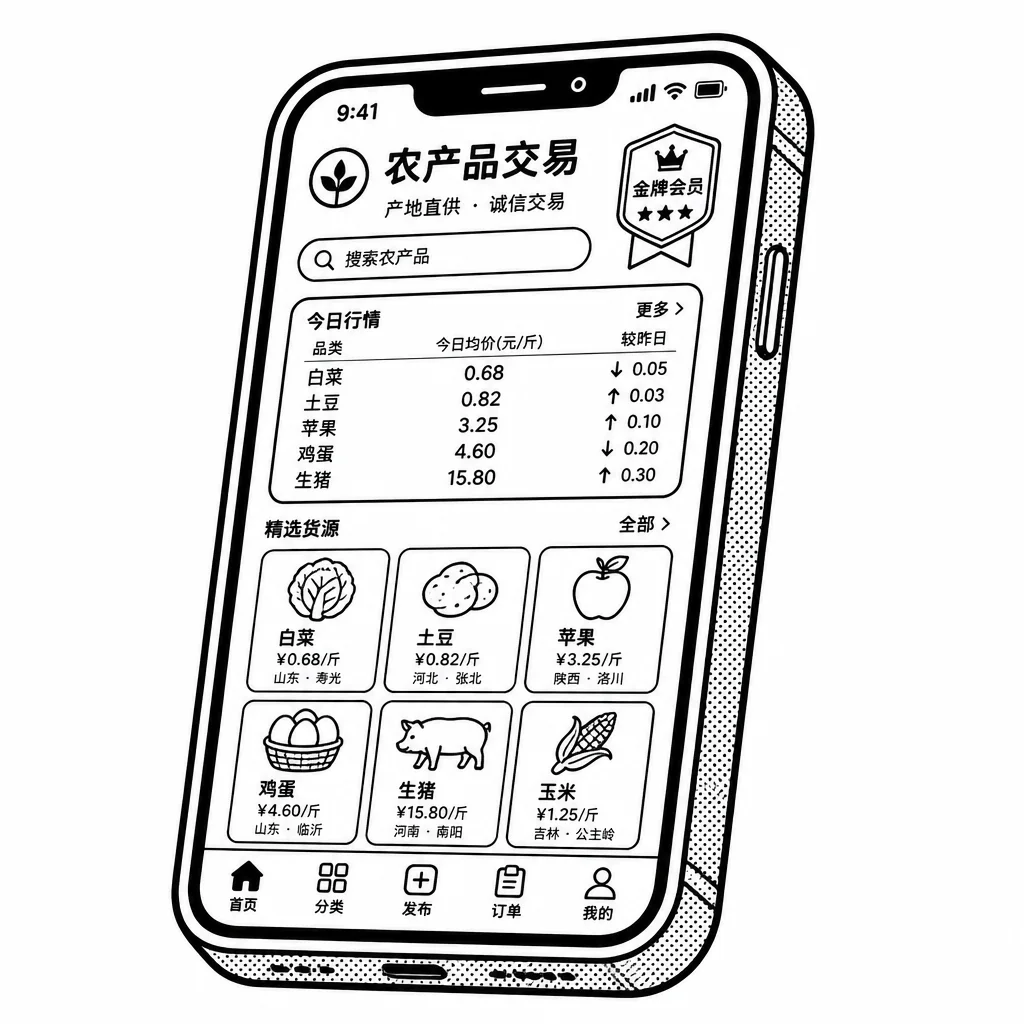
The company makes money by charging fees for transactions on its platform and by selling advertising and other services to sellers who want to stand out. It also offers logistics and financing services that help smooth the flow of goods and money between farmers and buyers. Customers choose Yimutian because it gives them a wider reach than local markets and helps them find better prices or more reliable supply.
Yimutian is a small company listed on the Nasdaq Capital Market. It operates in a huge but fragmented market—China's agricultural sector involves hundreds of millions of small farms—and faces competition from other online platforms and traditional wholesale channels. The business is still early in scaling, and its financial results have been modest, which is common for small-cap companies trying to build network effects in a tough industry.
Saved answer · last researched 10 Nov 2026
Timeline
A Baidu Veteran Goes Farming
Jinhong Deng had built internet products at Baidu, then tried an agricultural price-comparison site called Yi CunWang. In 2011 he founded Yimutian as a place where farmers and buyers could find each other and trade. It began as an information service and grew into a business-to-business platform spanning the whole agricultural chain, from field to buyer. His product background shaped the company's digital approach to a very old industry.
A Cayman Holding Company
In early 2014, Yimutian Group was incorporated in the Cayman Islands, wrapping the operating business in a holding structure. It was a quiet piece of housekeeping with a long throw: that entity would one day carry the company to a public listing.
Yimutian Lists on Nasdaq
Yimutian went public on Nasdaq in August 2025 at $4.10 per ADS, billed as the first Chinese agricultural full-chain internet company on global markets. The stock opened at $5.88 and then sagged to close its first day at $2.80, a drop of about a third, as investors worried about whether the company could make a profit. The IPO raised roughly $20-22 million, earmarked for expanding its offline 'Wolai' brokerage network and for going international.
Buying Xunxi for the Consumer
In November 2025 Yimutian agreed to buy all of Ningbo Xunxi Technology, an e-commerce operations provider, paying with cash and stock. The point was to move beyond a pure B2B platform into a B2B2C ecosystem, adding Xunxi's supply chain and channel muscle. Xunxi co-founder Lei Chen, a former Alibaba executive, was set to join as Vice President and General Manager of Retail.
Nasdaq Delisting Warnings
By May 2026 the warnings arrived: Nasdaq told Yimutian it was failing minimum market value and publicly held shares requirements, putting delisting on the table. The company asked for a hearing, which paused the process while it worked on a compliance plan. The notices laid bare just how small and financially strained the company was after its IPO.