Understand any stock in simple English
Enter a ticker to learn what the company does and how it makes money.
State Street SPDR S&P Emerging Markets ex-China ETF
It is a passively managed exchange-traded fund that gives investors a basket of emerging market stocks while leaving out companies based in China.
This is a fund, not a company that makes or sells things. It gives an investor one simple purchase that spreads their money across a wide slice of the developing world — India, Taiwan, Brazil, South Korea, Saudi Arabia and more — while deliberately skipping China. You buy shares of it on a normal stock exchange, just like a stock, and the fund manager uses that money to buy the underlying shares of hundreds of companies in those markets. What an investor gets is exposure to fast-growing economies outside China, without having to pick individual stocks or open accounts in a dozen foreign countries.
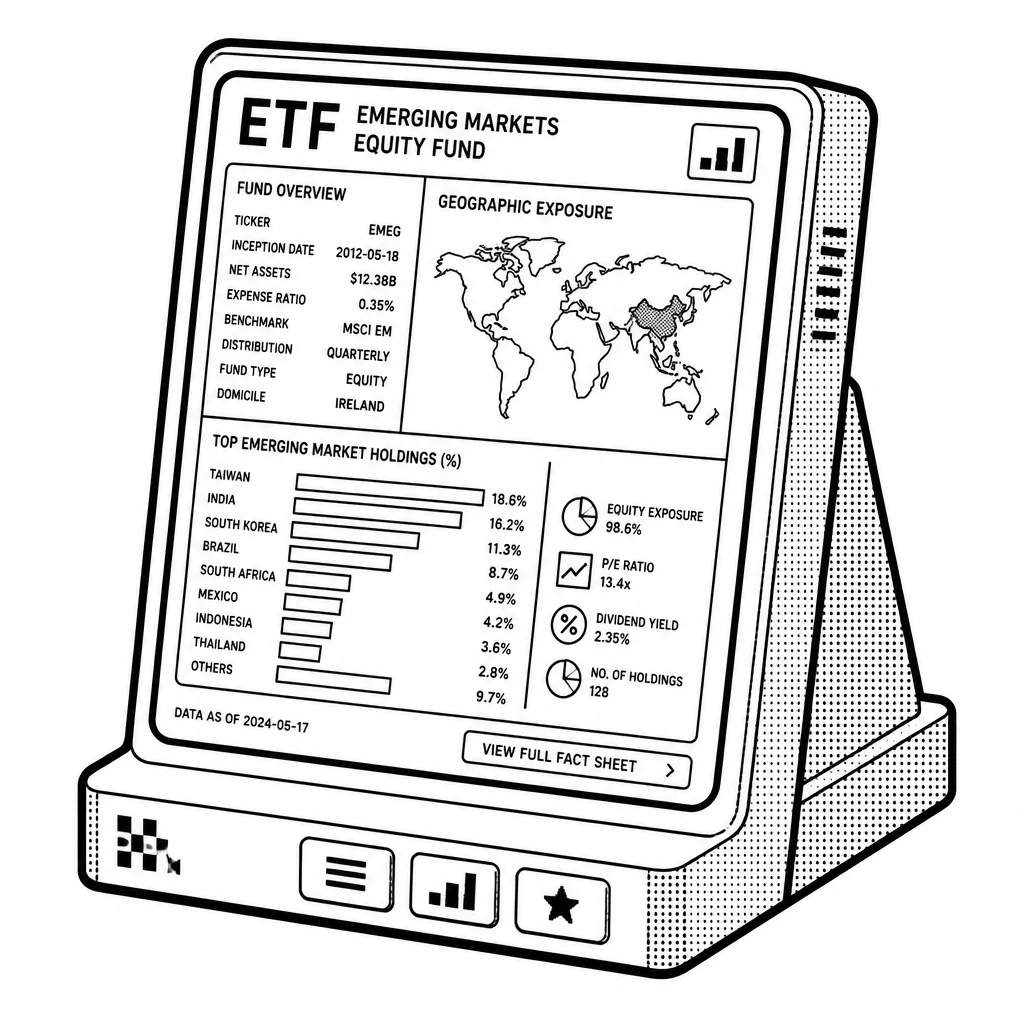
The fund tracks an index, which is just a published list of stocks with rules for which ones go in and how much of each to hold. Because it is "passively managed," nobody is paid to study companies and pick winners; the fund simply copies the index. That keeps costs low, and low costs matter a lot in indexing, because a cheap fund keeps more of the market's return for the investor. Investors usually reach for this sort of fund when they want the growth potential of emerging markets but are uneasy about concentrating too much in China, often because of political risk, regulatory crackdowns, or simply a desire to diversify away from the world's second-largest economy. The big trade-off is that by excluding China you also give up roughly a fifth of what a typical emerging markets fund would hold, and China has historically been one of the largest and most heavily traded pieces of that universe. You are also leaning more heavily on Taiwan, which means the fund's fate is tied closely to a single island and its giant chipmakers like Taiwan Semiconductor Manufacturing. Because these are foreign stocks, the fund carries currency risk too — a stronger dollar can eat into returns even when the underlying shares rise. It competes with larger, plain emerging markets funds such as iShares MSCI Emerging Markets and Vanguard FTSE Emerging Markets, and it is really a niche product for people who have a specific reason to want China out.
The fund is run by State Street, the giant Boston-based asset manager behind the SPDR family of funds, which includes the famous SPDR S&P 500 ETF SPDR S&P 500 ETF Trust. State Street earns its money by charging a small annual fee taken out of the fund's assets, not by you writing a check. The fund formerly went by a slightly shorter name before being rebranded, but the strategy — emerging markets, China excluded — stayed the same. The main thing to know is that this is a simple, low-drama tool: one ticket to own a broad set of developing-world companies, with one big country specifically left out.
Saved answer · last researched 16 Nov 2026