Understand any stock in simple English
Enter a ticker to learn what the company does and how it makes money.
TMX Group Limited
TMX Group runs Canada's main stock and derivatives exchanges, clearinghouses, and data services that let people trade shares and manage money safely.
TMX Group is the company behind the Toronto Stock Exchange and the TSX Venture Exchange, plus a handful of other marketplaces and clearing services. If you own a share of a Canadian company, or a fund that tracks Canadian stocks, there is a good chance it trades on a market TMX operates. TMX does not buy or sell stocks itself; it runs the venue where buyers and sellers meet, and it collects fees for that service.
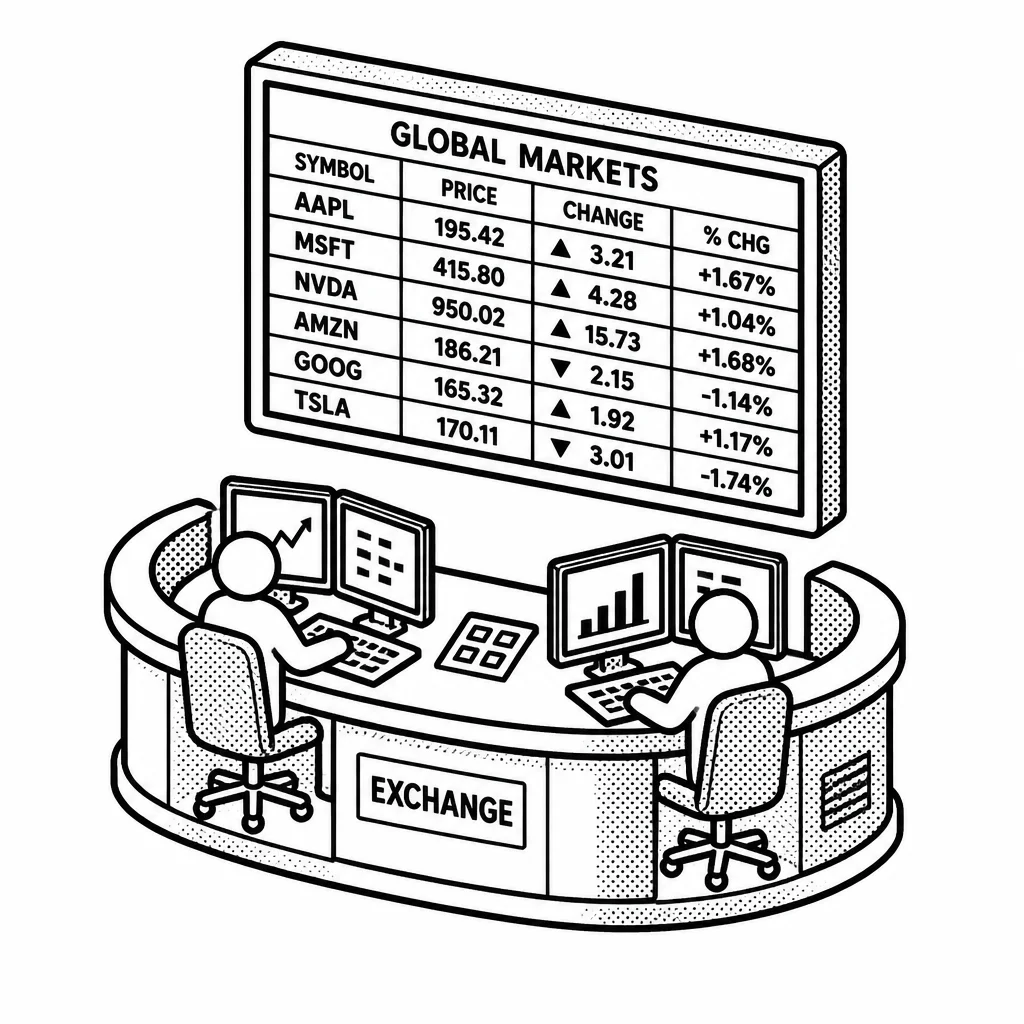
The business rests on a few connected pieces. Its exchanges match buyers and sellers and charge for each trade that clears through them. Its clearinghouses sit in the middle of trades, making sure money and securities actually change hands, which is the plumbing that keeps markets from seizing up. It also sells market data and analytics — the prices, volumes, and reference information that brokers, funds, and banks need to do their jobs. On top of that, TMX runs a trust business, serving companies that need a trustee or transfer agent, and it owns Trayport, a software platform used by energy traders, mostly in Europe. The core money-maker is trading and clearing activity on its markets, topped up by the steadier subscription-style revenue from data and analytics. Customers are brokers, banks, asset managers, and energy trading firms, and they stick with TMX largely because its exchanges are the deep, liquid home market for Canadian securities — a network effect that is hard to rebuild. That also marks the vulnerability: when trading volumes dry up, or when a rival venue or a new technology lures volume away, the fees shrink. TMX has spent years diversifying into data and software to smooth out those swings, and it has grown through acquisitions rather than just its home exchanges.
TMX pays out a meaningful share of its cash to shareholders as dividends, and it has a long record of raising that dividend. Its biggest shareholder is a consortium of Canadian financial institutions — the group that bought the exchange operator back in 2012 — so the banks and funds that use TMX are also, in a sense, its owners. The company's value rises and falls with market activity, but the underlying position — the toll booth on Canadian capital markets — is about as entrenched as a financial business gets.
Saved answer · last researched 12 Nov 2026