Understand any stock in simple English
Enter a ticker to learn what the company does and how it makes money.
ProShares UltraPro QQQ
It is an exchange-traded fund that aims to deliver three times the daily return of the Nasdaq-100 index.
ProShares UltraPro QQQ is a fund, not an operating company. It holds a basket of the stocks in the Nasdaq-100 — the hundred or so largest non-financial companies on the Nasdaq exchange, dominated by names like Apple, Microsoft, and Nvidia — and it is built to move three times as much as that index on any given day. If the Nasdaq-100 rises 1% in a day, this fund aims to rise about 3%. If it falls 1%, the fund aims to fall about 3%. Investors buy it when they feel bullish and want leverage without opening a margin account.
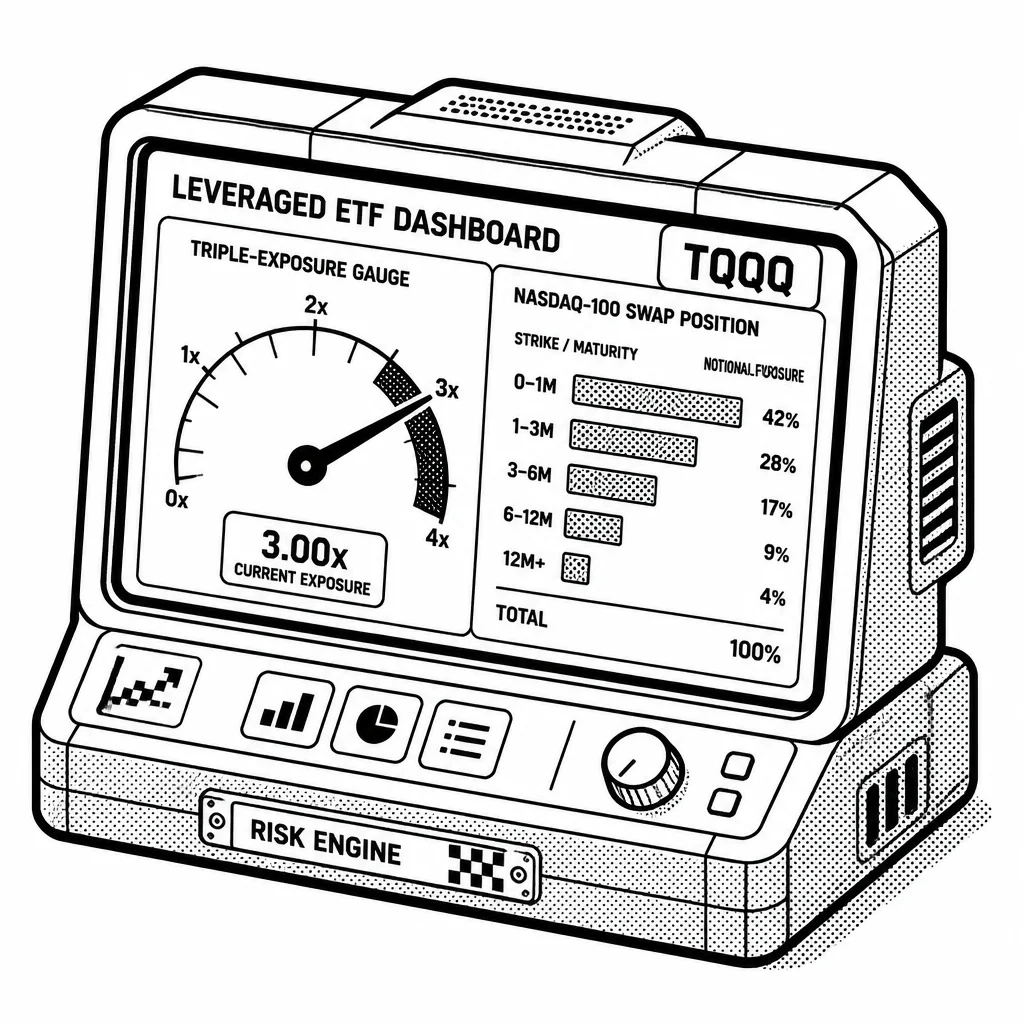
The mechanics are simpler than they sound. The fund doesn't just own the stocks outright; it uses swaps and other derivatives — contracts with big banks — to magnify the daily moves. That's what lets a modest pile of investor money behave like a much larger position. The trade-off is that this leverage resets every single day. Across weeks and months, compounding and the up-and-down chop of the market can pull the fund's returns far away from three times the index's longer-term return, sometimes in ways that surprise people. In a choppy market that goes nowhere, a triple-leveraged fund can lose money even when the index ends flat. The fund's sponsor is ProShares, a Maryland-based firm that specializes in these "geared" and alternative ETFs, and it collects an annual expense ratio of just under 1% of assets — higher than a plain index fund because running the daily swaps isn't free. The fund is enormous and heavily traded, which makes it easy to buy and sell, and it's a favorite tool for short-term traders and tactical bets rather than a buy-and-hold investment. Its sibling funds let people bet the other way too, aiming for triple the inverse of the index.
The honest warning label matters here. Because the leverage resets daily and the fund rebalances every day, holding it through volatility quietly bleeds value, and a sharp two-day drop can wipe out a large chunk of a position that a plain Nasdaq fund would have survived. Regulators and the fund's own documents stress it is meant for short holding periods. So the pitch is straightforward: it's a powerful, convenient turbocharger for a day-trade on tech stocks, and a dangerous thing to leave parked in a retirement account.
Saved answer · last researched 9 Nov 2026
Timeline
Three Times the Daily Move
In 2010, ProShares launched a fund with a simple but aggressive promise: three times the daily return of the Nasdaq-100, the index packed with big tech names. The idea was that investors could get magnified exposure while putting less cash at risk. It was the first and only ETF offering that triple daily dose of the tech index.
The 80% Wipeout
For years it looked like a genius product, until 2022 showed the dark side. The Nasdaq-100 fell about a third, but the fund dropped roughly 80%, because the daily resetting and the market's ups and downs chewed away at returns. Someone who held on needed a gain of over 400% just to get back to even. The lesson landed hard: this was a short-term trading tool, not a buy-and-hold stand-in for the index.
The World's Largest Leveraged ETF
By its fifteenth anniversary, the fund had become the biggest leveraged ETF on earth, with more than $25 billion in assets. It ranked among the most-traded ETFs in the country and, remarkably, was the best performer of any U.S. fund since launch. The wild ride had not scared people off; it had drawn them in.
Close to $40 Billion
Its assets kept climbing, reaching about $40 billion, and the fund was up 42% for the year while the plain Nasdaq-100 gained 18%. Notice that it delivered about 2.4 times the index, not three, thanks to the same volatility drag that hurt it in 2022. The leverage itself is built through swaps, futures and repo agreements, with heavy bets on the biggest tech companies.