Understand any stock in simple English
Enter a ticker to learn what the company does and how it makes money.
Sterling Infrastructure, Inc.
Sterling Infrastructure builds the physical foundations for America's growth — dirt work, roads, bridges, warehouses, data centers, and water systems — and gets paid a fixed price for each project.
Sterling Infrastructure is a construction company that does the unglamorous work that makes everything else possible. It moves dirt, pours concrete, builds highways and bridges, installs water and sewer pipes, and prepares land for giant warehouses and data centers. If a project needs hundreds of acres flattened and graded before a building goes up, Sterling's crews and machines are often the ones doing it.
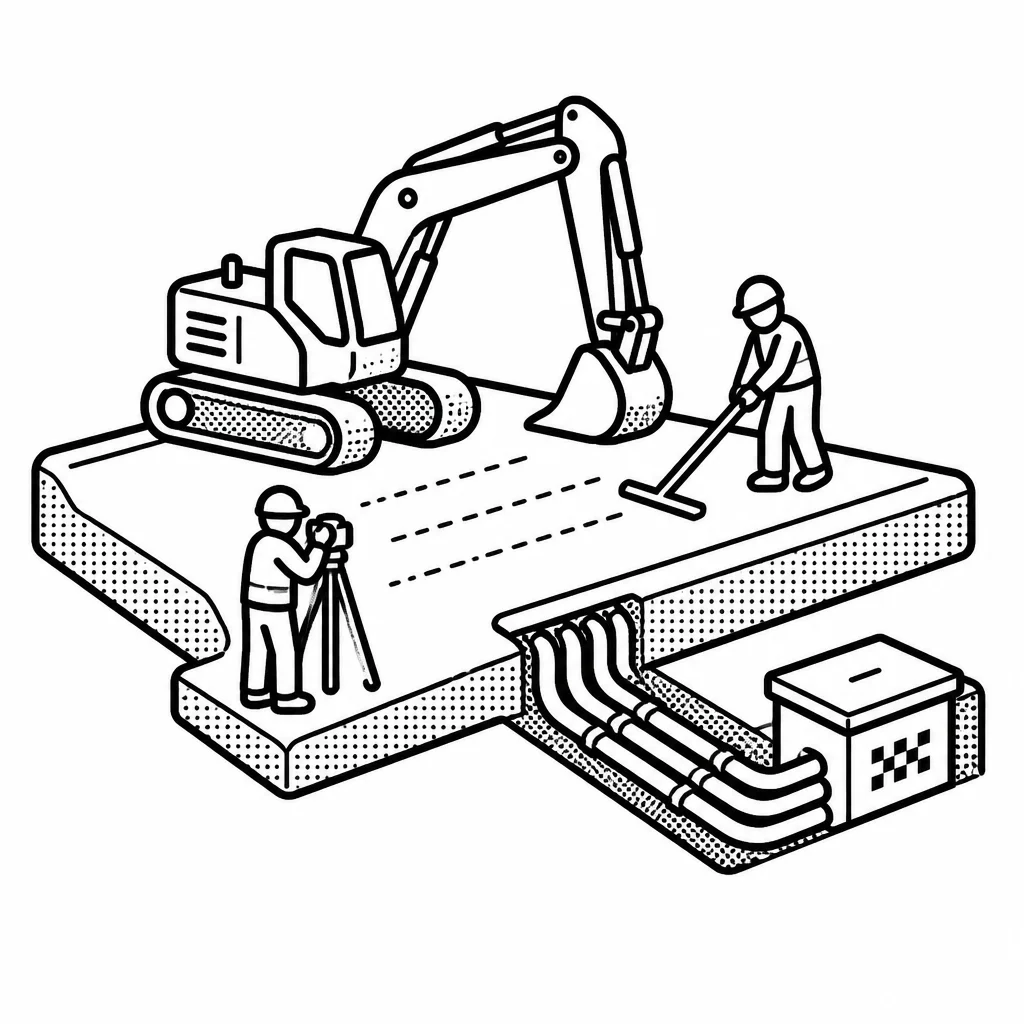
The company organizes itself around three main businesses. E-Infrastructure handles big civil projects: highways, bridges, aviation, water systems, and the site work for data centers — which has become a fast-growing slice as tech companies race to build computing campuses. Transportation Solutions builds and repairs roads, highways, and airport runways. Building Solutions does the concrete foundations and site preparation for warehouses, distribution centers, and other commercial buildings. The customers are mostly public agencies and large private developers, who pay fixed contract prices — so Sterling's profit depends on bidding jobs smartly and executing them without nasty cost overruns. A key part of Sterling's story is how it has repositioned itself. For years it was a fairly ordinary, cyclical contractor. More recently it has leaned hard into the data center and e-infrastructure boom, where demand is strong and projects are large. The work is not glamorous, but the barriers are real: heavy equipment, skilled crews, bonding capacity, and a track record with demanding customers. The main risk is the classic contractor's risk — fixed-price contracts can turn ugly if costs spike or schedules slip, and the business rises and falls with public infrastructure spending and private construction cycles. Sterling is headquartered in The Woodlands, Texas.
Timeline
A Michigan Road Builder Starts Out
The story starts small, in Michigan, where a predecessor company began building roads and bridges. Over the decades it grew into a heavy highway contractor, doing the kind of big, physical work that keeps cars and trucks moving. It was solid, useful, unglamorous business — the company poured concrete and built structures through a family of subsidiaries.
Joseph Cutillo Takes Over
By 2017, the company had a new leader: Joseph Cutillo became CEO, President, and a director. His job was not to keep things steady. He set out to remake the business over several years, and that transformation is the thread that runs through everything that follows.
A New Name for a New Company
The transformation showed up in the company's name. In 2022, Sterling Construction Company became Sterling Infrastructure, Inc., a change that reflected what it had actually become: not just a highway contractor but a provider of infrastructure solutions across three different segments. Same company, bigger ambition.
Sterling Buys CEC Facilities Group
Then came a deal that pushed the company further from its roots. Sterling paid about half a billion dollars for CEC Facilities Group, a specialist in electrical and mechanical engineering for data centers and semiconductor factories. This was not roadwork. It moved Sterling from preparing sites for buildings toward the high-tech electrical guts inside them.
The 2026 Stock Rollercoaster
The market loved the new Sterling — until it didn't. The stock ran from around $280 to a record above $1,000, then lost more than half its value. Here's the twist: the business itself was fine. The crash was about how much investors were willing to pay, spooked by fears that AI infrastructure spending might slow. Revenue in the E-Infrastructure segment was still up 192% from a year earlier, and backlog had reached $4.33 billion. The operations kept humming while the share price reset.
E-Infrastructure Becomes the Core
By 2026, the electrical side had taken over the company. E-Infrastructure made up about 70% of revenue, and Sterling projected roughly $4.7 billion in revenue for the year with operating margins near 17% — a huge jump from 3.4% in 2019. Nearly all of its opportunities in that segment were mission-critical projects, and total scoped work approached $8 billion. The road builder from Michigan had become something else entirely.
As for cash, Sterling historically reinvested most of its profits into equipment and acquisitions to grow, rather than paying big dividends. That approach paid off as its e-infrastructure segment grew and its stock rose sharply — one of the better-performing construction names of recent years.
Saved answer · last researched 8 Nov 2026
BIG PICTURE
More than 92% of Sterling's signed data-center and factory work is mission-critical projects
- 92% Mission-critical projects
- 8% Other E-Infrastructure work
Sterling's E-Infrastructure unit had $3.31 billion of signed backlog at the end of June 2026. Of that, 92% is tied to mission-critical projects: data centers, chip plants and advanced factories. That tells you where the money comes from. The company is no longer mainly a road builder. It gets paid to prepare the ground and wire up the campuses where AI computing is being built. Source: Zacks Investment Research via Yahoo Finance, data from 2026