Understand any stock in simple English
Enter a ticker to learn what the company does and how it makes money.
SPDR Portfolio S&P 600 Small Cap ETF
It is an exchange-traded fund that lets investors own a broad basket of small U.S. companies in one cheap purchase.
This is a simple product with a straightforward job: it gives you a slice of roughly 600 small American companies in a single trade. The fund tracks the S&P 600, an index built specifically for small-cap U.S. stocks — companies with market values generally in the range of a few hundred million to a few billion dollars. When you buy a share, you are not betting on one business; you are buying a tiny piece of hundreds of them at once, from regional banks and industrial suppliers to specialty retailers and healthcare firms.
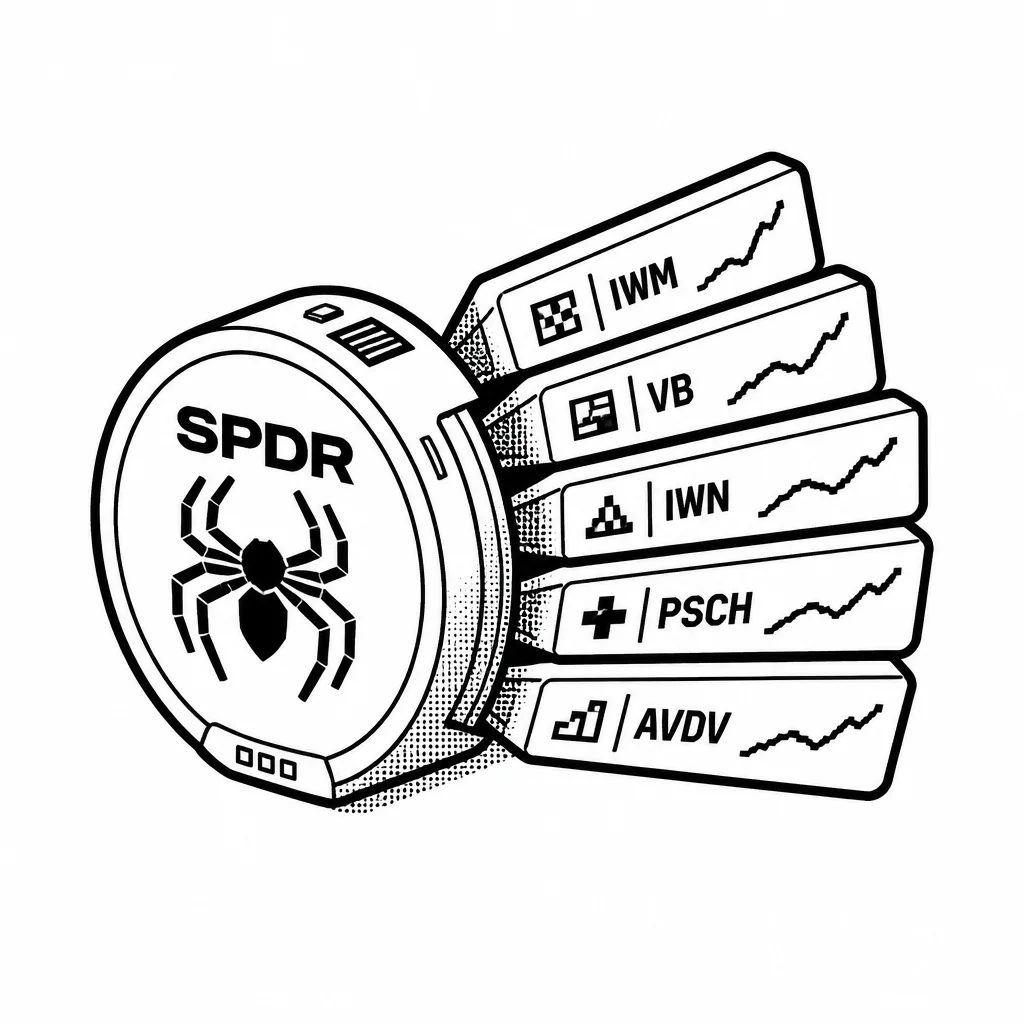
Who pays, and for what? Investors pay a small annual expense ratio, and in exchange they get instant diversification, professional index maintenance, and the ability to buy or sell shares on an exchange any time the market is open, just like a stock. The fund is sponsored by State Street, which runs the giant SPDR family of ETFs. That matters because scale keeps costs low and trading smooth. The main reason someone picks a fund like this over a rival small-cap ETF is price and liquidity — and this one is marketed as a low-cost way to own the small-cap segment. It helps to understand why small caps are their own thing. These are younger, scrappier companies than the household names in the S&P 500. They tend to grow faster in good times and fall harder in bad ones, and they often get bought up by bigger firms. The S&P 600 also screens for profitability before admitting a company, which filters out some of the shakiest businesses — a quieter detail that matters to investors comparing it with broader small-cap indexes.
The business itself is boring in the best way: it holds the stocks, rebalances when the index changes, and collects its fee. Its fortunes rise and fall with small-cap U.S. equities as a group, so its biggest risks are simply market risk and the possibility that small companies lag large ones for long stretches. It is a tool, not a story — a cheap, transparent way to own a corner of the market that most people would never assemble by hand.
Saved answer · last researched 16 Nov 2026