Understand any stock in simple English
Enter a ticker to learn what the company does and how it makes money.
Schwab Emerging Markets Equity ETF
It is an exchange-traded fund that gives investors a simple, low-cost way to own a broad basket of large and mid-sized companies in emerging markets like China, India, Taiwan, and Brazil.
The Schwab Emerging Markets Equity ETF is a basket, not a business. When you buy a share, you are buying a tiny slice of hundreds of companies across the developing world — banks in China, chipmakers in Taiwan, energy firms in Brazil, and software shops in India — all rolled into one investment you can trade like a stock. It is built for ordinary investors who want exposure to fast-growing economies without picking individual winners and losers or opening a brokerage account in each country.
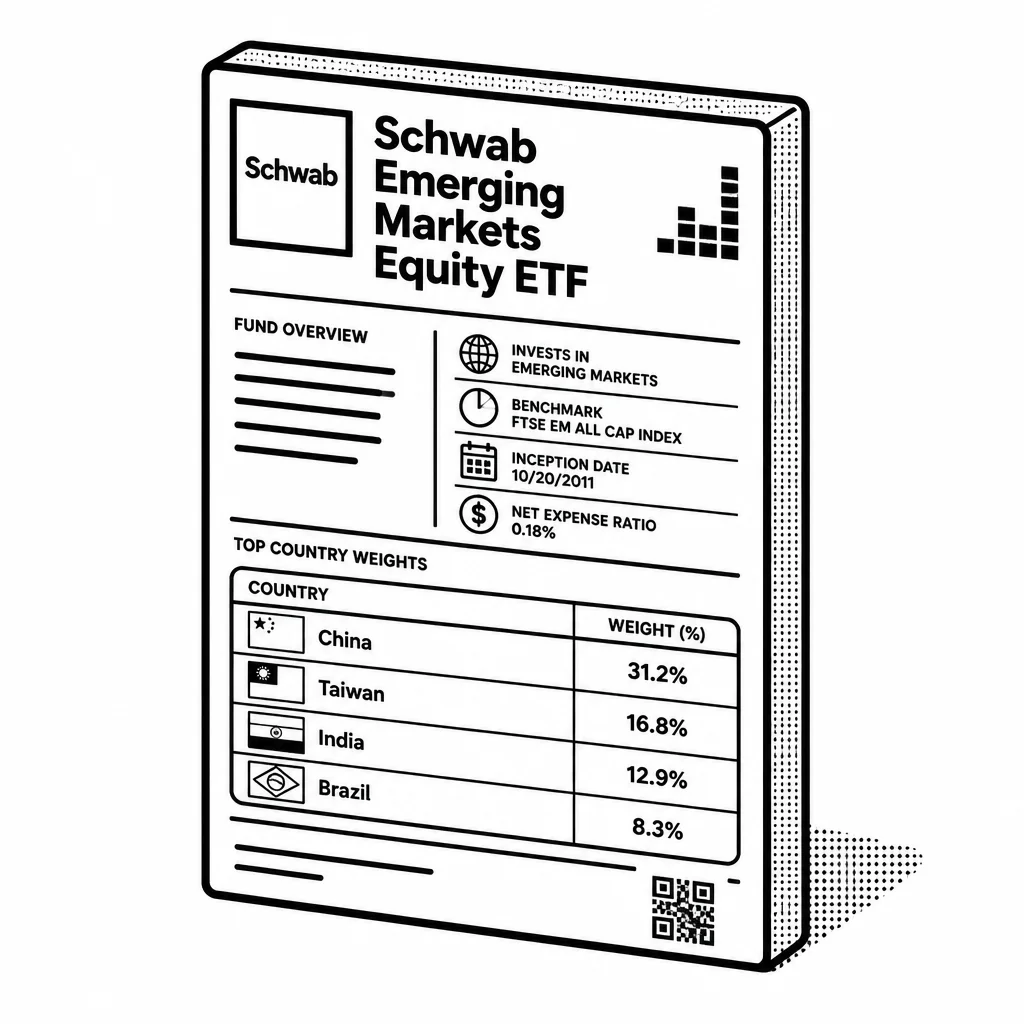
The fund tracks an index of large- and mid-cap emerging-market companies, weighted by market capitalization. In plain terms, that means money flows toward the biggest companies by total market value, so a giant like Taiwan Semiconductor Manufacturing carries far more weight than a smaller player. It is a passive approach: no manager is making bold bets, just holding the index and letting the market decide. That keeps costs low, and low costs matter a lot over decades, because every dollar of fees is a dollar not compounding for you. Emerging markets are the world's growth story and its drama in one package. They offer younger populations, rising middle classes, and faster economic growth than developed markets, but they also bring wilder swings, currency risk, and political surprises that can rattle prices overnight. The fund is a way to own that growth in a single click, but investors should expect a bumpier ride than a plain U.S. index fund. Schwab, the issuer, earns its keep through a small expense ratio rather than by trading the portfolio actively.
This is a tool, not a guru. It does not try to beat the market, and it does not protect you from it. It simply gives you a cheap, diversified seat at the table of the developing world — which for many long-term investors is the whole point.
Saved answer · last researched 16 Nov 2026