Understand any stock in simple English
Enter a ticker to learn what the company does and how it makes money.
Schwab International Small-Cap Equity ETF
It is an exchange-traded fund that gives investors a simple way to own a broad basket of small companies in developed markets outside the United States.
This is a fund, not an operating business. It holds hundreds of small companies based in developed markets outside America — places like Japan, the United Kingdom, Germany, and Australia — and sells itself to ordinary investors as a one-stop way to own that whole slice of the world in a single trade. When you buy a share, you get a tiny slice of all those companies at once, and the fund does the tedious work of tracking them for you.
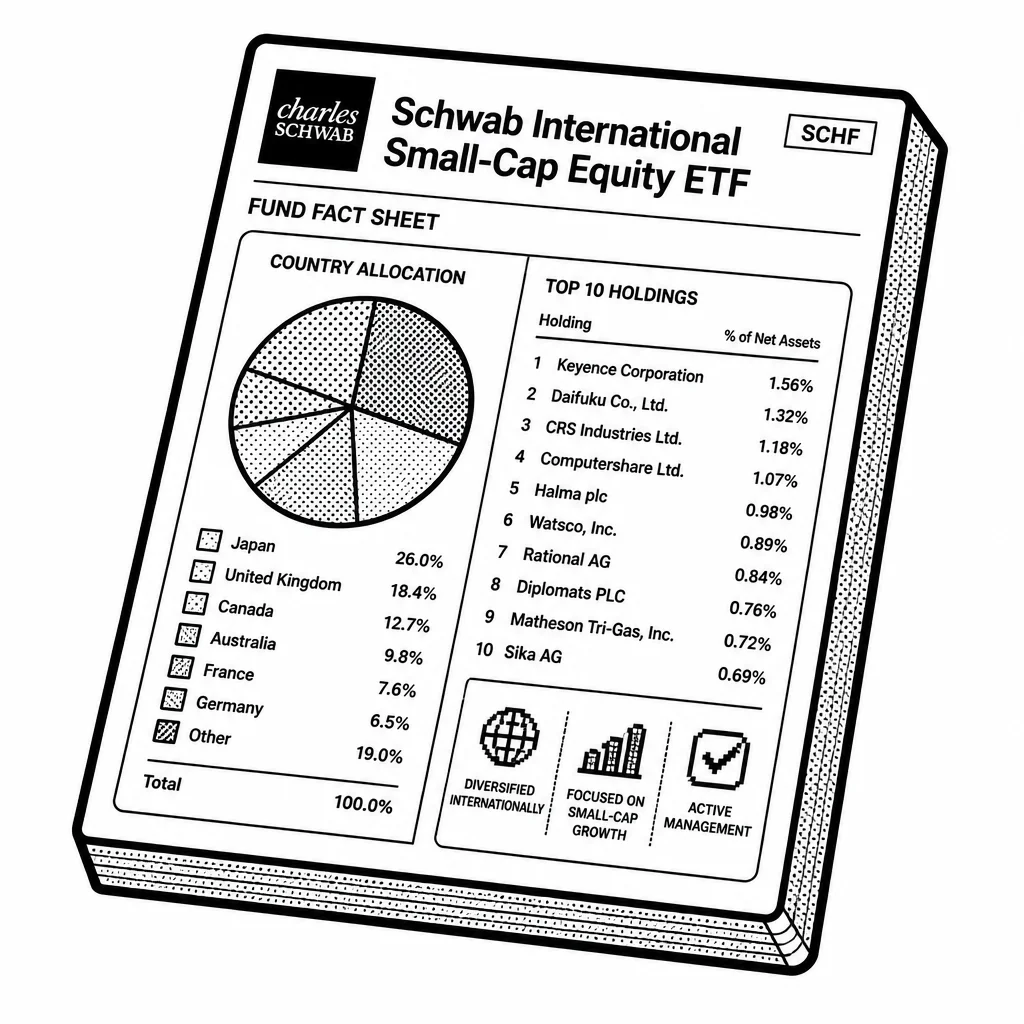
The appeal is diversification. Small companies in foreign markets can grow faster than the giant, well-known multinationals, and they often trade at lower prices relative to their earnings. But picking individual small foreign stocks is hard: the names are obscure, the paperwork is different in every country, and trading costs add up. This fund bundles that difficulty away, so an investor can add international small-cap exposure without becoming an expert on, say, a mid-sized Japanese machinery maker or a German industrial supplier. The fund is sponsored by Charles Schwab, the big brokerage, and it trades on NYSE Arca like a normal stock. It is passively managed, meaning it simply tries to match an index of developed-market small-caps rather than paying a manager to pick winners. That keeps costs low, which matters because foreign small-caps are a niche most investors only want a small helping of.
The catch is that "small-cap international" is a bumpy ride. Currency swings, thinner trading in faraway markets, and the fact that small firms are more fragile than giants all add volatility. It is best used as a seasoning in a diversified portfolio, not the main dish — a cheap, convenient way to reach a corner of the market that is otherwise a hassle to own.
Saved answer · last researched 16 Nov 2026