Understand any stock in simple English
Enter a ticker to learn what the company does and how it makes money.
EchoStar Corporation
EchoStar is a satellite communications company that provides TV broadcasting, satellite internet, and wireless services.
EchoStar is a satellite communications company that helps people get television and internet service, especially in places where regular cables and phone lines don't reach. The company operates a fleet of satellites that beam signals down to homes and businesses, and it also runs the equipment that receives those signals. You might know EchoStar through its Dish Network brand, which provides satellite TV to millions of American households, or through HughesNet, which sells satellite internet to rural customers who can't get cable or fiber.
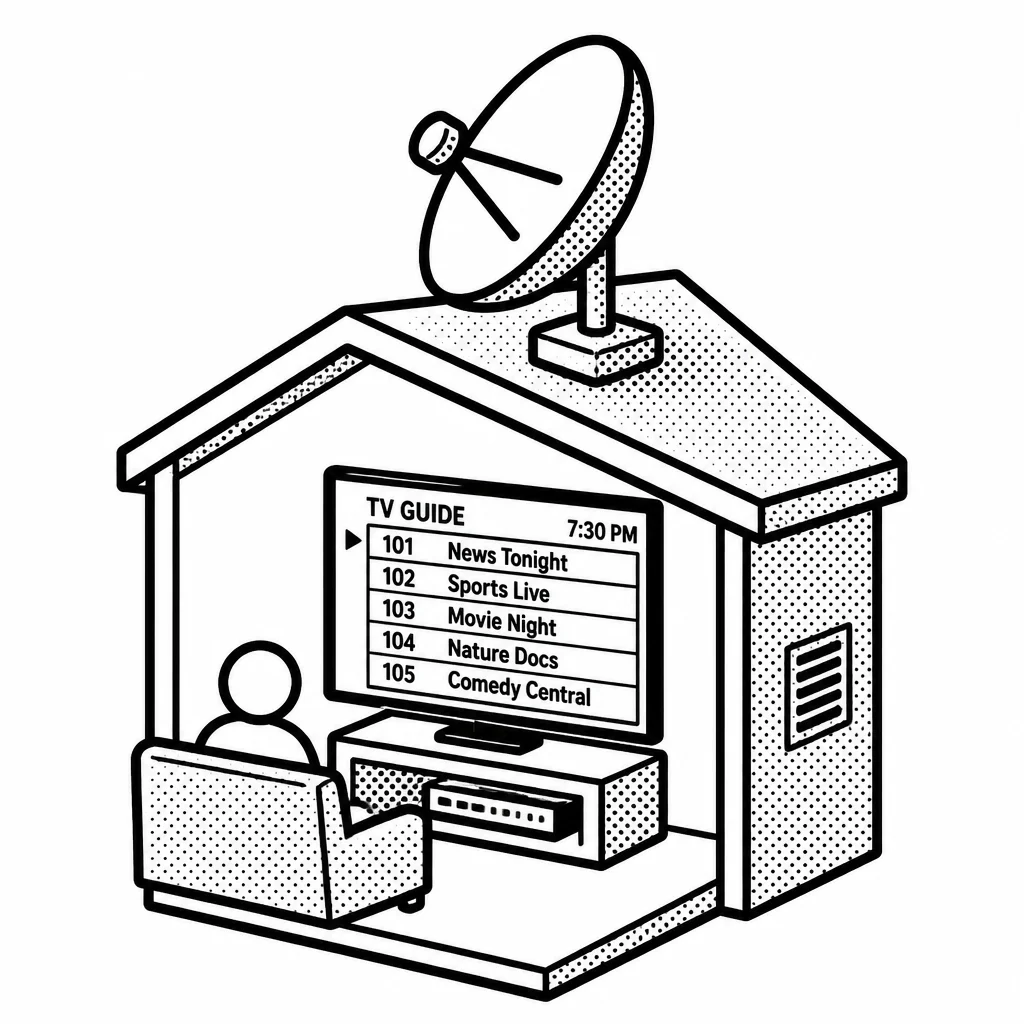
The business splits into a few main pieces. One part sells satellite television subscriptions, where customers pay a monthly bill to receive hundreds of channels beamed from space. Another part sells satellite internet service, which works similarly but delivers a two-way data connection instead of TV. EchoStar also owns wireless spectrum licenses—basically government permission to use certain radio frequencies—and has been building out a mobile network. The company makes money from monthly subscriptions, equipment sales, and increasingly from wholesale deals where other companies pay to use its spectrum or network. Here's the tricky part about EchoStar: it has been burning through cash and carries a heavy debt load. The satellite TV business has been shrinking as people switch to streaming services, and the satellite internet business faces new competition from low-orbit satellite constellations like those operated by SpaceX (which is private) and soon Amazon. EchoStar spent billions building a wireless network to meet government deadlines, and in 2024 it agreed to sell spectrum licenses to AT&T and Verizon for billions of dollars to raise cash. The company also sold its Dish TV business to DirecTV (a private joint venture) in a deal that combined the two biggest satellite TV providers.
The company's biggest challenge is managing the decline of older businesses while paying down debt and figuring out what comes next. EchoStar has valuable assets—satellites, spectrum, and millions of customers—but turning those assets into steady profits has proven difficult. The wireless buildout required enormous capital spending, and the company has had to sell pieces of itself to stay afloat. Whether EchoStar can stabilize its finances and find a growth path in a world moving away from traditional satellite services is the central question facing the business today.
Saved answer · last researched 10 Nov 2026
BIG PICTURE
EchoStar's satellite TV customers make up about 10% of America's traditional TV market
- 10% EchoStar's share of traditional U.S. TV market
- 90% Everyone else in traditional U.S. TV
About 5 million U.S. homes pay EchoStar for satellite television, roughly one in ten of the country's traditional TV subscribers. That base is the company's biggest moneymaker, yet it sits inside a market where streaming keeps pulling viewers away. EchoStar also counts 2 million Sling customers, a cheaper online option built for the same cord-cutting crowd. Source: Morningstar, data from 2026
Timeline
Three Founders and a Windy Day
In 1980, Charlie Ergen, Candy Ergen, and Jim DeFranco started EchoStar to sell satellite dishes to rural Americans the big cable companies never bothered to wire up. They believed people far from cities deserved TV too, and they delivered it straight from the sky. Early on, a gust of wind blew one of the company's two dishes into a ditch, but the founders climbed in and kept going. That stubbornness would define everything that came after.
EchoStar Wins a Spot in the Sky
Back in 1987, EchoStar had applied for a direct broadcast satellite license, and by 1992 it was granted a prized orbital slot above the western sky. Think of it as real estate in space: a fixed parking spot where a satellite can beam TV down to millions of homes. That spot set the stage for everything the company would build.
One Rocket, Fifty-Fifty Odds
Soon EchoStar put the whole company on the line with a single rocket launch, EchoStar I. The odds of success were roughly a coin flip. The rocket made it, and by March 1996 the first customers were watching, under a new name: DISH Network.
The Company Splits in Two
In 2008, EchoStar pulled itself apart. The consumer side, the part that sold TV service to homes, became its own public company under the Dish Network name. EchoStar kept the machinery behind the curtain: the satellites, the set-top box developers, and Sling Media. It was a clean divorce between the storefront and the factory.
EchoStar Buys Hughes
In 2011, EchoStar bought Hughes Communications, a leader in broadband equipment and services. The deal turned EchoStar into a global communications player and pushed it deeper into internet-from-space, not just television.
The Two Halves Reunite
In August 2023, DISH Network and EchoStar announced they would merge back together, with EchoStar buying DISH, and the deal closed at the end of that year. The storefront and the factory were one company again. The reunited EchoStar even debuted on the Fortune 500 list.
The One-Dollar Deal That Died
In September 2024, EchoStar agreed to hand Dish Network to DirecTV for a single dollar plus roughly $10 billion of debt, so it could focus on Boost Mobile and satellite connectivity. Then in November, DirecTV walked away, citing opposition from EchoStar's bondholders. EchoStar was left holding the debt, and the pressure was building.
Regulators and a Rival in the Wings
By 2025, the pressure was everywhere. The FCC was investigating whether EchoStar actually met the 5G buildout requirements attached to its spectrum licenses, and the company had missed over $500 million in interest payments, sparking fears of a bankruptcy filing. Meanwhile SpaceX was competing for the same 2 GHz band spectrum, making it harder for EchoStar to borrow money and stay afloat.
The Forty-Billion-Dollar Spectrum Sale
Then, in the summer of 2025, the story flipped. AT&T agreed to buy EchoStar spectrum licenses for $23 billion in cash, and SpaceX struck a roughly $17 billion cash-and-stock deal for other licenses. Together the two deals were worth around $40 billion. EchoStar said they would settle the FCC's questions and finally give it room to breathe.
Ergen Returns
CEO Hamid Akhavan, who took the job in 2022, resigned abruptly in July after the board discussed a change of strategic direction, following bankruptcy filings at Dish. In November, with the giant SpaceX spectrum deal in hand, founder Charlie Ergen came back as CEO. Now he runs EchoStar as Chairman, President, and CEO, keeping the decisions about money and spectrum in one pair of hands.