Understand any stock in simple English
Enter a ticker to learn what the company does and how it makes money.
Pasqal Holding SA
Pasqal builds quantum computers that use lasers to trap and control individual atoms, and sells access to these machines and the software that runs on them.
Pasqal is a quantum computing company. It builds machines that calculate in a fundamentally different way from ordinary computers, and it sells access to those machines plus the software and services that make them useful, to industrial companies, research labs, and governments.
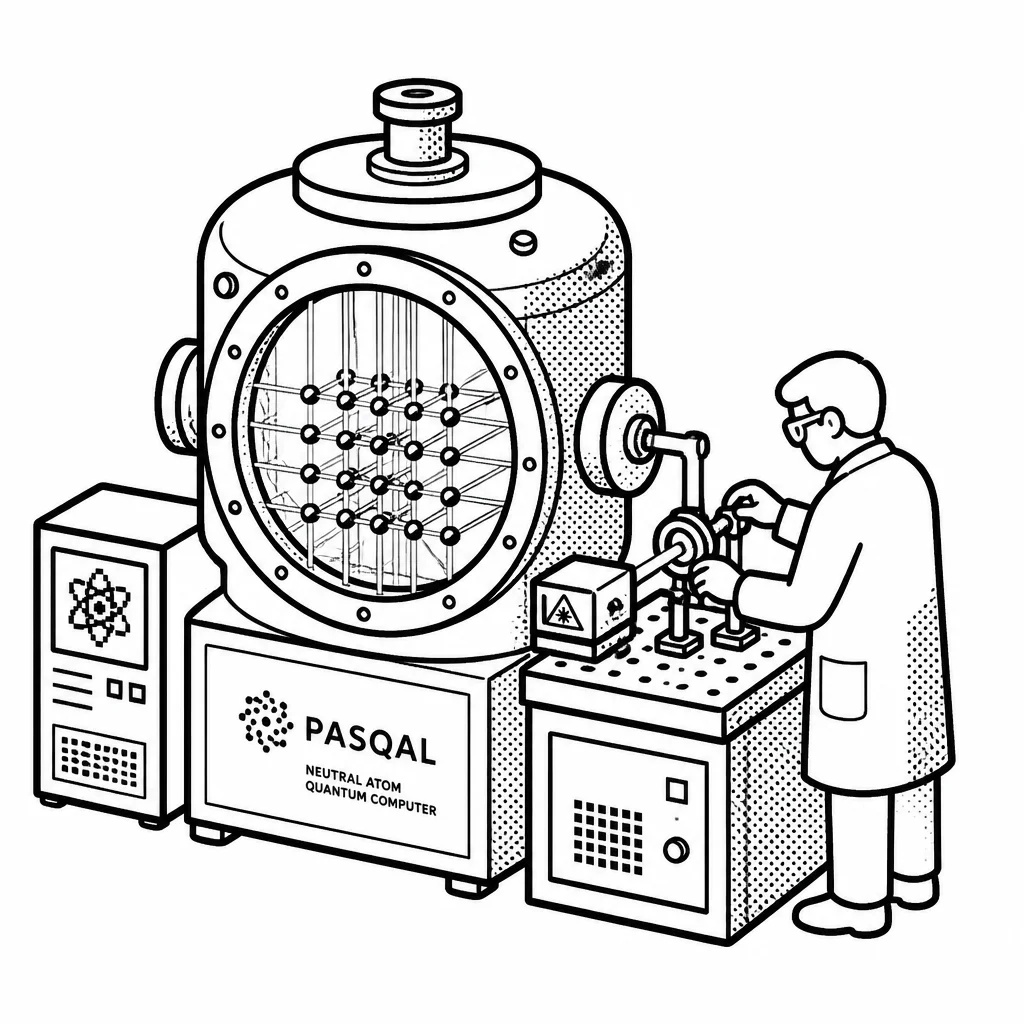
The core technology is what the industry calls "neutral-atom" quantum computing. Instead of etching tiny circuits into silicon, Pasqal uses lasers as tweezers to grab individual atoms and hold them in place in neat grids. Each atom can act as a quantum bit, or qubit, and lasers can flip and entangle them to run calculations. The pitch is that atoms are identical, natural, and easier to arrange at scale than the fussy manufactured qubits some rivals use, which could make the machines easier to grow. Who pays? Mostly organizations with problems too gnarly for classical computers: drug and materials discovery, logistics optimization, finance, and simulation for science and defense. Pasqal sells them time on its machines, typically through the cloud, along with software tools and engineering help to design quantum algorithms. It is still an early-stage business, so revenue is small and the payback is years away. The investor bet is on a future where quantum machines tackle problems ordinary computers never will.
The company began in 2019, spun out of research in France, and it carries real scientific pedigree. Its co-founder Alain Aspect won the 2022 Nobel Prize in Physics for experiments on quantum entanglement, which gave the field much of its foundation. Pasqal has raised substantial venture money, acquired a Canadian quantum software firm, and struck partnerships to put its hardware in front of users in Europe, the Middle East, and beyond. The risks are honest: the technology is unproven at commercial scale, well-funded rivals like IBM and Google are pushing their own quantum designs, and a single company can never be sure which approach wins. When it lists on Nasdaq, it will be asking public investors to bet on a science project with a very long fuse.
Saved answer · last researched 16 Nov 2026