Understand any stock in simple English
Enter a ticker to learn what the company does and how it makes money.
iShares U.S. Power Infrastructure ETF
It is an exchange-traded fund that lets ordinary investors buy a basket of American companies that generate, move, and store electricity.
This is a fund, not a company that builds anything itself. An exchange-traded fund is a single investment that holds a bundle of many different stocks, and it trades on a stock exchange just like one share of a company. You buy it through your brokerage account, and one purchase gives you a small slice of every company in the basket. The iShares U.S. Power Infrastructure ETF is built to own the businesses behind America's electric grid — the utilities that generate power, the companies that transmit and deliver it, and the firms involved in storing it. The point is to give an investor a simple way to bet on electricity demand without picking a single winner.
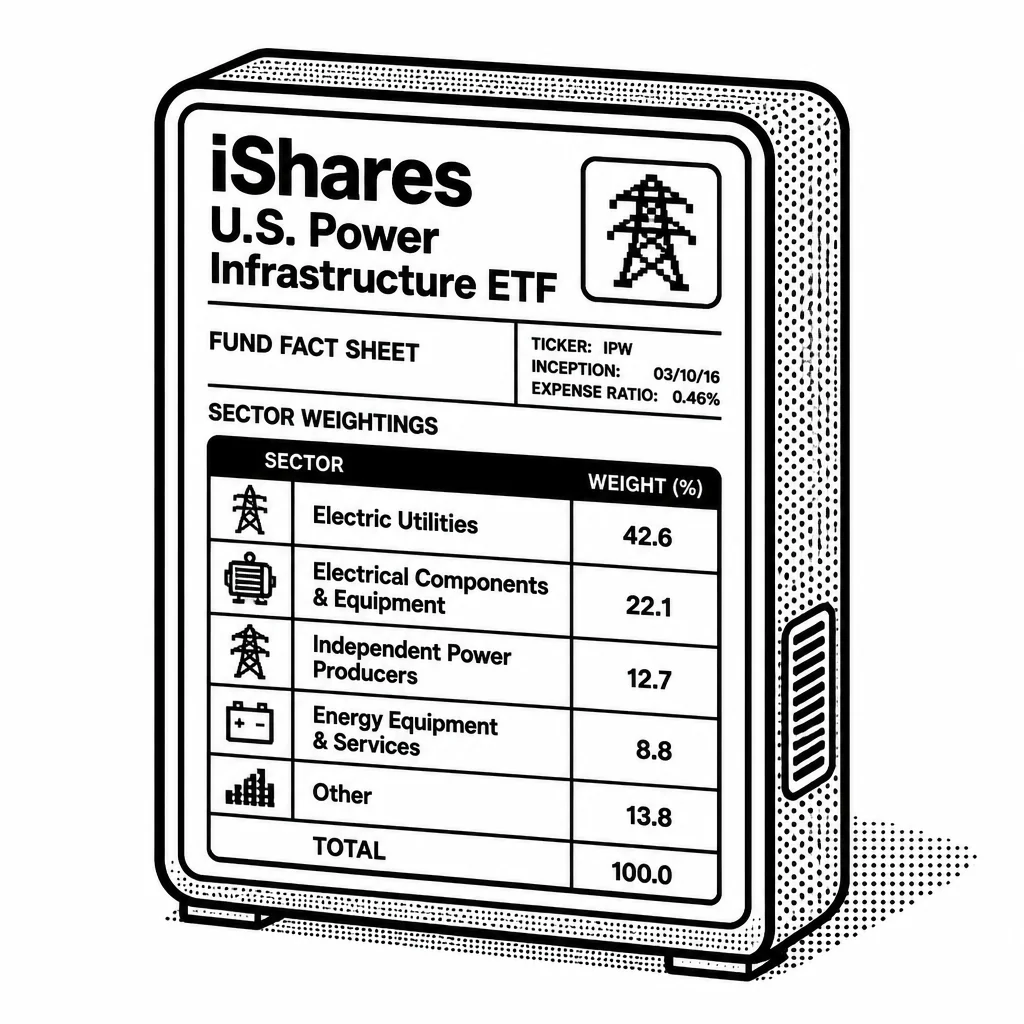
The word "infrastructure" is doing real work here. America's power system is aging, and it is being asked to carry far more than it was designed for. Data centers for artificial intelligence are ravenous for electricity, electric vehicles are plugging in, and old coal and gas plants are being replaced with wind and solar that need new wires to move their power. All of that requires enormous spending on poles, wires, substations, and batteries over the coming years. A fund like this lets an investor own a slice of the companies that collect the money for that work. The fund is run by iShares, the giant fund brand owned by BlackRock, the world's largest asset manager. BlackRock does not pick these stocks by gut feel. The fund tracks an index — a preset list and formula — and charges investors a small annual fee, taken quietly out of the fund's assets, to run it. Investors choose it because one ticker gives them instant diversification across dozens of power companies instead of a concentrated bet on any one utility or equipment maker. The trade-off is that index funds follow the market up and down, and a narrow theme like power infrastructure can swing harder than the broad market.
Because this is a fund, there is no factory floor or product line to describe. Its "business" is simply holding the right stocks and keeping costs low, and its value to an investor rises and falls with the fortunes of the American power sector. The real risk is concentration: if regulators cap utility profits, if electricity demand disappoints, or if one giant holding stumbles, the whole basket feels it. It is a neat, low-effort way to own the companies keeping the lights on — and the bill for that is paid by the investors who buy it.
Saved answer · last researched 16 Nov 2026