Understand any stock in simple English
Enter a ticker to learn what the company does and how it makes money.
Plus500 Ltd.
Plus500 runs an online trading platform where retail customers bet on price movements of shares, currencies, and other assets using contracts for difference.
Plus500 is an online trading platform. It lets ordinary people, not Wall Street professionals, place bets on whether the price of something will go up or down — a share, a currency pair, gold, or a stock index — without ever owning the underlying asset. These bets are called contracts for difference, or CFDs. You put down a small deposit, the platform lets you control a much larger position, and your profit or loss is the difference between the opening and closing price. It is fast, it is leveraged, and it can go very wrong very quickly if the market moves against you.
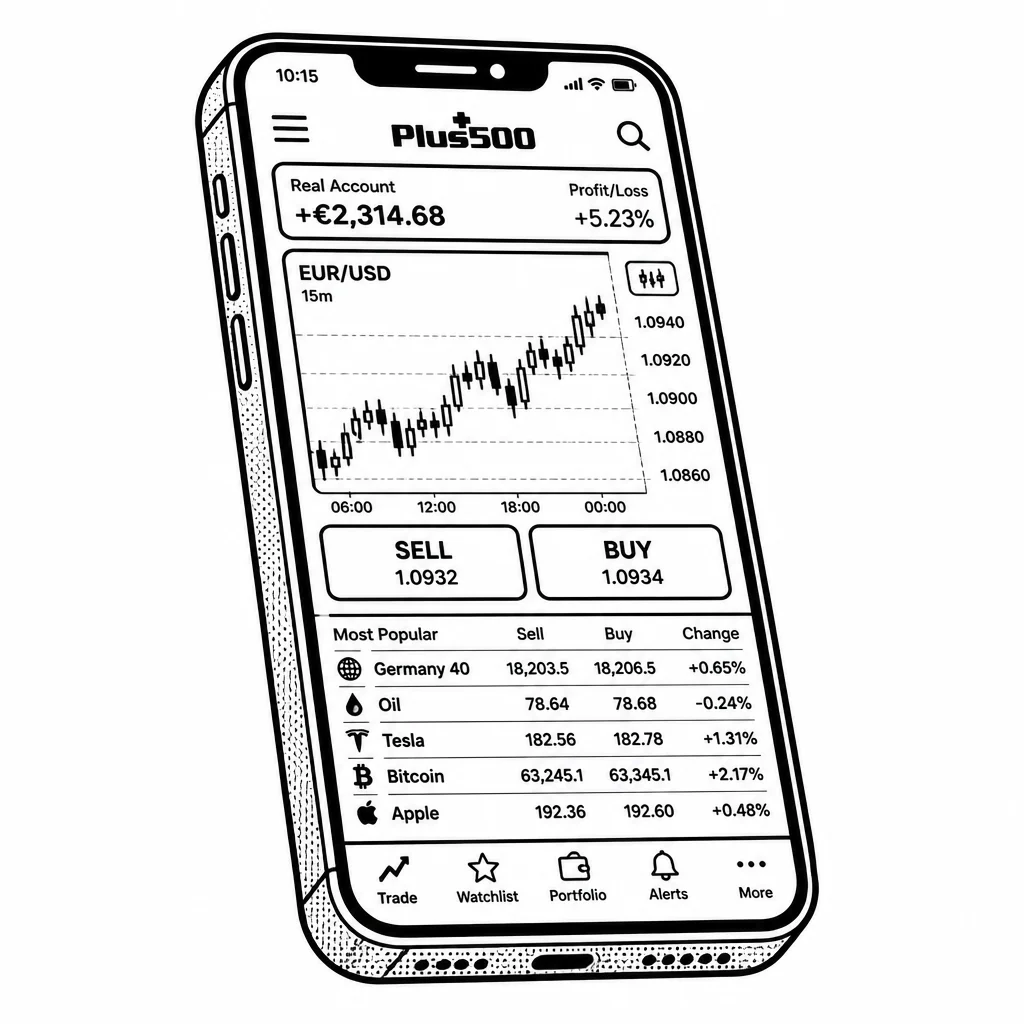
The company makes money in two main ways. First, it charges a spread — a small gap between the buy price and the sell price — so every trade starts slightly in the house's favor. Second, it earns overnight financing fees on leveraged positions and collects fees from inactive accounts. Plus500 does not take the other side of your bet the way a traditional bookmaker does. Instead it passes most customer trades to a group of banks and brokers, hedging its own exposure, and keeps the spread and fees. It also runs a share-dealing service for customers who prefer to buy actual shares rather than bet on them. Customers choose Plus500 for speed and simplicity. The app is clean, sign-up takes minutes, and the platform is available in dozens of countries and languages. That accessibility is the point — it opens leveraged trading to people who would never open a futures account. Regulators, meanwhile, are the company's biggest constraint. Leverage limits, marketing restrictions, and rules about who can trade CFDs differ sharply between the UK, Europe, Australia, and other markets, and Plus500 must hold licenses and follow local rules in each one. It makes money from a steady stream of small fees across millions of trades rather than from a few giant clients.
The business is a cash machine when markets are volatile, because nervous traders trade more, and quieter when markets are calm. It is headquartered in Israel and listed in London. It is not a household name in the way a bank or a brokerage is, but it is one of the largest listed pure-play CFD providers in the world. Its main rivals include IG Group, CMC Markets, and other retail trading platforms. The company has used its cash to pay dividends and buy back shares, returning a large chunk of profits to shareholders rather than reinvesting everything in growth. The simple version: Plus500 sells access to leveraged trading, earns a small slice of every trade, and profits most when its customers are busy — which is exactly when many of those customers are losing money.
Saved answer · last researched 14 Nov 2026