Understand any stock in simple English
iShares S&P 100 ETF
It is a fund that owns the biggest 100 US companies and sells shares in that basket to investors.
The iShares S&P 100 ETF is a basket of stock in about 100 of the largest American companies, sold as a single share. When you buy it, you own a tiny slice of each one — Apple Apple, Microsoft Microsoft, Amazon Amazon, and roughly a hundred more — without picking any of them yourself. It trades on NYSE Arca all day like a normal stock, so you can buy or sell in seconds.
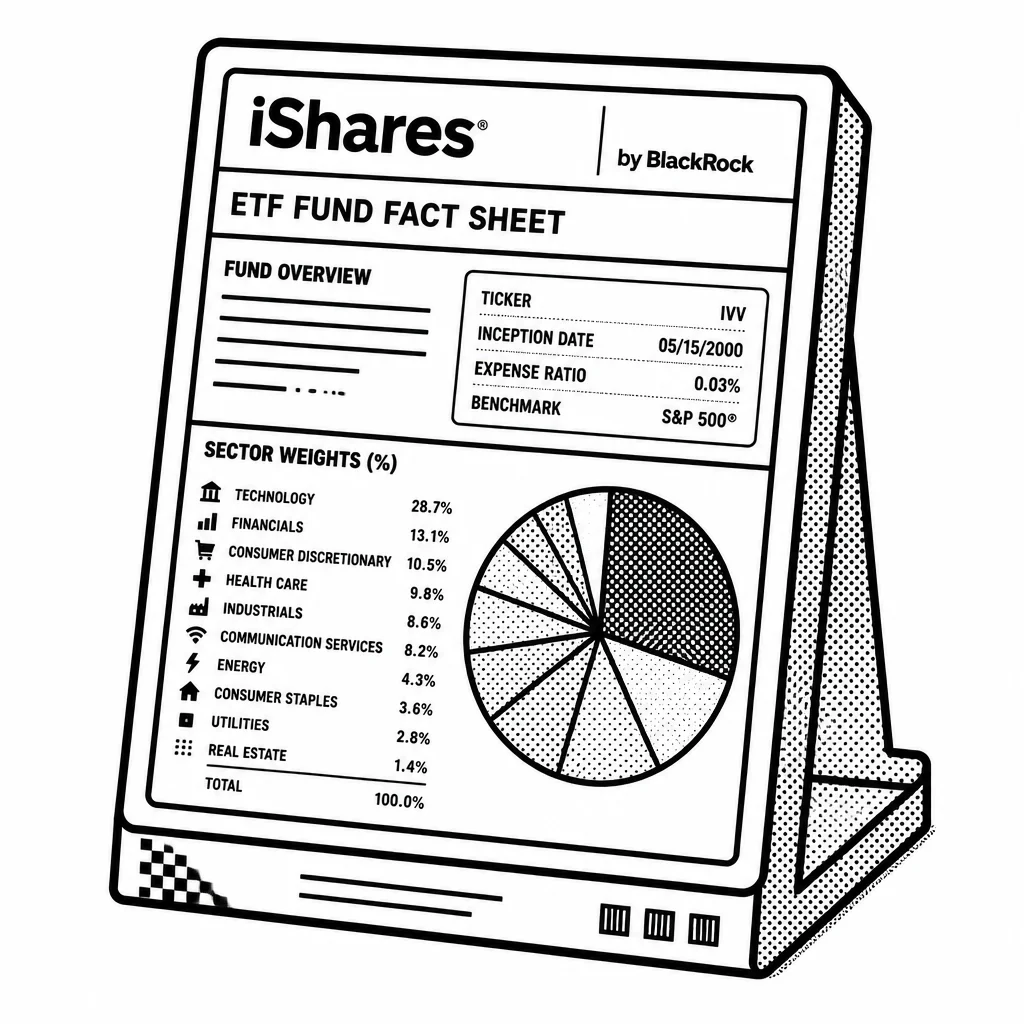
The fund follows the S&P 100 index. That index tracks a hundred of the biggest US companies chosen from the broader S&P 500, each one large enough to have listed options trading on it. It is the S&P 500's more concentrated cousin — fewer names, heavier bets on the giants. Investors buy it because one purchase instantly gives them the broadest, bluest chips in America, and the fund charges a small fee for doing the copying. That fee is the main way the fund business makes money. The ETF takes a sliver of the money it manages each year, so falling markets shrink the fee and rising markets grow it. Because the fund simply buys whatever the index buys, it needs almost no research staff — the work is arithmetic, not stock picking. That is why competing index funds race to cut fees, and why this one is cheap.
What you get by owning it is whatever those hundred giant companies earn. When Apple sells iPhones or Microsoft sells cloud space, a fraction of the profit flows into the fund, and it passes most of that along to shareholders as dividends. Some of it is also spent buying back shares, which nudges the price up for everyone who stays. The catch is concentration: because it holds so few names, a stumble at one or two giants hurts more than it would in a broader fund. You are betting on America's biggest companies, and almost nothing else.
Saved answer · last researched 19 Nov 2026
Timeline
A Fund That Owns the Biggest Blue Chips
In October 2000, iShares launched a fund that aimed to hold the roughly 100 largest and most established U.S. companies, the so-called mega-caps, by tracking the S&P 100 index. Instead of buying every stock in the index, it used sampling — holding a representative mix that behaves like the whole group. It arrived just as the dot-com bubble was peaking, and it came seven years after the first ETF ever appeared, so the idea of a cheap, tradeable basket of stocks was still fairly new.
OEF Reaches Mexican Investors
Nine years in, the fund got a second home. It was cross-listed on the Bolsa Mexicana de Valores, Mexico's stock exchange, so local investors could buy it in pesos without going through a U.S. market. It was a small step, but it widened the fund's audience beyond its New York listing.
Another Latin American Listing
The international push continued when the fund was listed on the Santiago Stock Exchange in Chile. Together with the Mexican listing, it made the fund easier to reach for investors across Latin America. Still, these were modest additions — the fund itself remained a quiet, little-known product.
Twenty-Five Quiet Years, Then a Surge
For most of its life, this fund was an afterthought. Its assets stayed under $5 billion for much of two decades and only crossed $10 billion at the end of 2023. Then, in 2025, everything changed: investors poured in more than $10 billion in a single year, nearly doubling its assets to almost $28 billion. The reason was simple — a handful of giant tech companies had come to dominate the market, and owning just the top 100 stocks turned out to be a winning bet. The forgotten fund became one of the year's biggest success stories.
The Tech Tilt Becomes Hard to Ignore
The next year made the fund's transformation plain. The S&P 100 index swapped out old-line names like Nike, Colgate-Palmolive, Simon Property Group and Honeywell and brought in AI-linked tech stocks like Dell, Palo Alto Networks, Arista Networks and SanDisk. The index was simply following market value, not spreading bets around. The fund's return trailed the tech-heavy QQQ and the broad VOO while charging about four times VOO's fee, which left investors asking a pointed question: was this still diversified mega-cap exposure, or just a watered-down tech fund?