Understand any stock in simple English
Enter a ticker to learn what the company does and how it makes money.
Münchener Rückversicherungs-Gesellschaft Aktiengesellschaft in München
Munich Re is one of the world's largest reinsurers, selling insurance to insurance companies and also running its own primary insurance business.
Munich Re is the insurance company for insurance companies. When you buy home or car insurance, your insurer takes on the risk that your house burns down or your car gets wrecked. Munich Re sells those insurers their own backup policy, so that when a giant hurricane or earthquake hits and thousands of claims arrive at once, the insurer doesn't go broke. It also runs a primary insurance arm, ERGO, which sells policies directly to people and small businesses, mostly in Europe.
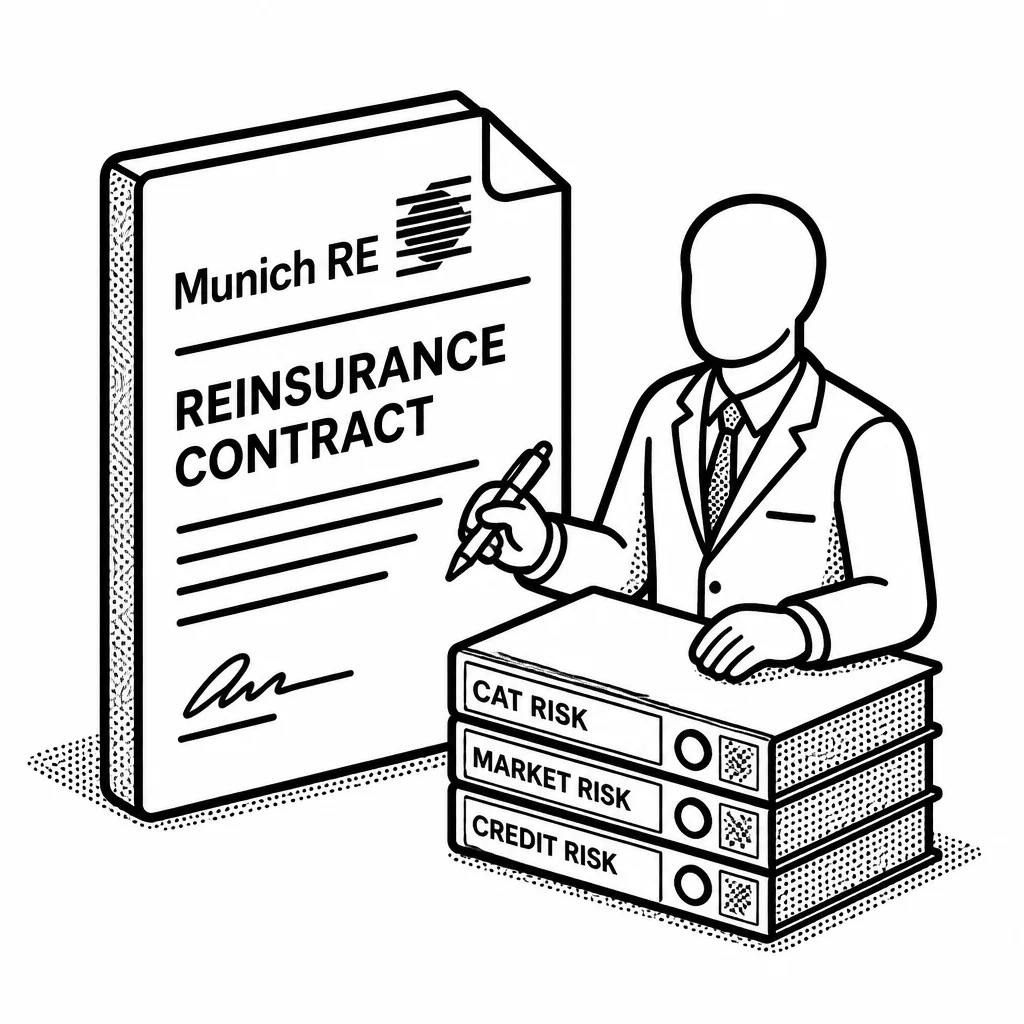
Here is the basic problem it solves. A single insurer can handle one house fire, but a once-in-a-century storm can wipe out a whole region and bankrupt it. Reinsurance spreads that risk across the globe. Munich Re collects premiums from insurers and, when a big disaster strikes, writes the checks that keep the whole system standing. In exchange, it keeps the profit when a year turns out calmer than expected. The catch is that a bad year — a major hurricane, a wildfire, a European flood — can cost it billions in a matter of weeks. The business has two engines. Reinsurance is the bigger and more famous one, where Munich Re covers life, health, and property risks for insurers worldwide. ERGO is the retail side: selling life, health, and property policies to ordinary customers in Germany and across Europe. Munich Re also puts the money it holds in premiums to work as a large investor, and that investment income is a meaningful part of the profit. Its main competitors are Swiss Re, Hannover Re, and SCOR.
What makes Munich Re strong is data and discipline. It has been collecting catastrophe loss records for over a century, so it prices hurricanes and earthquakes better than almost anyone. That lets it walk away from badly priced deals and raise prices after costly years, which is exactly what it did after several rough years of disasters and inflation. The weakness is the same as its strength: it is a giant warehouse of disaster risk. Climate change is making some storms and floods more severe, and one huge event can erase a whole year's profit. Management tends to return a lot of cash to shareholders through dividends and share buybacks when capital is plentiful. In short, it is a quiet, essential piece of the financial plumbing — one that earns steady money most years and occasionally takes a very expensive hit.
Saved answer · last researched 12 Nov 2026