Understand any stock in simple English
Enter a ticker to learn what the company does and how it makes money.
T-Rex 2X Inverse MSTR Daily Target ETF
This fund aims to deliver twice the opposite of MicroStrategy's daily stock move, letting traders bet against the stock for a single day at a time.
This is a small exchange-traded fund built for one narrow job: letting a trader bet that MicroStrategy's stock will fall, with double the daily move in the opposite direction. MicroStrategy is the software company that has become famous mostly for holding a giant pile of Bitcoin. If the stock drops 1% on a given day, this fund is designed to rise about 2%. If the stock climbs 1%, the fund is designed to fall about 2%.
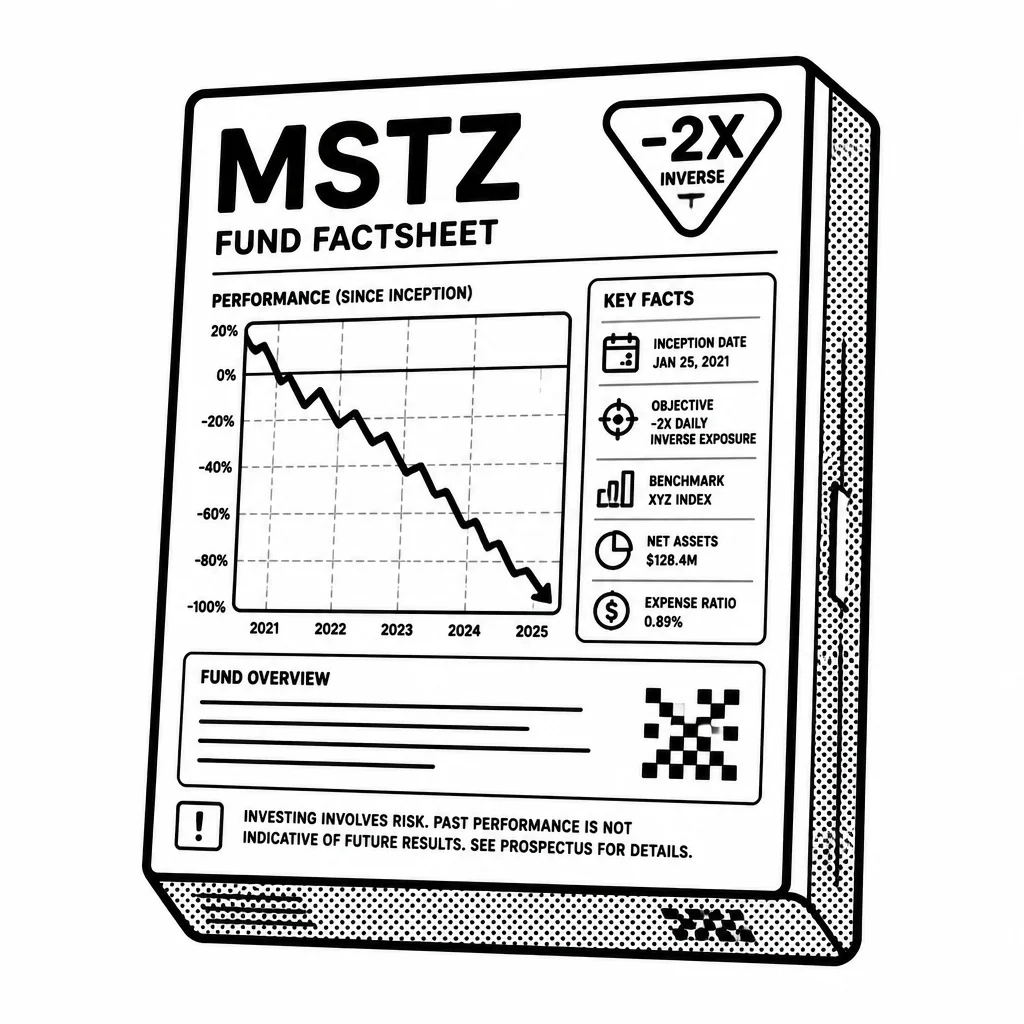
The mechanics are simple to say and tricky to live with. The fund doesn't own shares of MicroStrategy outright and hold them, the way an ordinary index fund buys and keeps stocks. Instead, it uses swaps and other financial contracts to create that amplified, reversed exposure, and it resets the target every single trading day. That daily reset is the key detail. Over one day it behaves as advertised. Over weeks or months, the compounding of daily moves can drift far away from what a casual trader expects, especially in a jumpy stock. So who pays for it? Traders do, through the fund's expense ratio, which is steep by ETF standards — the fund charges well over 1% a year. People choose it because it is a convenient, exchange-listed way to get short, doubled exposure without opening a margin account or wrestling with options. The trade-off is that it is a tactical tool, not a buy-and-hold investment, and the fund's own materials say as much: it is meant for short-term traders who watch their positions closely. Holding it through a choppy stretch can quietly erode value even when the direction call is right.
The issuer sits in the US, and the fund trades on CBOE. Its fate is tightly bound to one stock, and that stock is unusually volatile because of its Bitcoin-heavy balance sheet, which makes the daily-reset problem more serious than it would be for a sleepy blue chip. That is the whole business in a nutshell: a sharp, short-lived betting instrument for people with a view on MicroStrategy, priced for convenience and best used with discipline.
Saved answer · last researched 16 Nov 2026