Understand any stock in simple English
Enter a ticker to learn what the company does and how it makes money.
Marex Group plc
Marex is a financial services firm that connects buyers and sellers across commodity and financial markets, earning fees and spreads for matching trades and clearing them safely.
Marex is a middleman for the world's risk. When an airline wants to lock in the price of jet fuel, a farmer wants to sell next year's crop in advance, or a hedge fund wants to trade metals, energy, or interest rates, Marex sits in the middle and makes the trade happen. It provides liquidity — meaning it's often willing to take the other side of a trade when few others will — along with market access and the back-office plumbing that clears and settles deals.
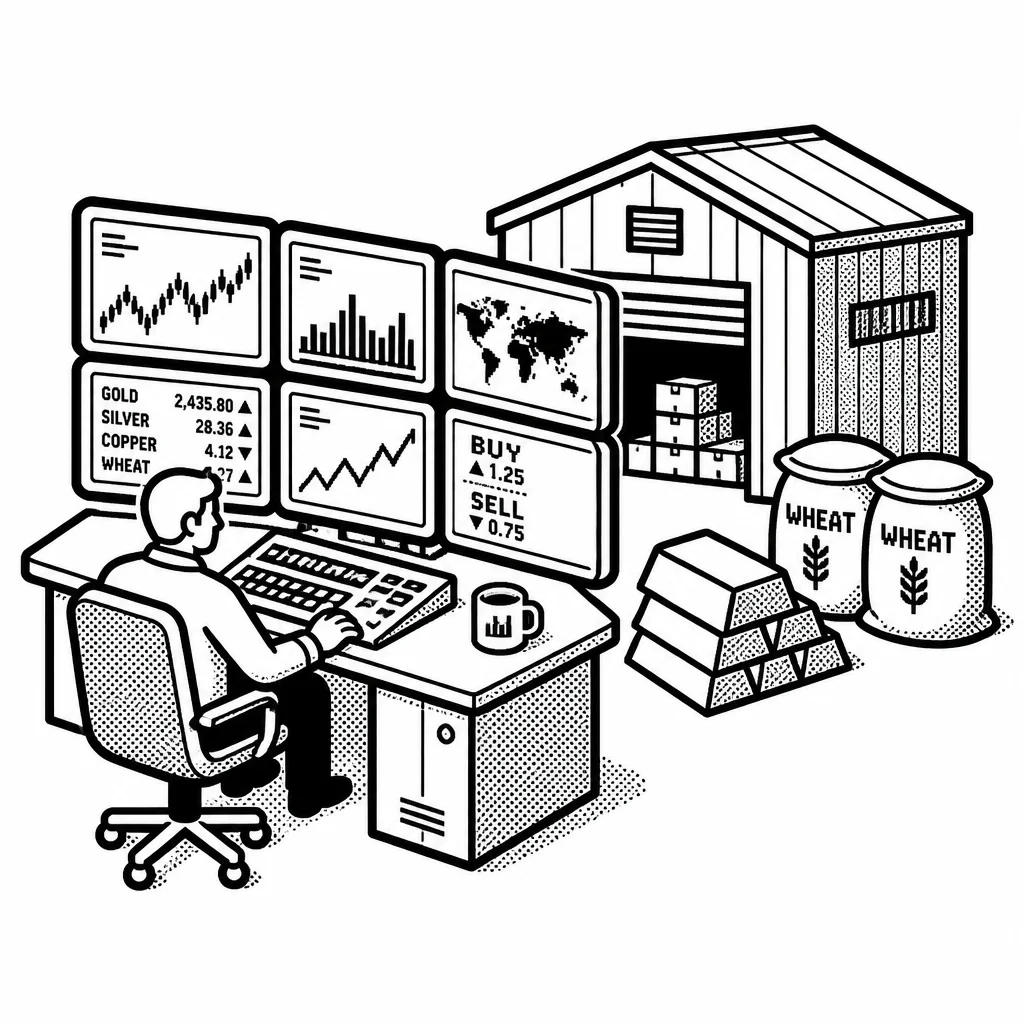
The business splits into two broad halves. One is clearing: Marex guarantees that trades get settled, standing between buyers and sellers so neither has to trust the other. The other is agency and execution, where it matches clients' orders and earns a commission, plus market-making, where it quotes prices and profits from the spread. Its clients are mostly professional: commodity producers and consumers, banks, funds, and corporates hedging real exposures. They come for the breadth of products and the fact that Marex will handle the messy, less-liquid corners of the market that bigger banks have drifted away from. That last point is the heart of the story. After the 2008 crisis, many large banks pulled back from commodity trading because new rules made it expensive to hold inventory and take risk. Marex stepped into that gap, buying pieces of banks' commodities desks and growing into a listed company on NASDAQ. It is now one of the larger independent players, competing with the remaining bank desks and with brokers like StoneX and Interactive Brokers. Its customers stick around because switching clearing relationships is a hassle and because Marex offers a single door to many exchanges and products.
The catch: this is a cyclical, thinly-margined business that lives on trading volumes. In quiet markets, activity dries up and profits wobble. Marex also carries real risk when it makes markets or guarantees trades, so a big client blowup can hurt. It has been expanding through acquisitions and paying a dividend, and revenue has grown strongly in recent years — but investors should remember that a middleman's fortune rises and falls with how much the world wants to trade and hedge.
Saved answer · last researched 15 Nov 2026