Understand any stock in simple English
Enter a ticker to learn what the company does and how it makes money.
London Stock Exchange Group plc
It runs the plumbing and data services that let investors buy, sell, and track financial assets around the world.
London Stock Exchange Group is, at its core, a company that runs the machinery of financial markets. If you want to buy shares in a company, the exchange is where buyers and sellers meet, and LSEG owns one of the world's most famous ones. But the modern LSEG is much more than the famous London trading floor people picture. It's a collection of businesses that handle the invisible work behind every trade: matching orders, clearing them so neither side gets stiffed, and selling the data and analytics that investors rely on to decide what to buy.
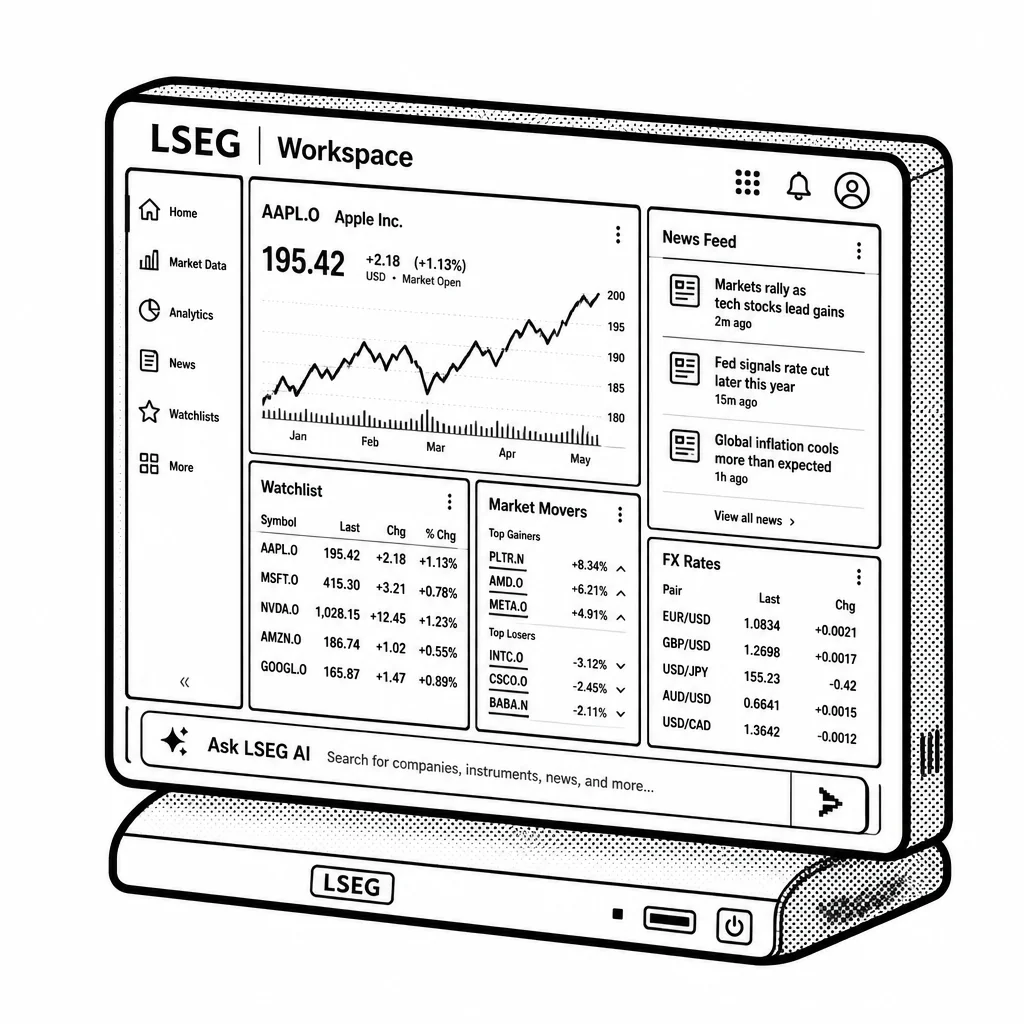
Here's a simple way to split it up. The trading side runs stock exchanges, most notably in London and Milan, where companies list their shares and investors trade them. Then there's the clearing side, which is the safety net: when two parties trade, a clearing house steps in the middle to guarantee the deal settles even if one side goes bust. That business, called LCH, is a huge profit engine and clears enormous volumes of interest-rate swaps — the contracts big banks and funds use to manage interest-rate risk. Finally, there's the data and analytics arm, which sells prices, indexes, and software tools that investors use to understand markets. So who pays? Banks, asset managers, hedge funds, and even other exchanges pay LSEG for access to trading, for clearing services, and for the flood of data it produces. Customers stick around because these are deeply embedded systems — switching your clearing house or data feed is a headache, and the network effects are strong. The company also owns FTSE Russell, the index business whose benchmarks underpin trillions of dollars in funds, giving it another steady stream of subscription-like revenue.
The big strategic story is LSEG's pivot from a pure exchange operator into a data powerhouse. In 2021 it bought Refinitiv, the former Thomson Reuters financial-data business, for a huge sum, transforming itself into a serious rival to Bloomberg in market data. Bringing a data company together with an exchange and clearing house is the bet: the trading generates data, the data feeds the analytics, and the analytics keep customers glued in. It also owns a big stake in Tradeweb, an electronic bond-trading platform, which adds another growing marketplace to the mix. The risks are the flip side of the strengths — regulators watch clearing houses closely, and the company has to keep spending to stay competitive with data giants while managing the debt from the Refinitiv deal.
Saved answer · last researched 15 Nov 2026