Understand any stock in simple English
Enter a ticker to learn what the company does and how it makes money.
IQM Quantum Computers Oyj
IQM builds full-stack superconducting quantum computers and sells cloud access to them for enterprises, research labs, and supercomputing centers.
IQM Quantum Computers builds quantum computers — whole machines, from the cooling hardware up to the software that runs on them — and sells access to that computing power over the cloud. Its customers are the kinds of organizations that want to experiment with quantum computing but don't want to build a lab from scratch: enterprises, universities, research institutions, and high-performance computing centers.
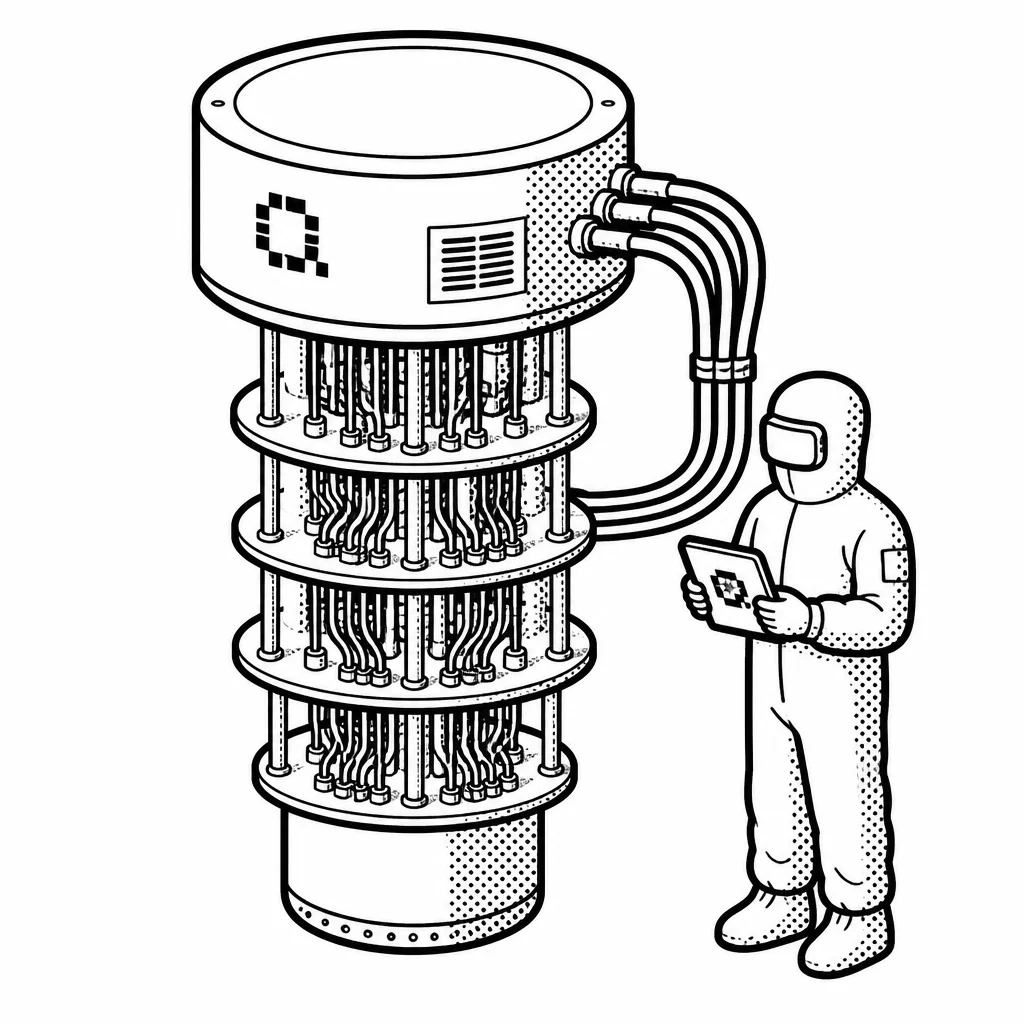
The basic idea behind a quantum computer is that it uses quantum physics to attack certain problems that ordinary computers handle badly — simulating molecules for drug or battery design, for example. IQM's machines are "superconducting," meaning they use circuits chilled to near absolute zero to act as quantum bits, or qubits. IQM designs and builds the full stack: the quantum processing hardware, the control electronics, and the software layer that lets a customer actually run a program. Customers choose IQM partly because buying a full machine or cloud access is faster than building the capability in-house, and because IQM sells both on-premises systems and cloud time rather than only one or the other. The money comes from selling these systems and cloud access, plus hardware and research partnerships. This is still an early-stage, cash-hungry business: the whole quantum computing field is pre-profit, and revenue is small relative to the research spending needed to stay competitive. Rivals include much larger players like IBM and Google, plus other pure-play quantum firms, and the big risk is that useful, error-corrected quantum computers take longer to arrive than investors hope.
IQM is based in Finland and listed on Nasdaq under the ticker IQMX. It is one of Europe's most prominent quantum hardware companies, and it positions itself as a European alternative in a field dominated by American giants — a story that resonates with governments and institutions that want local control over sensitive computing technology.
Saved answer · last researched 11 Nov 2026
BIG PICTURE
IQM signed 19% of all quantum computing contracts since 2021, more than any other vendor
- 19% IQM's share of quantum computing contracts
- 81% Other vendors
That count covers deals struck from 2021 through the first quarter of 2026, based on publicly reported transactions. IQM also led in national supercomputer quantum installations, with nine across six countries between 2025 and early 2026. The company sells full machines and cloud access, and these contracts are how that business actually gets paid. Source: State of Quantum 2026 (The Quantum Insider), published by IQM Quantum Computers, data from 2026
Timeline
Scientists Spin Out From Aalto
A group of scientists from Aalto University and VTT had spent years on quantum theory, and in 2018 they decided to turn it into actual machines, starting in Espoo, Finland. Their challenge was making quantum computers big enough to matter, with a European approach built on three simple aims: good qubits, fast gates, and keeping the whole thing cool. The idea clearly caught on, because they raised the biggest seed round a Finnish startup had ever seen, about eleven million euros.
World Fund Leads Big Series A
Just a few years later, the money got serious. World Fund led a €128 million round, its biggest single bet at the time. The bet was really on a belief: that Europe could build world-class companies in frontier tech, not just watch from the sidelines.
Goetz Becomes Sole CEO
As the company grew up, so did its leadership. At the start of 2026, IQM moved from two CEOs to one: co-founder Jan Goetz took the top job alone, while Mikko Välimäki shifted to an advisory role. The point was to sharpen global strategy ahead of a much bigger step.
First European Quantum Firm on Nasdaq
That bigger step came in July 2026, when IQM began trading on Nasdaq under the ticker IQMX, making it the first European quantum computing company listed on a major US exchange. It got there by merging with a SPAC, leaving it with about €337 million in cash. And it had a real business behind it: 23 quantum computers sold worldwide, more than any other manufacturer, to customers like CINECA, LRZ, and Oak Ridge National Laboratory.
Soft First Trading Day
The market's welcome was polite, not enthusiastic. Shares slipped a few percent on the first day, down to about $13. The caution made sense: IQM's own prospectus warned that large-scale commercial quantum computing may never actually take off.