Understand any stock in simple English
Enter a ticker to learn what the company does and how it makes money.
Hexcel Corporation
Hexcel makes lightweight composite materials, like carbon fiber and honeycomb, that go into airplanes, defense equipment, and industrial products.
Hexcel makes the fancy materials that let airplanes be strong and light at the same time. Its two big products are carbon fiber — hair-thin strands of carbon woven into sheets and stiffened with resin — and honeycomb, a lightweight core that looks like the inside of a cardboard box but is made from materials like aluminum or special paper. When you glue carbon fiber skins onto a honeycomb core, you get a sandwich panel that is incredibly stiff for its weight. That is the whole trick of modern aircraft construction: every kilogram saved burns less fuel over a plane's 20-to-30-year life.
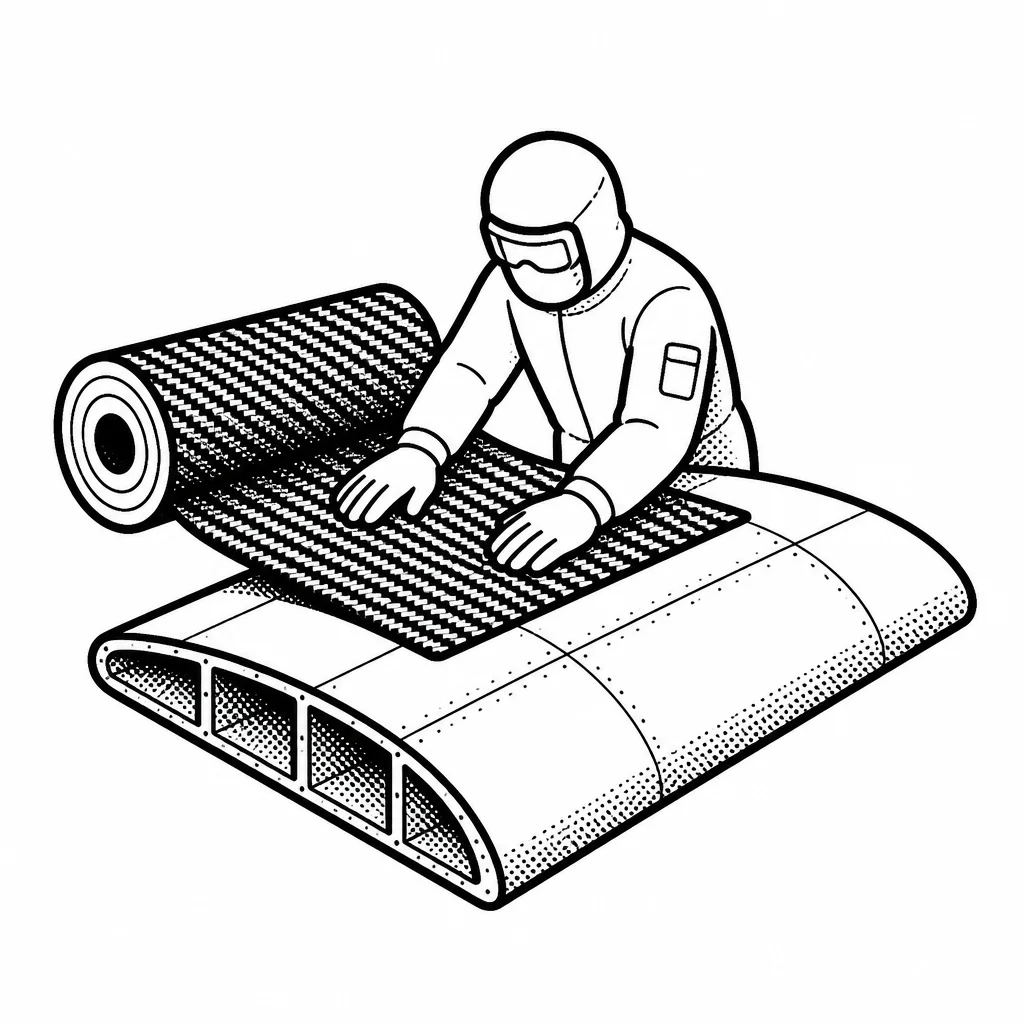
The company sells these materials to three main groups. The biggest is commercial aerospace: planemakers like Boeing and Airbus use Hexcel's carbon fiber prepreg — fabric or tape pre-soaked in resin, ready to be baked hard — for wings, fuselage sections, and tail parts. On the Airbus A350, composites make up more than half the plane's structure by weight, and Hexcel is a major supplier. The second group is defense and space: fighter jets, helicopters, drones, and rockets all need materials that are strong without being heavy. The third is industrial, where wind turbine blades, cars, and sporting goods soak up carbon fiber too. Hexcel also makes finished composite parts, not just raw materials, which deepens its role with customers. Why do customers stick with Hexcel rather than shop around? Qualifying a new material for an aircraft takes years of testing and certification with the planemaker and regulators. Once Hexcel's carbon fiber is baked into a Boeing or Airbus design, switching suppliers means re-certifying the whole part — so the relationship is sticky and lasts for the life of the program. That is a real moat. The flip side is brutal: Hexcel's fortunes ride on how many planes Boeing and Airbus build. When Boeing's 737 MAX was grounded and later slowed by safety problems, and when Airbus cut production during the pandemic, Hexcel felt it immediately, with revenue tumbling in 2020 and 2021 before recovering.
Based in Stamford, Connecticut, Hexcel traces its roots to 1946, when a California company started making honeycomb from glass fiber for the military — and famously supplied honeycomb for the skin of early satellites and aircraft. It went public in 1980 and today competes with rivals like Toray Industries of Japan and Solvay of Belgium, plus smaller players. It spends real money on R&D and capacity, has paid a dividend for years, and buys back shares when cash allows. The simple bet: as planemakers ramp production and shift to lighter, more fuel-efficient designs, Hexcel sells more of the stuff that makes that possible. The simple risk: it is a supplier to a duopoly, and when the duopoly sneezes, Hexcel catches the cold.
Saved answer · last researched 14 Nov 2026