Understand any stock in simple English
Groupon, Inc.
Groupon sells discounted deals from local businesses, restaurants, and travel providers, taking a cut of each sale.
Groupon is a marketplace for bargains. It connects people looking for a deal — a cheaper massage, a discounted dinner, a marked-down hotel night — with businesses that have spare capacity and want more customers through the door. Shoppers browse deals on Groupon's app or website, pay upfront, and redeem a voucher later. The merchant gets paid after the customer shows up, minus Groupon's cut, which is how the company makes its money.
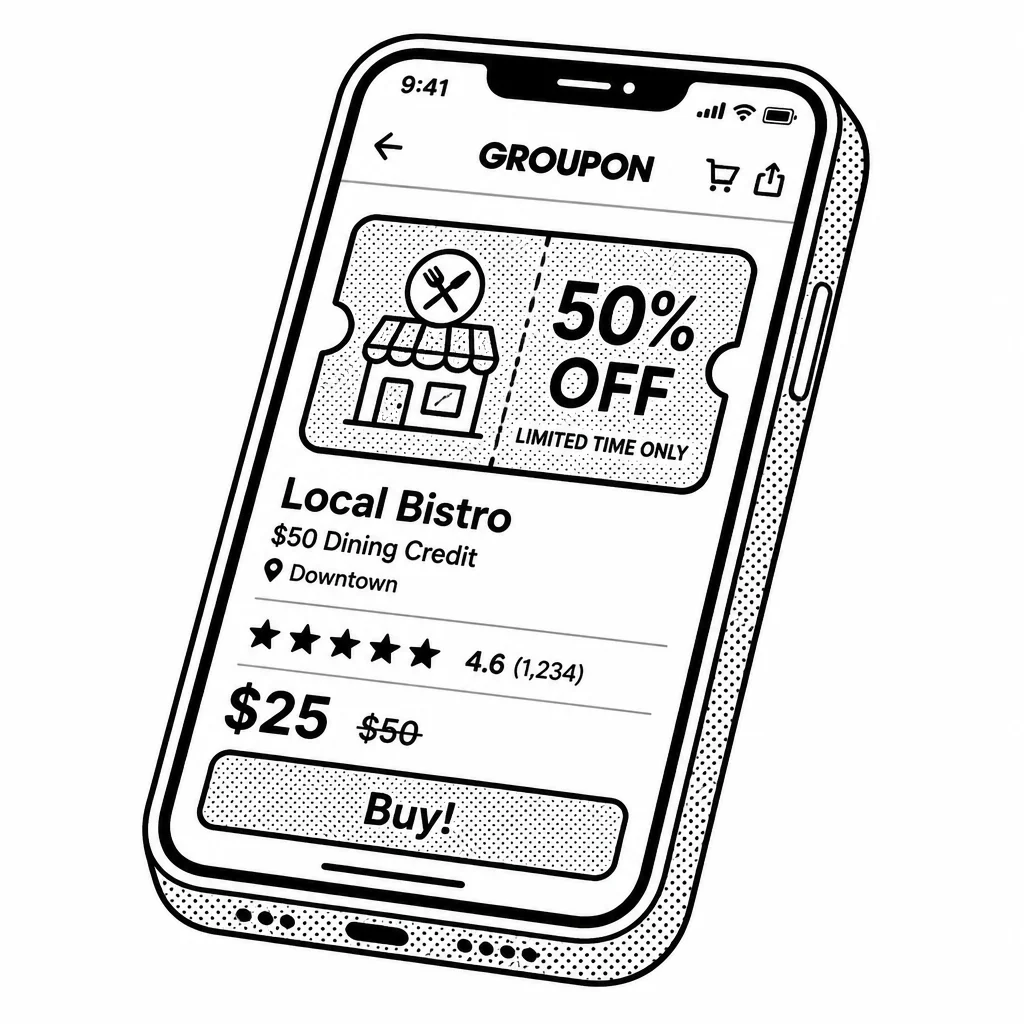
The core idea is simple: a restaurant with empty tables on a Tuesday night would rather sell a discounted meal than nothing at all. Groupon bundles that spare capacity into a deal, markets it to millions of subscribers, and takes a slice of each sale. Merchants buy in because they get new customers and only pay when a deal actually sells. Shoppers buy in because the price is lower than walking in off the street. Groupon sits in the middle and collects a commission — that's the whole machine. The business is split between local deals (restaurants, beauty, fitness, events) and travel, where it resells discounted hotel stays and getaways. Both are highly competitive, low-margin worlds. Groupon competes with big marketplaces like Amazon and Booking Holdings on travel, and with a long tail of local deal apps, daily-deal newsletters, and the merchants' own marketing. Its edge is a large existing audience and years of relationships with small businesses, but that edge is not a moat — customers will chase whichever discount is best, and merchants can walk away anytime.
Groupon's story is a cautionary one. It was one of the fastest-growing companies ever in the early 2010s, went public in 2011 at a huge valuation, then shrank hard as the daily-deal fad cooled and copycats multiplied. Revenue has fallen for years. The company has tried to pivot toward a leaner marketplace model, cut costs, and focus on higher-margin local services, but it remains a small, shrinking business fighting for relevance. It is not a growth story anymore — it's a survivor trying to squeeze profit from a mature, commoditized niche.
Saved answer · last researched 17 Nov 2026