Understand any stock in simple English
iShares China Large-Cap ETF
It is an exchange-traded fund that lets investors buy a basket of the 50 biggest Chinese companies listed in Hong Kong in one trade.
The iShares China Large-Cap ETF is a simple way to own a slice of China's biggest companies without picking individual stocks. It holds the 50 largest Chinese firms that trade on the Hong Kong Stock Exchange, so when you buy a share, you get a package that includes giants from sectors like internet, banking, insurance, energy, and consumer goods. The fund is managed by BlackRock's iShares unit and trades on NYSE Arca, which means American investors can buy and sell it during the U.S. trading day just like a normal stock.
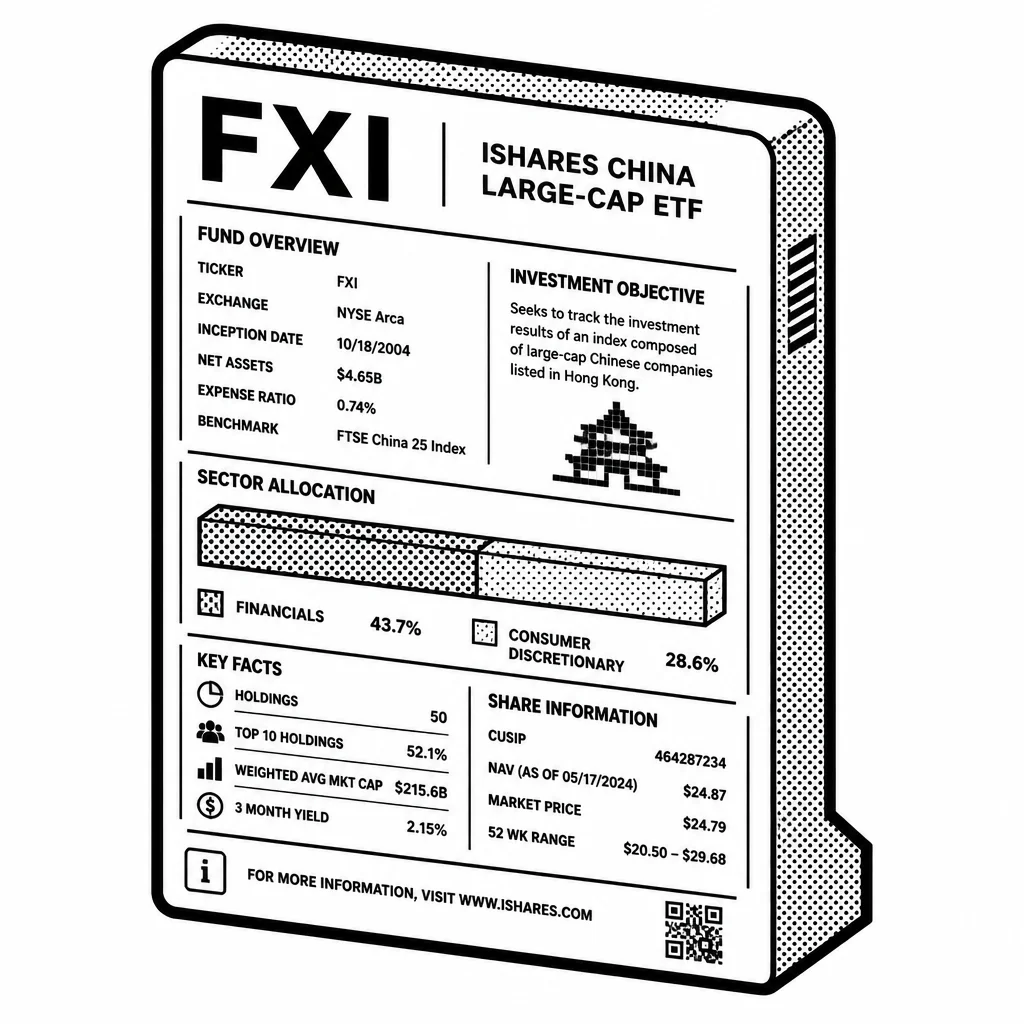
What you actually own inside the fund are companies like Tencent, Alibaba, and China Construction Bank. These are the heavyweights of the Chinese economy — the platforms people use to chat and shop, the banks that finance everything, and the insurers that cover it all. For an investor, the appeal is convenience: one ticker gives you exposure to the broad Chinese large-cap market, and you don't have to open a Hong Kong brokerage account or figure out which company will win. The trade-off is concentration. Fifty stocks sounds like a lot, but the biggest names carry serious weight, so a bad year for Chinese tech or a regulatory crackdown can hit the whole fund hard. The fund charges a small annual fee — roughly 0.74% of your money — which is more than you'd pay for a plain U.S. index fund but not unusual for a specialized international ETF. That fee pays for the management, the trading, and the administrative work of keeping the basket in line with its index. There's no magic stock-picking here; it's a passive tracker, meaning it simply follows the index rather than trying to beat it. The bigger story with this fund is the risk that comes with China itself. Over the past few years, Beijing has cracked down on tech companies, tightened rules on data and overseas listings, and clashed with Washington over everything from tariffs to audit rules. Those moves have whipsawed the fund's value and reminded investors that owning Chinese stocks comes with political risk you don't get from a U.S. index fund. The fund also reflects a shifting Chinese economy — the old guard of banks and state-owned enterprises sits alongside newer internet giants, and how that mix performs depends heavily on policy decisions made in Beijing.
For all its simplicity, this ETF is a bet on China's biggest companies behaving like the rest of the world's big companies. Sometimes they do. Sometimes the government has other plans.
Saved answer · last researched 17 Nov 2026